
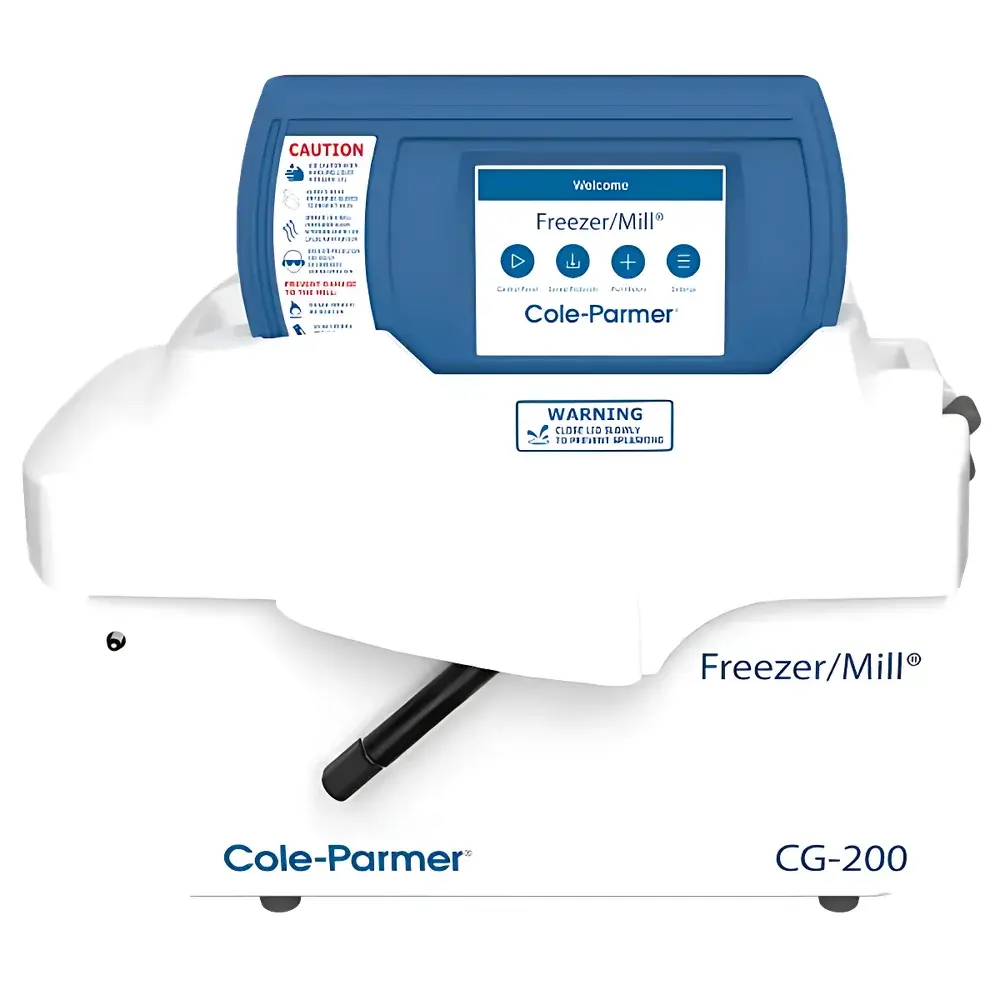
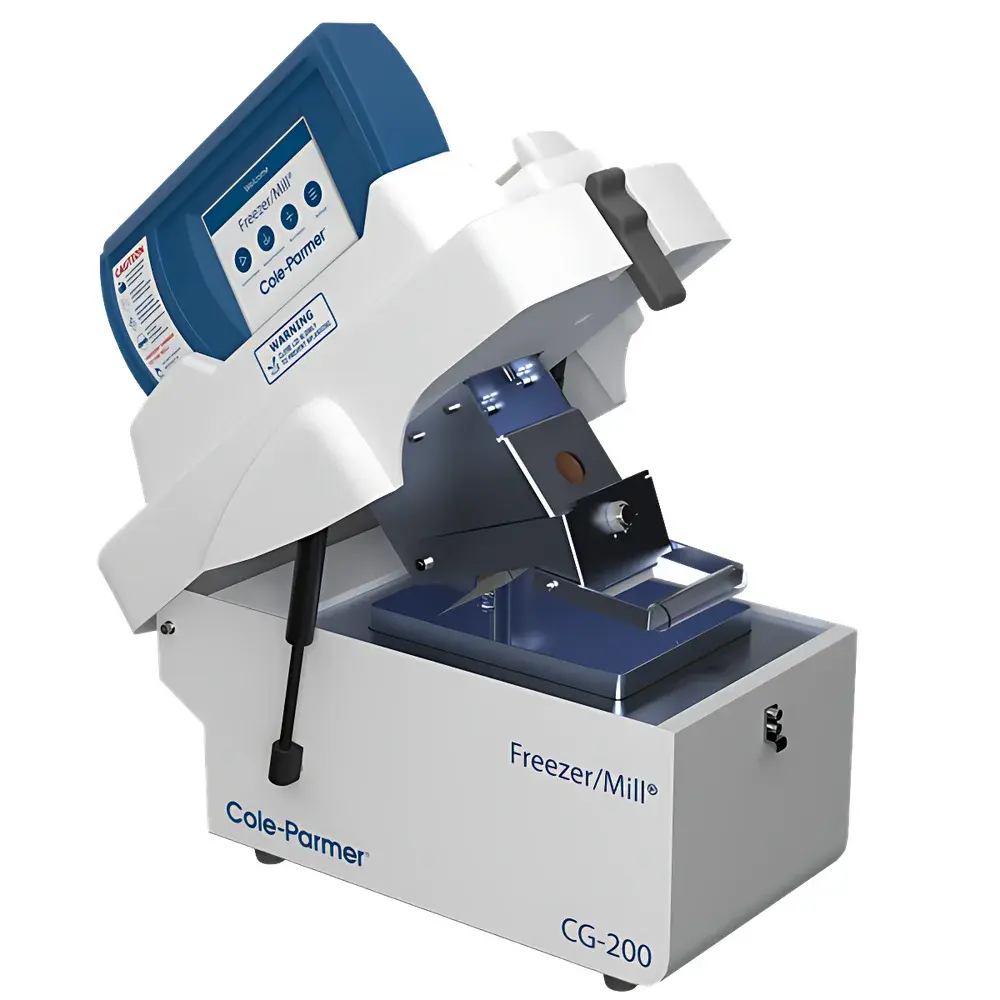
SPEX SamplePrep 6775 Freezer/Mill Cryogenic Grinding Mill
| Brand | SPEX SamplePrep |
|---|---|
| Origin | USA |
| Model | CG-200 Freezer/Mill |
| Instrument Type | Cryogenic Grinder |
| Sample Compatibility | Frozen & Temperature-Sensitive Materials |
| Output Particle Size | < 0.01 mm |
| Input Sample Size | ≤ 3 cm |
| Batch Capacity | 0.1–10 g |
| Cooling Medium | Liquid Nitrogen (LN₂) |
| Precooling Time | 4.5 min to −196 °C |
| Grinding Time | Adjustable, typically 2 min |
| Chamber Volume | 20 mL (standard) |
| Precooling Chamber Volume | 100 mL |
| Power | 225 W |
| Voltage | 230 V / 50 Hz |
| Frequency Range | 5–15 Hz |
| Dimensions | 48 × 27 × 32 cm |
| Weight | 11.8 kg |
| Certifications | CE, RoHS, WEEE compliant |
| Data Interface | USB port for program upload/download and diagnostics |
| Stored Methods | Up to 20 user-defined protocols |
| Safety Features | LN₂ level sensor with auto-shutdown, interlocked lid, coil overheat protection |
Overview
The SPEX SamplePrep 6775 Freezer/Mill Cryogenic Grinding Mill is an engineered solution for the controlled, high-fidelity comminution of thermolabile, elastic, or otherwise difficult-to-grind materials. It operates on the principle of electromagnetic oscillation-driven impact grinding under cryogenic conditions—specifically, immersion in liquid nitrogen (−196 °C). At this temperature, samples—including biological tissues, polymers, elastomers, bone, hair, and pharmaceutical compounds—undergo a reversible transition from ductile or viscoelastic to brittle mechanical behavior. This enables efficient fragmentation via high-frequency, high-energy impacts delivered by a stainless-steel or Cr-free steel impactor housed within a sealed, cryo-compatible grinding vial. Unlike conventional ball mills or rotor-stator homogenizers, the Freezer/Mill eliminates frictional heating and shear-induced degradation, preserving molecular integrity, enzymatic activity, nucleic acid stability, and volatile compound composition. Its design reflects decades of refinement in sample preparation physics, grounded in reproducible energy transfer kinetics and thermal management rigor.
Key Features
- Patented electromagnetic impactor system delivering precise, repeatable kinetic energy pulses at 5–15 Hz—no rotating shafts, gears, or bearings to wear or fail
- Integrated dual-chamber architecture: 20 mL grinding chamber + 100 mL precooling reservoir for rapid thermal equilibration (reaches −196 °C in ≤ 4.5 min)
- Modular vial system supporting multiple configurations: micro-vials (0.1–0.5 g), small vials (0.1–5 g), medium (1–40 g), and large (1–100 g), each compatible with stainless steel, polycarbonate, or Cr-free components
- Intuitive color touchscreen control panel enabling full parameterization: grinding duration, oscillation frequency, precooling interval, cycle count, and method storage (up to 20 protocols)
- Comprehensive safety architecture including lid interlock, real-time LN₂ level monitoring with automatic shutdown, and coil overtemperature protection
- CE-certified and compliant with RoHS/WEEE directives; suitable for GLP/GMP environments requiring traceable, auditable operation
- USB interface for firmware updates, diagnostic logging, remote troubleshooting, and method synchronization across laboratory networks
Sample Compatibility & Compliance
The 6775 Freezer/Mill accommodates a broad spectrum of challenging matrices without chemical pretreatment or solvent exposure. Certified for use with forensic bone fragments, archival tissue specimens, polymer composites, pharmaceutical actives, mineral clays (e.g., kaolinite for XRD analysis), and RoHS-regulated plastics. Its sealed vial system prevents cross-contamination between batches and maintains sample containment during volatile retention workflows—critical for EPA Method 8270D (semivolatiles), ASTM D7269 (polymer characterization), and ISO 17025-accredited testing. The instrument supports compliance with FDA 21 CFR Part 11 when paired with validated LIMS-integrated software, providing electronic audit trails for grinding parameters, operator ID, timestamps, and method versioning.
Software & Data Management
Operation is governed by embedded firmware supporting deterministic protocol execution and non-volatile storage of up to 20 user-defined methods. Each stored method includes configurable fields for precool time, impact frequency, total grinding duration, and cycle repetition—all timestamped and accessible via USB export. While the base unit lacks cloud connectivity, its USB interface enables integration with laboratory informatics systems for automated data ingestion into ELN platforms or QC dashboards. For regulated environments, optional validation packages are available to document installation qualification (IQ), operational qualification (OQ), and performance qualification (PQ) per ASTM E2500 and ICH Q9 principles.
Applications
This instrument serves as a foundational tool across disciplines requiring structural preservation during size reduction. In genomics, it enables high-yield DNA/RNA extraction from calcified tissues, ancient remains (e.g., Ötzi the Iceman), and degraded forensic samples—proven in mass casualty identification efforts post-9/11 and Indian Ocean tsunami response. In materials science, it facilitates contaminant-free milling of lunar regolith simulants (NASA JSC protocols) and crystallographically intact clay grinding for XRD phase analysis. Pharmacologists rely on it for metabolite-stable pulverization of thermosensitive APIs prior to HPLC-MS quantification. Environmental labs apply it to CPSIA-compliant lead and phthalate screening in children’s products, while polymer engineers use Cr-free configurations for RoHS-compliant halogen-free flame retardant analysis. Additional applications include volatile retention in coal/wax analysis, dental enamel fragmentation for trace metal mapping, and surgical bone graft powder production under sterile conditions.
FAQ
What types of samples are incompatible with the Freezer/Mill?
Samples containing free water or high moisture content (>15% w/w) may fracture unpredictably or cause vial seal failure upon rapid freezing. Highly reactive metals (e.g., sodium, potassium) and pyrophoric organometallics are strictly prohibited.
Can the instrument be used for continuous processing?
No—it is designed exclusively for discrete batch operation. Each cycle requires manual vial loading, LN₂ replenishment, and post-grind handling per ISO/IEC 17025 chain-of-custody requirements.
Is method validation support available?
Yes—SPEX provides IQ/OQ documentation templates and third-party PQ services aligned with ASTM E2500, USP <1058>, and ISO/IEC 17025 Annex A.2.
How does the Freezer/Mill compare to planetary ball mills for polymer analysis?
Unlike planetary mills, which generate localized heat exceeding 60 °C and induce chain scission or crosslinking, the Freezer/Mill maintains bulk sample temperature at −196 °C throughout grinding—preserving molecular weight distribution and crystallinity for GPC and DSC correlation.
What maintenance is required beyond LN₂ refills?
Annual inspection of electromagnetic coil insulation resistance, impactor surface finish verification, and vial sealing integrity testing using helium leak detection per ASTM E499. No lubrication or bearing replacement is necessary due to the contactless drive mechanism.



