
SPEX SamplePrep BM-400/450 High-Energy Ball Mill (Formerly SPEX 8000M/D)
| Brand | SPEX SamplePrep |
|---|---|
| Origin | USA |
| Model | BM-400/450 |
| Instrument Type | High-Energy Ball Mill |
| Sample Compatibility | Hard and brittle materials |
| Feed Size | <20 mm |
| Final Particle Size | <5 nm |
| Batch Capacity | 0.1–10 g per vial |
| Motion Type | Patented ∞-shaped 3D eccentric oscillation |
| Vial Displacement | ±59 mm (front-rear), ±25 mm (left-right) |
| Oscillation Frequency | 1060 cycles/min |
| Motor Speed | 1725 rpm |
| Cooling | Integrated forced-air cooling for clamp and motor housing |
| Control Interface | Programmable LCD touchscreen with time-based automation (up to 10,000 min) |
| Compliance | Designed for GLP/GMP-aligned workflows |
Overview
The SPEX SamplePrep BM-400/450 High-Energy Ball Mill (formerly SPEX 8000M/D) is an industrial-grade laboratory mill engineered for extreme mechanical energy transfer via patented ∞-shaped 3D eccentric oscillation. Unlike conventional planetary or shaker mills relying on 2D rotational or linear motion, the BM-400/450 employs a dynamically balanced eccentric drive system that simultaneously induces high-frequency vertical vibration, lateral oscillation, and torsional shear—delivering up to three times the effective energy input per unit time compared to standard planetary configurations. This kinematic architecture enables rapid mechanical alloying, crystalline phase transformation, amorphization, and top-down nanoscale particle size reduction (9,800 indexed publications citing the 8000-series platform).
Key Features
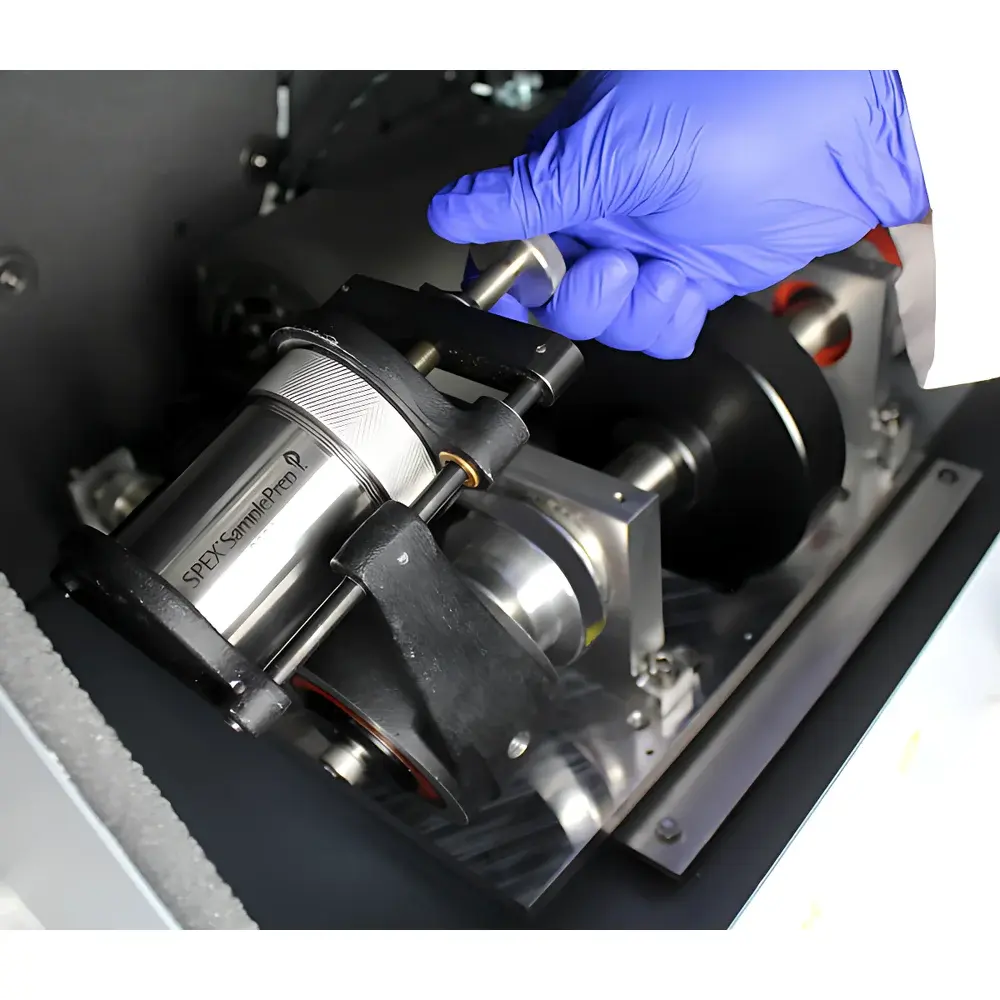
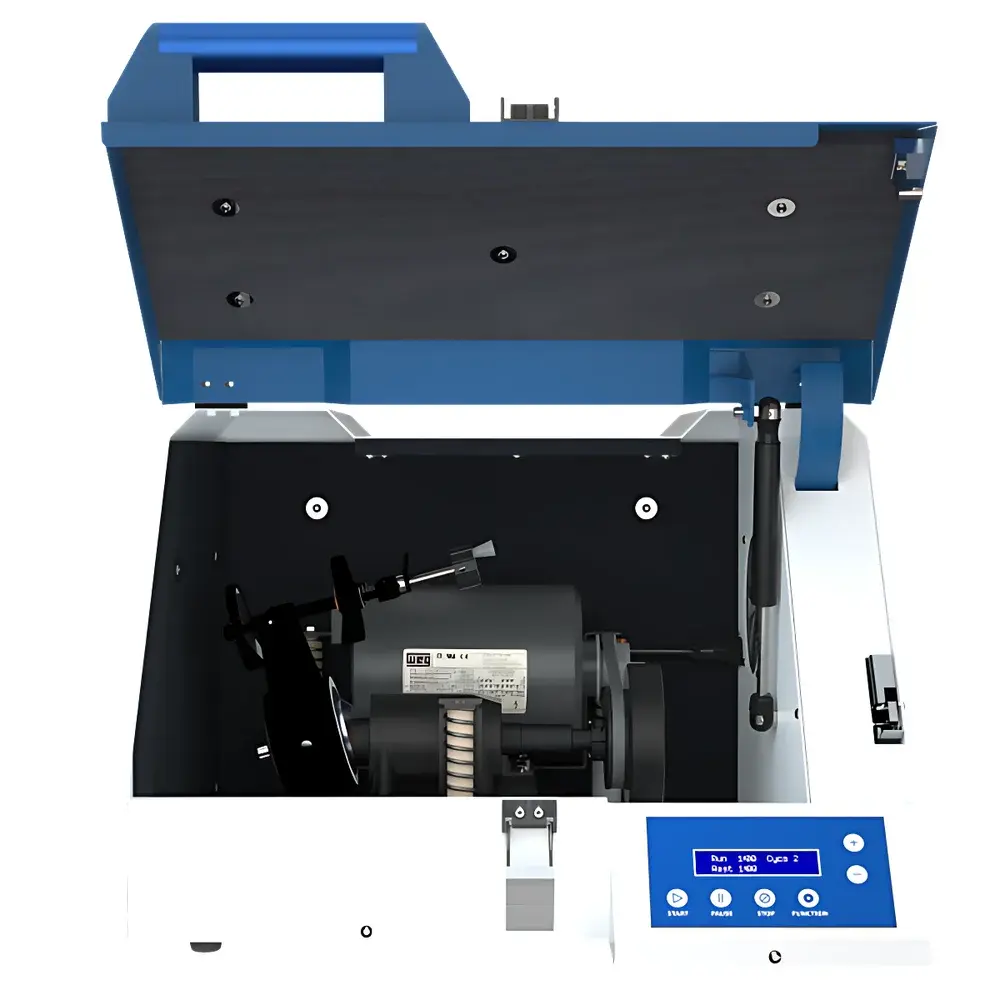
- Patented ∞-shaped 3D motion mechanism: Combines vertical impact (±59 mm displacement), horizontal oscillation (±25 mm), and angular shear at 1060 cycles/min—maximizing collision frequency and kinetic energy transfer while minimizing localized thermal buildup.
- High-efficiency forced-air cooling system: Actively cools both the vial clamp assembly and motor housing during extended operation, enabling stable thermal conditions critical for thermally sensitive reactions (e.g., solvent-free mechanochemical synthesis).
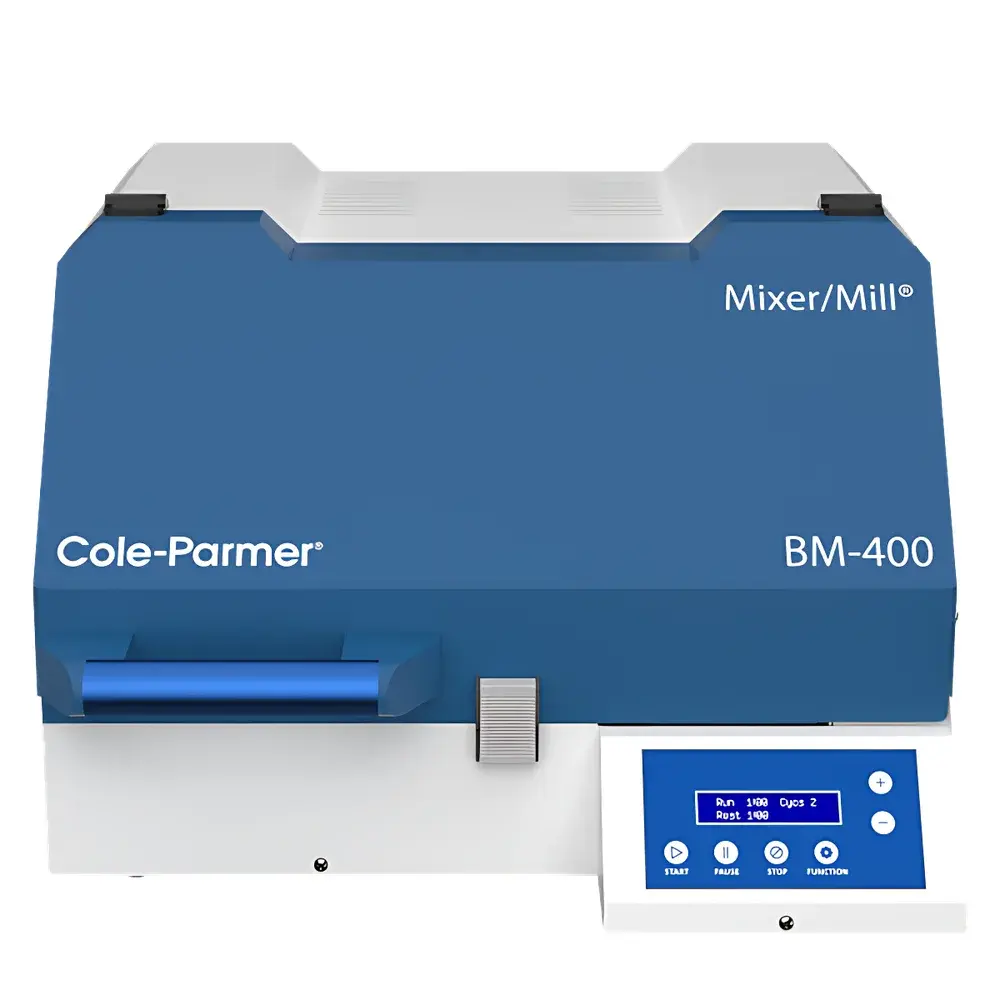
- Programmable digital control interface: Touchscreen LCD with intuitive menu navigation; time-based automation from 1 second to 10,000 minutes; real-time parameter logging (time, cycle count, status flags) stored internally for traceability.
- Optimized vial geometry: Proprietary arc-contoured vial interior eliminates dead zones common in cylindrical or right-angled vessels—ensuring complete sample engagement with grinding media and uniform energy distribution across all particle fractions.
- Rugged cast-aluminum frame with precision-machined eccentric drive train: Engineered for long-term dimensional stability under repeated high-load impact; compatible with stainless steel, tungsten carbide, agate, and hardened ceramic vials (standard 60 mL capacity).
Sample Compatibility & Compliance
The BM-400/450 accepts feed particles up to 20 mm in maximum dimension and routinely achieves final particle size distributions with D90 < 5 nm in optimized protocols—validated by TEM, XRD line-broadening analysis, and BET surface area measurement. It accommodates aggressive chemistries (e.g., halide-containing precursors, reactive metal powders) when used with inert-atmosphere vials. The system supports ISO 17025-compliant calibration documentation packages and meets key requirements for FDA 21 CFR Part 11–aligned environments through configurable electronic signature support and immutable audit trails. Its mechanical design adheres to IEC 61000-6-2 (EMC immunity) and UL 61010-1 safety standards.
Software & Data Management
While the BM-400/450 operates autonomously via its embedded microcontroller, optional USB export enables transfer of timestamped run logs (CSV format) for integration into LIMS or ELN platforms. Each session records start/stop time, total cycles, motor RPM stability profile, and user-defined parameters—facilitating retrospective process validation and cross-laboratory method transfer. No proprietary software installation is required; raw data files are natively readable in Excel, Python (pandas), or MATLAB.
Applications
- Mechanical alloying of immiscible metal systems (e.g., Al-Fe, Cu-Ta) for metastable phase development
- Top-down synthesis of nanocrystalline oxides (TiO2, ZnO, Fe3O4) and layered double hydroxides
- Amorphization of pharmaceutical actives to enhance dissolution kinetics
- Preparation of homogenized geochemical reference materials (rocks, soils, slags)
- Catalyst precursor activation (e.g., Ni-Mo/SiO2, Co-P/C) without thermal decomposition
- ROHS-compliant PCB digestion matrix homogenization prior to ICP-MS analysis
- Grinding of high-hardness ceramics (Al2O3, SiC, ZrO2) and refractory metals (W, Mo, Ta)
FAQ
What distinguishes the BM-400/450’s motion from planetary ball mills?
The BM-400/450 uses a single-axis eccentric drive generating true 3D motion (∞-trajectory), whereas planetary mills rely on compound rotation of vials around a sun gear—introducing centrifugal losses and uneven force distribution.
Can the system handle air-sensitive samples?
Yes—when equipped with SPEX-certified sealed vials and inert gas purging adapters (optional), enabling anaerobic milling under Ar or N2.
Is routine calibration required?
No scheduled recalibration is mandated; however, periodic verification of oscillation amplitude (via laser vibrometer) and timer accuracy is recommended per ISO/IEC 17025 internal quality procedures.
What vial materials are supported?
Stainless steel (304/316), tungsten carbide, agate, zirconia, and borosilicate glass—each validated for specific chemical and hardness compatibility profiles.
Does the BM-400/450 comply with FDA 21 CFR Part 11?
It supports Part 11 readiness through secure user authentication, electronic signatures, and tamper-evident audit logs—though full compliance requires site-specific validation per organizational SOPs.



