
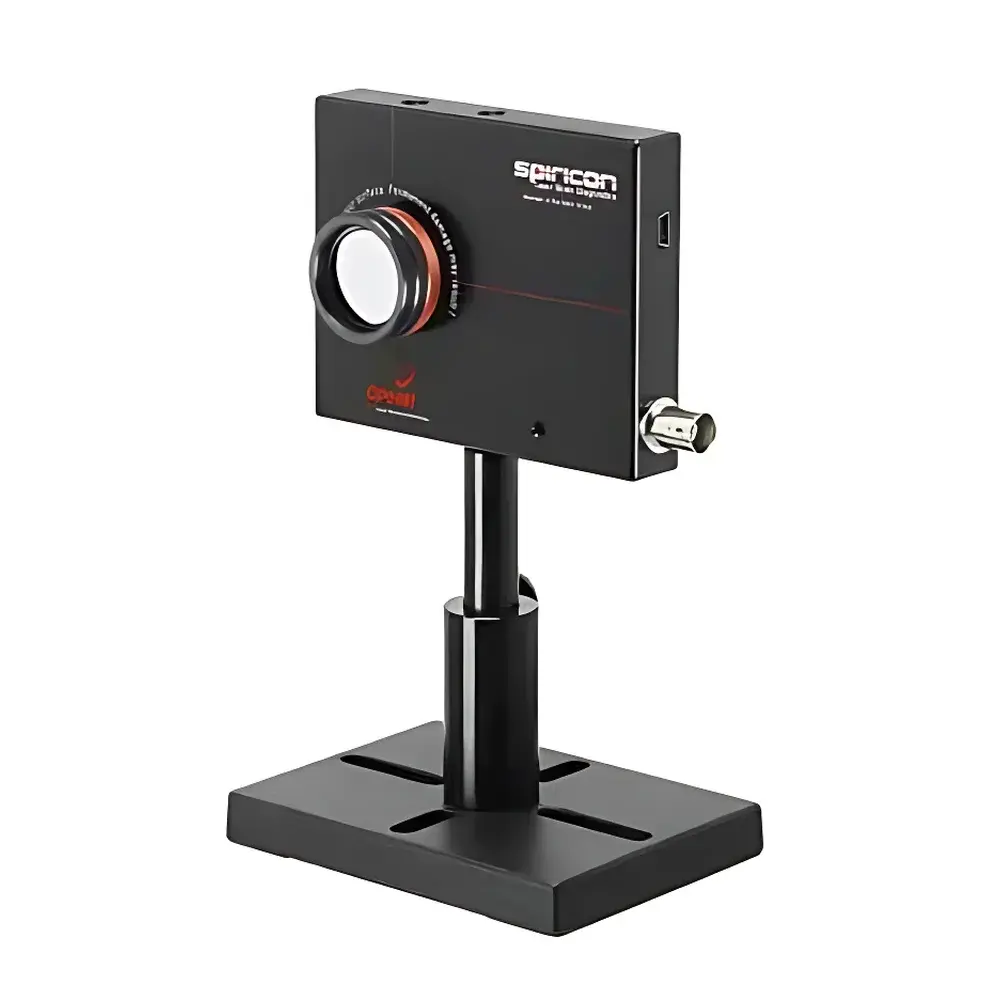
Spiricon SP503/SP620/L11058/GRAS20 Silicon-Based CCD Cameras for Laser Beam Profiling
| Brand | Spiricon |
|---|---|
| Origin | USA |
| Camera Type | Silicon-based CCD |
| Interface Options | USB 2.0 or IEEE 1394b (FireWire) |
| Spectral Response | 190–1320 nm (SP503, SP620, L11058), 190–1100 nm (GRAS20) |
| Pixel Sizes | 9.9 × 9.9 µm (SP503), 4.4 × 4.4 µm (SP620 & GRAS20), 9.0 × 9.0 µm (L11058) |
| Resolutions | 640 × 480 (SP503), 1600 × 1200 (SP620 & GRAS20), 4008 × 2672 (L11058) |
| Active Sensor Area | 6.3 × 4.7 mm (SP503), 7.1 × 5.4 mm (SP620 & GRAS20), 20 × 13.5 mm (L11058) |
| Dynamic Range | 59–64 dB |
| Minimum Detectable Irradiance | 0.17–2.5 nW/cm² |
Overview
Spiricon silicon-based CCD cameras are engineered for high-fidelity laser beam profiling and spatial intensity characterization in research, industrial metrology, and laser system validation environments. These cameras operate on the principle of photon-to-charge conversion in a monolithic silicon photodiode array, followed by low-noise analog-to-digital conversion and frame-based readout. Designed specifically for quantitative beam analysis—not general-purpose imaging—they deliver calibrated, linear response across a broad spectral range (190–1320 nm), enabling accurate measurement of beam width (D4σ, knife-edge, ISO 11146-compliant), centroid position, ellipticity, M² estimation (when paired with appropriate optics), and topological features such as hot spots, multimode structure, and near-field divergence. The absence of micro-lens arrays or Bayer filters ensures pixel-level radiometric uniformity and eliminates interpolation artifacts critical for ISO/IEC 17025 traceable measurements.
Key Features
- Multi-model platform supporting diverse beam size and resolution requirements—from compact collimated beams (10 mm)—via optimized sensor formats (640 × 480 to 4008 × 2672 pixels).
- True 12-bit or higher ADC resolution with hardware binning capability to enhance signal-to-noise ratio (SNR) without compromising spatial fidelity in low-flux conditions.
- Integrated thermoelectric (TE) cooling options available on select models (e.g., L11058) to reduce dark current drift, ensuring stable baseline performance during extended acquisition sequences required for pulsed laser characterization or long-exposure profiling.
- Factory-calibrated quantum efficiency (QE) curves and pixel responsivity maps supplied with each unit, enabling absolute irradiance mapping per ISO 11146-3 Annex B protocols.
- Robust mechanical housing compliant with ANSI Z87.1 optical safety standards; C-mount and SM1-threaded lens adapters included for seamless integration into beam delivery lines or M² measurement stations.
Sample Compatibility & Compliance
These cameras accommodate continuous-wave (CW) and pulsed laser sources—including Nd:YAG (1064 nm), Ti:Sapphire (700–1000 nm), excimer (193–351 nm), and UV/VIS/IR diode lasers—provided beam power density remains within sensor damage thresholds (typically <10 W/cm² for CW, <1 J/cm² for ns pulses, dependent on wavelength and spot size). All models meet RoHS and CE electromagnetic compatibility (EMC) directives. Data acquisition workflows support GLP/GMP-aligned documentation through audit-trail-enabled software (see Software & Data Management). Calibration certificates are traceable to NIST standards and include uncertainty budgets per ISO/IEC 17025 requirements.
Software & Data Management
Bundled Ophir BeamGage™ Professional software provides full control over exposure time, gain, region-of-interest (ROI) selection, background subtraction, and real-time beam parameter computation. The software supports FDA 21 CFR Part 11 compliance via electronic signatures, user access levels, and immutable audit logs for regulated environments (e.g., medical laser manufacturing, aerospace QA/QC). Export formats include CSV (for statistical process control), TIFF (16-bit linear), HDF5 (for MATLAB/Python post-processing), and PDF reports with embedded metadata (timestamp, camera ID, calibration date, operator ID). API libraries (C++, .NET, Python) enable custom integration into automated alignment systems or PLC-controlled test benches.
Applications
- Quantitative verification of Gaussian, super-Gaussian, and top-hat beam profiles in ultrafast amplifier chains and fiber-coupled systems.
- In-process monitoring of CO₂ laser focus stability during sheet metal cutting or additive manufacturing build cycles.
- Characterization of VCSEL arrays and diode bar stacks for automotive LiDAR and facial recognition modules.
- Validation of spatial mode purity in single-frequency solid-state lasers prior to frequency doubling.
- Teaching and research labs performing hands-on instruction in Fourier optics, diffraction-limited imaging, and laser resonator design.
FAQ
What is the recommended maximum average power density for safe operation?
For unattenuated direct illumination, typical safe limits are ≤5 W/cm² at 1064 nm and ≤1 W/cm² at 355 nm for continuous exposure. Use calibrated neutral density filters or beam splitters for high-power applications.
Can these cameras measure pulsed lasers with repetition rates above 1 kHz?
Yes—frame rates up to 60 Hz (SP503) and 30 Hz (L11058) support single-shot capture of individual pulses; for higher PRFs, external triggering and rolling-shutter synchronization ensure temporal fidelity.
Is NIST-traceable calibration included with purchase?
Each camera ships with a factory calibration certificate referencing NIST-traceable irradiance standards; optional annual recalibration services are available under ISO/IEC 17025 accreditation.
How is pixel non-uniformity corrected?
BeamGage software applies per-pixel gain and offset correction using user-acquired flat-field and dark-frame reference images, meeting ISO 11146-3 linearity verification criteria.
Are drivers compatible with Linux or macOS?
Native Linux support is available via open-source libuvc and FireWire stack integrations; macOS compatibility is limited to USB models using vendor-provided SDKs and requires Xcode toolchain configuration.




