
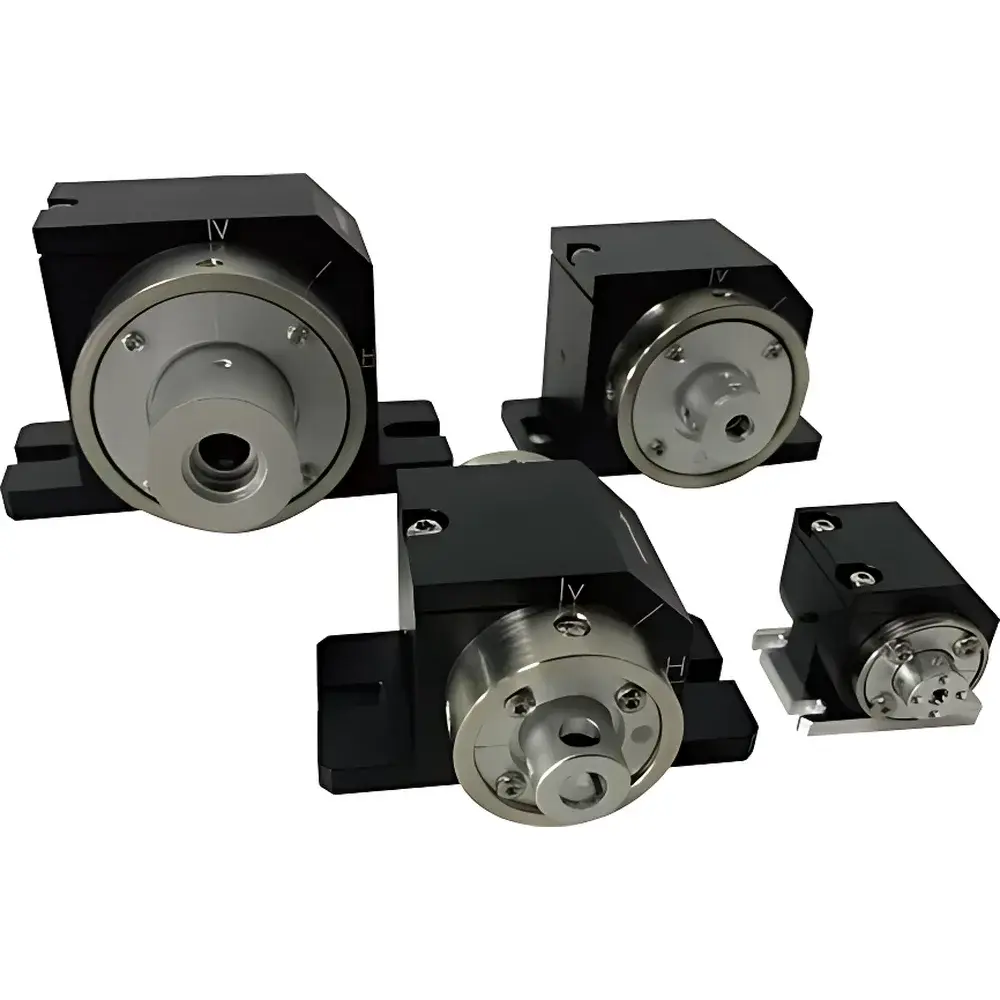
SPL Free-Space Faraday Rotators and Optical Isolators
| Brand | SPL |
|---|---|
| Origin | Zhejiang, China |
| Manufacturer Type | Authorized Distributor |
| Product Category | Optical Components |
| Models | SPL-ROT-405-2.5 to SPL-ISO-1064-10 |
| Key Specifications | Center Wavelengths from 405 nm to 1064 nm |
| Aperture Options | 2 mm, 2.5 mm, 5 mm, 8 mm, 10 mm |
| Faraday Rotation Angle | 45° ±1° @ 25°C |
| Extinction Ratio | >30 dB @ 25°C |
| Transmission | >90% (Rotators), >85% (Isolators) |
| Laser-Induced Damage Threshold (LIDT) | 3.5–5 J/cm² @ 10 ns |
| Magnetic Material | High-Coercivity Permanent Magnet Assembly |
| Magneto-Optic Crystal | Terbium Gallium Garnet (TGG) |
| Polarizer Type (Isolators) | Polarizing Beam Splitter (PBS) Cube |
| Package Types | #1 (Integrated Mount), #2 (Adapter-Mount for Ø50.8 mm Kinematic Mounts), #3 & #4 (High-Power Compact Housing) |
Overview
The SPL Free-Space Faraday Rotators and Optical Isolators are precision magneto-optic components engineered for high-stability polarization control in demanding laser systems. Based on the non-reciprocal Faraday effect—where linearly polarized light undergoes a fixed rotation of its polarization plane under an axial magnetic field—the devices deliver deterministic, direction-independent rotation. Unlike reciprocal birefringent elements, Faraday rotation is invariant with propagation direction, enabling unidirectional optical isolation when integrated with polarizing optics. These components operate across a broad spectral range (405–1064 nm), supporting CW and pulsed lasers—including Ti:sapphire, Nd:YAG, fiber, and diode-pumped solid-state sources—with rotation accuracy of 45° ±1° at 25°C. The core magneto-optic medium is high-purity, low-absorption Terbium Gallium Garnet (TGG), selected for its exceptional Verdet constant, thermal stability, and resistance to photorefractive damage. All isolators integrate cube-type polarizing beam splitters (PBS) and are magnetically biased using high-coercivity rare-earth permanent magnets, ensuring long-term field stability without active power or thermal drift compensation.
Key Features
- Non-reciprocal 45° Faraday rotation with <±1° angular tolerance at 25°C, guaranteed across full operational temperature range (−10°C to +70°C)
- High extinction ratio >30 dB, enabling effective suppression of back-reflected light in amplifier chains and cavity-coupled systems
- Low insertion loss: >90% transmission for rotators; >85% for isolators (typical >90% at design wavelength)
- Laser-induced damage threshold (LIDT) certified to 3.5–5 J/cm² at 10 ns pulse width, validated per ISO 21254-1
- Multiple mechanical packaging options: #1 (integrated base mount), #2 (Ø50.8 mm kinematic-compatible adapter), #3 & #4 (compact high-power housings with enhanced thermal dissipation)
- Standard apertures from 2 mm to 10 mm, supporting beam diameters up to 80% of clear aperture with minimal wavefront distortion (<λ/8 PV)
- Output polarization state fully controllable via input polarization alignment—critical for polarization-sensitive interferometry and quantum optics setups
Sample Compatibility & Compliance
These components are compatible with free-space laser architectures requiring polarization fidelity and bidirectional isolation. They meet key requirements for laboratory-grade optical infrastructure, including compatibility with standard Ø25.4 mm and Ø50.8 mm lens tubes, translation stages, and kinematic mounts. All TGG crystals are grown via the Czochralski method and polished to λ/10 surface flatness with super-polished AR coatings (R<0.25% per surface, broadband or wavelength-specific). Device compliance includes adherence to ISO 10110 optical component standards for surface quality (scratch-dig 10–5), wavefront error, and coating durability. While not classified as medical or industrial safety-certified equipment, their performance parameters align with common specifications referenced in ASTM F1501 (laser safety enclosures) and IEC 60825-1 (laser product safety), particularly regarding LIDT reporting methodology and thermal management under continuous irradiation.
Software & Data Management
As passive optical components, SPL Faraday Rotators and Isolators require no firmware, drivers, or software integration. However, they are fully interoperable with industry-standard optical modeling platforms—including Zemax OpticStudio, Synopsys CODE V, and Thorlabs’ OptoMechanical Design Suite—for polarization ray tracing, isolation efficiency simulation, and thermal lensing analysis. Each unit ships with a traceable calibration certificate listing measured rotation angle, extinction ratio, transmission spectrum (20 nm bandwidth centered on nominal wavelength), and LIDT test report (per ISO 21254-2). For GMP/GLP-regulated environments, SPL provides optional audit-ready documentation packages including raw test data logs, material lot traceability (TGG crystal batch ID, magnet grade), and environmental stress screening records (thermal cycling, vibration).
Applications
- Seed laser isolation in multi-stage Nd:YAG and Yb-fiber amplifier systems, preventing destabilizing feedback into oscillator cavities
- Polarization-preserving beam routing in ultrafast Ti:sapphire and Cr:forsterite oscillators operating below 100 fs pulse duration
- Back-reflection suppression in external cavity diode lasers (ECDLs) used for cold atom trapping and optical lattice experiments
- Optical parametric oscillator (OPO) pump beam conditioning where polarization purity directly impacts conversion efficiency
- High-precision interferometric metrology (e.g., gravitational wave detector prototypes) requiring sub-microradian polarization stability over 8-hour acquisition windows
- Quantum optics platforms utilizing polarization-encoded qubits, where extinction ratio directly governs Bell-state fidelity
FAQ
What determines the rotation angle in a Faraday rotator?
The rotation angle θ is governed by θ = V·B·L, where V is the Verdet constant of the magneto-optic material (TGG), B is the axial magnetic flux density (in tesla), and L is the interaction length (in meters). SPL units are factory-calibrated to deliver 45° ±1° at 25°C using optimized B-field homogeneity and crystal length.
Can these isolators be used with femtosecond pulses?
Yes—provided pulse energy remains below the specified LIDT and spectral bandwidth falls within the AR coating design window. Group delay dispersion (GDD) is not characterized but is negligible for pulses >100 fs due to the short TGG path length (<10 mm).
Is temperature stabilization required for stable rotation angle?
No active stabilization is needed. TGG’s low thermo-optic coefficient (dn/dT ≈ 2.5×10⁻⁶ /°C) and compensated magnet design limit rotation drift to <0.02°/°C across −10°C to +70°C.
How is isolation performance affected by input polarization alignment?
Maximum isolation requires precise 45° alignment between input polarization and the first PBS axis. A misalignment of ±2.5° reduces extinction ratio by ~3 dB; alignment fixtures and kinematic mounts are recommended for reproducible setup.
Are custom wavelengths or apertures available?
Yes—SPL offers OEM customization for center wavelengths from 355 nm to 1550 nm and apertures up to Ø15 mm, subject to TGG crystal availability and magnetic circuit redesign. Lead time and MOQ apply.





