
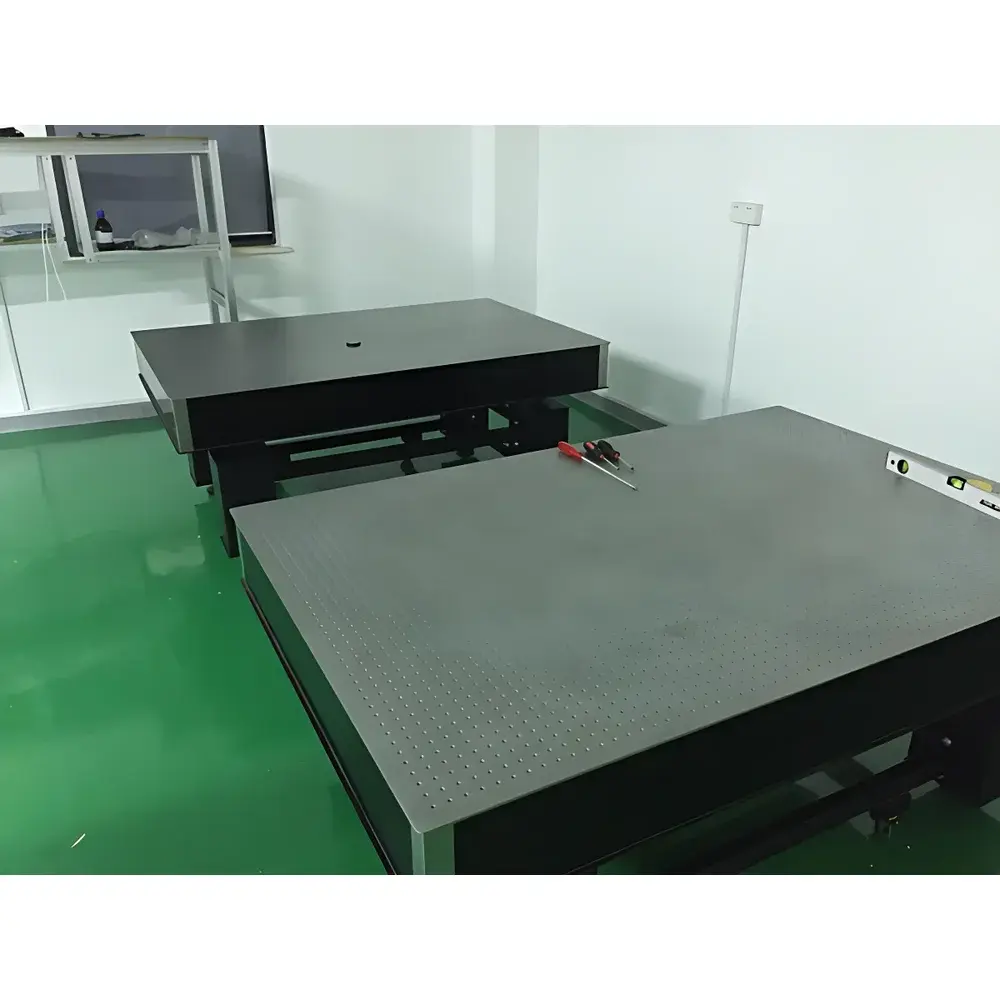
SPL Honeycomb Optical Breadboard with Dust-Proof Skirt
| Brand | SPL |
|---|---|
| Model | SPL-R-1812(200), SPL-A-2012(200) |
| Construction | Honeycomb-core steel breadboard with stainless steel top/bottom plates and integrated aluminum dust skirt |
| Top Plate Material | 17-4PH precipitation-hardened stainless steel (non-magnetic, corrosion-resistant) |
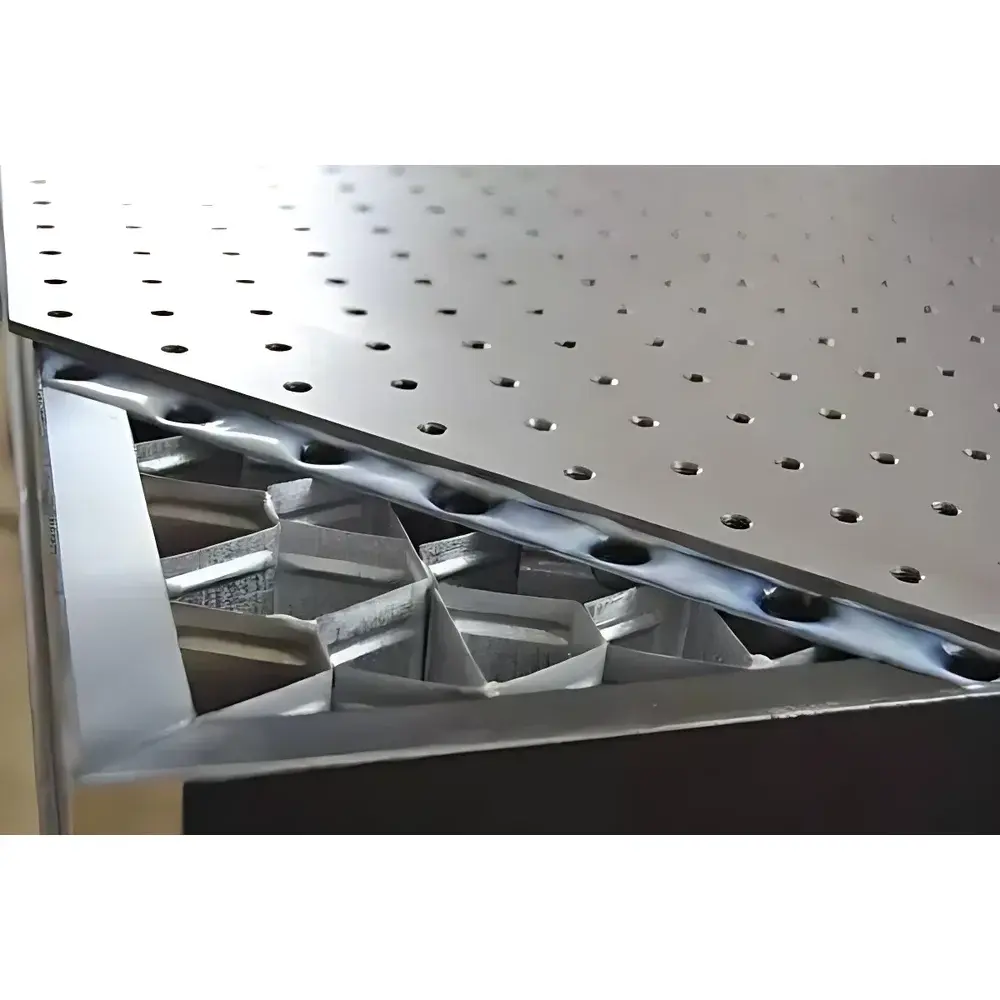
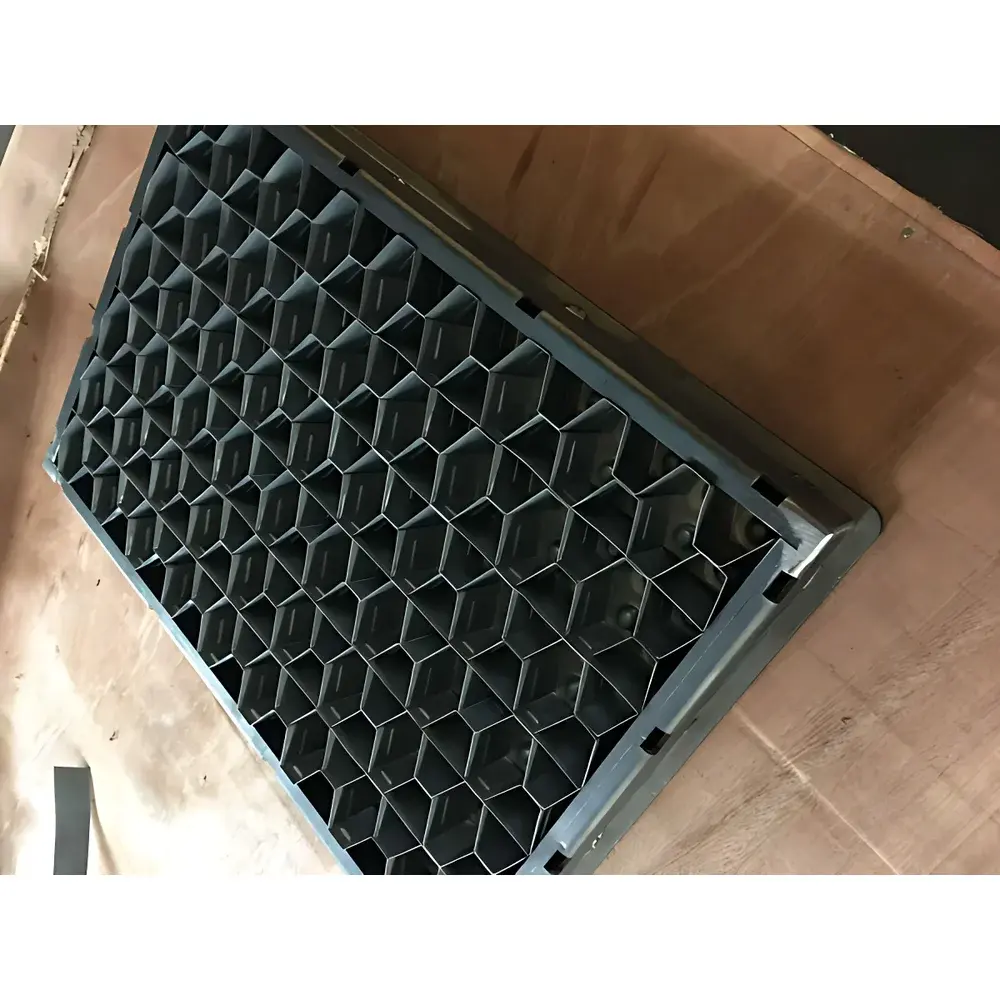
| Core Structure | Weld-free trapezoidal steel honeycomb core |
| Mounting Pattern | M6 threaded holes on 25 mm grid |
| Structural Height | 800 mm |
| Tabletop Thickness | 200 mm |
| Flatness | ≤0.05 mm/m² |
| Surface Roughness | Ra 0.8–1.6 µm |
| Resonant Frequency Range | 3–6 Hz |
| Maximum Vibration Amplitude | ≤5 µm |
| Damping System | Precision viscoelastic damping isolators + GB-compliant rubber isolation pads |
| Compliance | Designed for ISO 14644 cleanroom-compatible environments and GLP/GMP-aligned optical metrology workflows |
| Customization | Available in non-standard dimensions and thicknesses |
Overview
The SPL Honeycomb Optical Breadboard with Dust-Proof Skirt is an engineered passive vibration isolation platform designed for high-stability optical experimentation, precision metrology, laser interferometry, quantum optics setups, and aerospace-grade alignment testing. Its structural integrity derives from a monolithic honeycomb core architecture—comprising interlocked trapezoidal steel lamellae bonded without welding—to achieve an optimal stiffness-to-mass ratio. This geometry suppresses internal resonances while maintaining dimensional stability over time. The top and bottom plates are fabricated from 17-4PH precipitation-hardened stainless steel, delivering non-magnetic performance, long-term corrosion resistance, and surface cleanliness essential for Class 5–7 cleanroom applications. Unlike welded or cast platforms, the absence of residual thermal stress ensures no time-dependent warping or creep-induced flatness deviation. The integrated dust-proof skirt—deep-drawn from high-purity aluminum—is acoustically decoupled from the core and forms a continuous perimeter seal to prevent particulate ingress, liquid spillage, and mechanical interference from external airflow or footfall-induced cavity resonance.
Key Features
- Weld-free honeycomb core construction eliminates internal stress accumulation, guaranteeing long-term planarity retention (≤0.05 mm/m²) across decades of service life.
- 17-4PH stainless steel top plate with surface finish Ra 0.8–1.6 µm provides exceptional scratch resistance, non-magnetic compatibility for MRI-adjacent optics, and seamless integration with vacuum-compatible optical mounts.
- Dust-proof aluminum skirt fully encloses the platform periphery, preventing dust accumulation inside the core cavity and eliminating acoustic coupling between ambient noise and internal air columns.
- Passive damping system combines precision viscoelastic isolators (designed for 3–6 Hz natural frequency suppression) with GB/T 7759.1-compliant rubber isolation pads to attenuate broadband floor-borne vibrations from HVAC systems, nearby machinery, or building sway.
- Standardized M6 tapped holes on 25 mm Cartesian grid enable repeatable, traceable component positioning—fully compatible with Thorlabs, Newport, and Standa mounting hardware ecosystems.
- Rigid column-supported frame (4-column for ≤2400 mm length; 6-column for ≥3000 mm) maintains lateral rigidity under asymmetric loading up to 150 kg/m² without measurable deflection.
Sample Compatibility & Compliance
The SPL optical breadboard supports full compatibility with standard optical components including kinematic mirror mounts, translation stages, fiber launch systems, and interferometric beam paths. Its non-magnetic surface allows safe operation adjacent to electron microscopes, NMR spectrometers, and magneto-optic traps. Platform flatness and surface roughness meet ISO 10110-7 specifications for optical substrate referencing. The design adheres to ISO 14644-1 Class 5 particle control requirements when used with appropriate cleanroom protocols. For regulated environments—including pharmaceutical QC labs and medical device R&D—the platform’s passive, non-powered architecture satisfies FDA 21 CFR Part 11 data integrity prerequisites for supporting instrumentation (i.e., no embedded firmware or software requiring validation). Documentation packages include material certifications (EN 10088-1 for 17-4PH), dimensional inspection reports, and damping performance curves per ISO 2041:2009.
Software & Data Management
As a purely mechanical passive platform, the SPL Honeycomb Breadboard requires no embedded firmware, drivers, or proprietary software. All calibration, installation verification, and long-term stability monitoring are performed using third-party metrology tools—including laser trackers (e.g., Leica AT960), electronic levels (e.g., WYLER X1), and white-light interferometers (e.g., Zygo Verifire)—with traceable NIST or PTB-certified reference standards. Comprehensive dimensional validation reports—including flatness maps, hole pattern deviation analysis, and resonant mode spectra—are provided upon request and archived per GLP Annex 11 requirements for audit readiness. Platform serial numbers are engraved and linked to individual test certificates stored in secure customer portals.
Applications
- Laser cavity alignment and ultrafast pulse compression setups requiring sub-micron positional stability over multi-hour acquisition windows.
- Gravitational wave detector prototype benches where mechanical Q-factor and modal density below 10 Hz directly impact signal-to-noise ratio.
- Biophotonics imaging rigs integrating confocal, STED, or light-sheet microscopy—where platform-induced drift degrades Z-stack registration accuracy.
- Aerospace optical payload qualification tests simulating launch vibration profiles per MIL-STD-810H Method 514.8.
- Calibration laboratories performing ISO/IEC 17025-accredited measurements of optical component wavefront error using interferometric null testing.
- Quantum computing testbeds housing trapped-ion or superconducting qubit control optics, demanding electromagnetic silence and thermal drift minimization.
FAQ
What is the difference between SPL-R (passive) and SPL-A (active) models?
The SPL-R series utilizes passive viscoelastic damping and optimized mass distribution to suppress vibrations below 10 Hz. The SPL-A series integrates pneumatic leveling valves and piezoelectric inertial actuators for real-time correction of low-frequency disturbances (0.5–100 Hz), making it suitable for nanoscale lithography or atomic force microscopy.
Can the platform be anchored to an optical table or concrete floor?
Yes—each leg includes adjustable leveling feet with M12 threaded inserts for rigid bolting to ISO-standard optical tables or reinforced concrete substrates. Anchoring does not compromise damping performance when isolation pads remain uncompressed.
Is custom hole patterning available beyond the standard 25 mm grid?
Yes—custom CNC drilling patterns (e.g., 12.5 mm grids, concentric rings, or hybrid layouts) can be implemented during manufacturing. Lead time increases by 10–14 working days.
Does the dust skirt affect thermal expansion behavior?
No—the skirt is mechanically isolated via elastomeric gaskets and exhibits negligible thermal coupling to the core. CTE mismatch is mitigated through independent mounting, preserving overall platform thermal stability (±0.5 µm/m·K typical).
What documentation is supplied with each unit?
Each platform ships with a Certificate of Conformance (CoC), dimensional inspection report (including flatness map and hole position tolerance analysis), material test reports (MTRs) for 17-4PH steel and aluminum alloy 5052-H32, and ISO 2041-compliant vibration transmissibility curves.




