
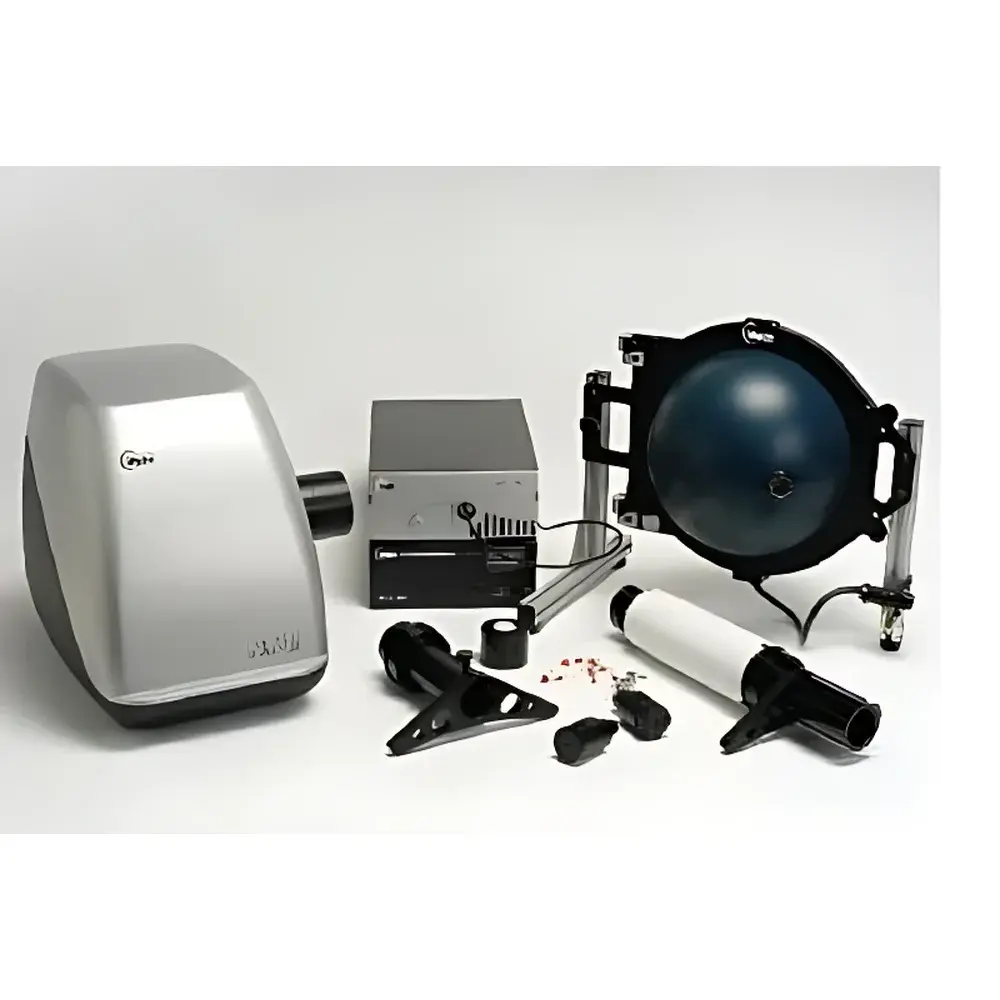
SPL SPL Flashlight, Projector & Strobe Spectral Flux Measurement System
| Brand | SPL |
|---|---|
| Origin | USA |
| Manufacturer Type | Authorized Distributor |
| Origin Category | Imported |
| Model | SPL Flashlight, Projector & Strobe Spectral Flux Measurement System |
| Pricing | Upon Request |
| Calibration | NIST-traceable |
| Software | MtrX-SPEC v3.2+ |
| Dynamic Range | 10⁶:1 (typical for integrated sphere-based spectral radiometric systems) |
| Spectral Range | 380–780 nm |
| Resolution | ≤1 nm (FWHM) |
| Measurement Speed | <500 ms per full spectrum (380–780 nm) |
Overview
The SPL Flashlight, Projector & Strobe Spectral Flux Measurement System is a purpose-engineered optical metrology platform designed for quantitative photometric and radiometric characterization of directional, high-intensity, pulsed, and continuous-wave (CW) light sources—including tactical flashlights, architectural projectors, emergency strobes, LED searchlights, and portable illumination devices. Built around an integrating sphere coupled with a high-sensitivity back-thinned CCD spectroradiometer, the system operates on the principle of spectral radiant flux (Φe,λ) integration across the visible spectrum (380–780 nm), enabling traceable determination of luminous flux (Φv, in lumens), chromaticity coordinates (CIE 1931 x,y), correlated color temperature (CCT), color rendering index (CRI/Ra), and spectral power distribution (SPD). Its architecture supports both steady-state and time-gated acquisition modes—critical for accurate energy-integrated measurement of short-duration strobe pulses (down to 10 µs pulse width) without saturation or dynamic range compression.
Key Features
- Integrated sphere configuration (1.5 m diameter, BaSO4-coated interior) optimized for directional source geometry and spatial uniformity compliance per CIE Publication 84 and IES LM-79-19.
- NIST-traceable factory calibration delivered with each system; includes spectral responsivity, linearity, and geometric correction coefficients certified to ISO/IEC 17025-accredited laboratory standards.
- MtrX-SPEC v3.2 software suite providing automated calibration workflows, real-time spectral curve overlay, pass/fail thresholding against user-defined specification limits (e.g., ANSI FL1, IEC 62471, or internal QC criteria), and audit-ready export of measurement reports in PDF, CSV, and XML formats.
- Dynamic range extension via dual-gain detector electronics and adaptive exposure control—enabling single-shot measurement of sources spanning 0.1 lm to >50,000 lm without manual attenuation or hardware reconfiguration.
- Configurable data display interface: users may toggle visibility of derived metrics (e.g., CCT, Duv, R9, S/P ratio, TM-30 fidelity index) alongside raw SPD and photometric integrals.
- Full GLP-compliant data management: timestamped measurements with operator ID, instrument serial number, calibration certificate ID, environmental sensor logging (ambient T, RH), and immutable audit trail enabled by optional 21 CFR Part 11 module.
Sample Compatibility & Compliance
The system accommodates fixtures with beam angles from 5° to 180°, physical dimensions up to Ø200 mm × 300 mm (L), and electrical interfaces including battery-powered, USB-C powered, and AC-line-driven configurations. Mounting is facilitated via adjustable kinematic stage with XYZ translation and θ-φ angular positioning. All measurements adhere to the geometric and photometric requirements of IES LM-79-19 (Electrical and Photometric Measurements of Solid-State Lighting Products), CIE S 025/E:2015 (Test Method for LED Lamps, LED Luminaires and LED Modules), and ISO/CIE 19476:2014 (Colorimetry — Spectral irradiance and radiance measurements). Optional UV-VIS-NIR extension (350–1050 nm) available for comprehensive photobiological safety assessment per IEC 62471.
Software & Data Management
MtrX-SPEC serves as the central operational and analytical environment. It implements ISO 17025-aligned calibration verification routines—including daily system check using built-in reference LEDs—and supports scheduled recalibration reminders tied to certificate expiry dates. Raw spectral data are stored in vendor-neutral HDF5 format with embedded metadata (wavelength array, integration time, slit width, detector temperature). Batch processing enables statistical analysis across production lots (mean, SD, CPK, histogram distribution), while database synchronization allows centralized deployment across multiple QA labs. Export modules comply with LIMS interoperability standards (ASTM E1482, HL7) and support direct integration into enterprise quality management systems (QMS) such as MasterControl or Veeva.
Applications
- Manufacturing QA/QC of handheld illumination tools (tactical flashlights, headlamps, inspection lights) against ANSI/NEMA FL1 performance claims.
- R&D validation of projector optical engines for luminance uniformity, gamut coverage (DCI-P3, Rec.2020), and temporal stability under thermal load.
- Safety certification testing of aviation obstruction lights, marine distress strobes, and railway signaling beacons per ICAO Annex 14 and EN 12967.
- LED module binning and sorting based on spectral flux consistency and chromaticity deviation.
- Regulatory submission support for ENERGY STAR, DesignLights Consortium (DLC), and EU Ecodesign Lot 10 compliance documentation.
FAQ
Does the system support pulsed light sources with variable repetition rates?
Yes—the spectroradiometer’s programmable trigger input synchronizes with external TTL signals, supporting pulse frequencies from 1 Hz to 20 kHz and enabling gated integration aligned to individual strobe events.
Can calibration certificates be renewed remotely?
NIST-traceable recalibration requires physical return to an SPL-accredited service center; however, interim verification checks can be performed on-site using the included reference standard lamp and MtrX-SPEC’s automated validation protocol.
Is the software validated for use in FDA-regulated environments?
The optional 21 CFR Part 11 compliance package includes electronic signature enforcement, role-based access control, and immutable audit logs—validated per GAMP 5 guidelines for regulated pharmaceutical and medical device manufacturing settings.
What environmental conditions must be maintained during measurement?
Ambient temperature stability within ±2°C (20–25°C recommended) and relative humidity below 70% non-condensing are required; integrated environmental sensors log conditions automatically with each measurement.
How is stray light error minimized in high-dynamic-range measurements?
The spectrometer employs order-sorting filters, double-pass monochromator design, and proprietary stray-light correction algorithms trained on NIST SRM 2035 reference data—reducing out-of-band contributions to <0.01% at 400 nm when measuring broadband white sources.




