
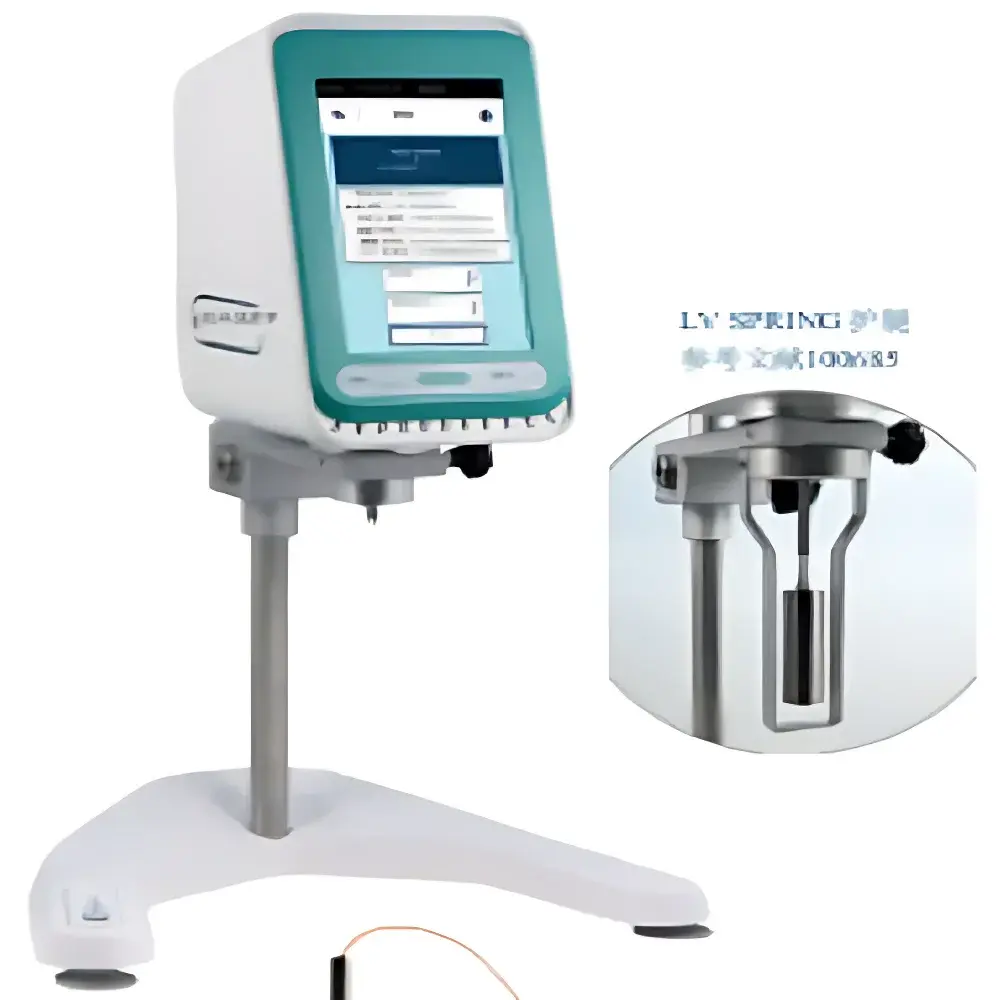
Spring-Driven Rotational Viscometer JHX LV-SPRING (Imported from France, LAMY Technology Platform)
| Brand | JHX |
|---|---|
| Origin | France |
| Model | LV-SPRING |
| Type | 7-inch Touchscreen Spring-Based Rotational Viscometer |
| Display | Viscosity, Rotational Speed, Torque, Time, Temperature |
| Viscosity Units | cP, Poise, mPa·s, Pa·s |
| Shear Rate Display | Yes |
| Control Modes | Speed-controlled & Shear-rate-controlled |
| Temperature Integration | Direct temperature unit control interface |
| Multi-step Method Programming | Yes |
| Data Logging | Internal memory + USB export |
| Connectivity | RS232, USB (PC & printer), 4–20 mA analog output |
| Software Compatibility | RheoTex v3.x |
| Language Support | English, French, Spanish, Russian |
| User Authentication | 4-digit operator ID lock |
| Compliance Features | LIMS-ready, QC limit setting, audit trail-capable configuration locking |
| Power Supply | 90–240 VAC, 50/60 Hz |
Overview
The JHX LV-SPRING is a precision-engineered spring-driven rotational viscometer developed on the validated LAMY mechanical platform and distributed globally by JHX Instrumentation. Unlike motor-driven rheometers that rely on servo-controlled torque feedback, the LV-SPRING employs a calibrated torsion-spring transduction system to directly measure resistance to rotation under defined shear conditions. This architecture delivers high reproducibility in routine QC environments where robustness, minimal maintenance, and intrinsic linearity across low-to-mid viscosity ranges are prioritized. Designed for laboratories requiring ISO/IEC 17025-compliant viscosity verification—particularly in paints, coatings, adhesives, food emulsions, and pharmaceutical suspensions—the instrument operates on the principle of steady-state rotational viscometry per ASTM D2196 and ISO 2555. Its spring-based torque sensing eliminates electronic drift associated with strain-gauge or electromagnetic transducers, making it especially suitable for long-duration stability testing and calibration traceability workflows.
Key Features
- Calibrated torsion-spring torque transducer with mechanical hysteresis compensation
- 7-inch capacitive touchscreen interface with intuitive icon-driven navigation
- Dual control modes: fixed-speed operation or user-defined shear rate profiling
- Integrated multi-step method editor supporting up to 12 sequential test phases with independent speed, time, and temperature setpoints
- Real-time torque display (0.01–100 mN·m range) synchronized with viscosity calculation
- Operator authentication via 4-digit numeric ID, enabling secure parameter locking and role-based access control
- Onboard data logging (≥10,000 measurement records) with timestamp, temperature, and method ID tagging
- Direct USB export to FAT32-formatted drives; no proprietary drivers required
- RS232 and USB ports for bidirectional communication with LIMS or ERP systems
- Configurable 4–20 mA analog output for integration into industrial process monitoring loops
Sample Compatibility & Compliance
The LV-SPRING accommodates standard DIN, ASTM, and ISO geometry spindles—including LV, RV, and HA types—as well as custom geometries compliant with ISO 3219. It supports sample volumes from 15 mL (with small-volume adapter) to full 600 mL jacketed vessels. Temperature control is achieved via external circulator integration using the built-in PT100 input and PID-regulated output signals. The system meets essential requirements for GLP and GMP environments: all method parameters are stored with version stamping, QC limits are configurable per product batch, and operator ID linkage ensures accountability in audit scenarios. While not FDA 21 CFR Part 11–certified out-of-the-box, its logging architecture supports validation protocols for electronic record integrity when deployed with documented SOPs.
Software & Data Management
The instrument natively runs firmware compatible with RheoTex v3.2+, a Windows-based laboratory software package supporting method synchronization, automated report generation (PDF/CSV), and statistical process control (SPC) charting. USB-host functionality allows direct firmware updates and method library transfers. All exported datasets include embedded metadata: instrument serial number, calibration certificate expiry, operator ID, environmental temperature, and spindle identification. Audit trail capabilities are implemented at the firmware level—any change to QC thresholds, unit preferences, or language settings is logged with timestamp and authenticated user ID. For enterprise deployment, the RS232 ASCII command set enables integration with LabWare LIMS and Thermo Fisher SampleManager via custom middleware.
Applications
- Quality assurance of solvent-based and waterborne architectural coatings (ASTM D1084)
- Batch release testing of topical gels and ointments per USP
- In-process monitoring of polymer melt precursors in extrusion feedstocks
- Stability assessment of dairy-based beverage emulsions over 72-hour shear profiles
- Viscosity grading of industrial lubricants according to ISO 3104
- Validation of cleaning-in-place (CIP) solution rheology in food-grade pipelines
FAQ
Does the LV-SPRING require annual recalibration?
Yes—torque calibration must be verified annually using NIST-traceable reference oils (e.g., Cannon-Manning series) and certified spindle geometry. Certificate of conformance is issued post-calibration.
Can the instrument operate without a PC connection?
Yes. All measurement, storage, and reporting functions are fully autonomous via the onboard touchscreen and internal memory.
Is temperature control built-in or external?
Temperature regulation is external: the LV-SPRING provides PT100 input and 0–10 V analog output to drive third-party circulators (e.g., Huber, Julabo) but does not include a heating/cooling bath.
What spindle geometries are supported?
Standard LV, RV, and HA spindles per ISO 2555; optional cone-and-plate and vane spindles available upon request with geometry-specific firmware patches.
How is data integrity ensured during USB transfer?
Files are written in atomic write mode with CRC32 checksum validation; incomplete transfers are automatically discarded and flagged in the event log.



