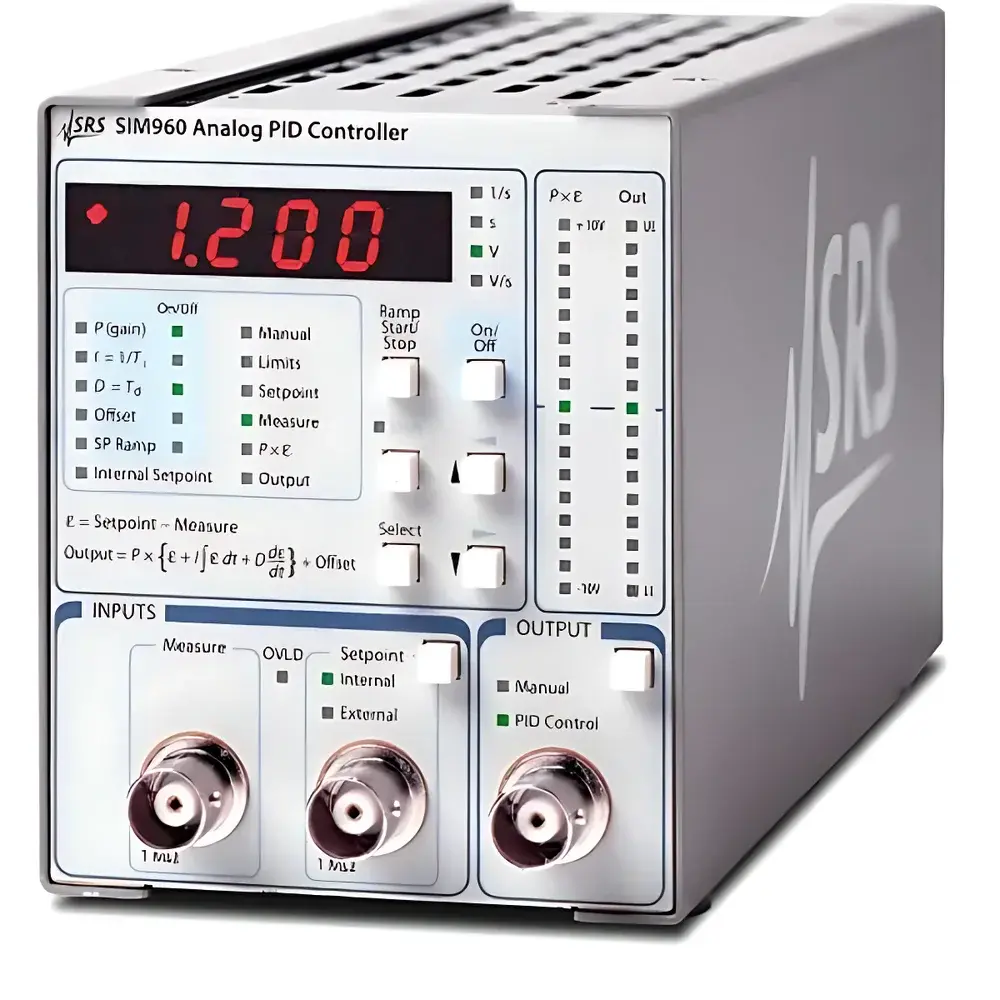
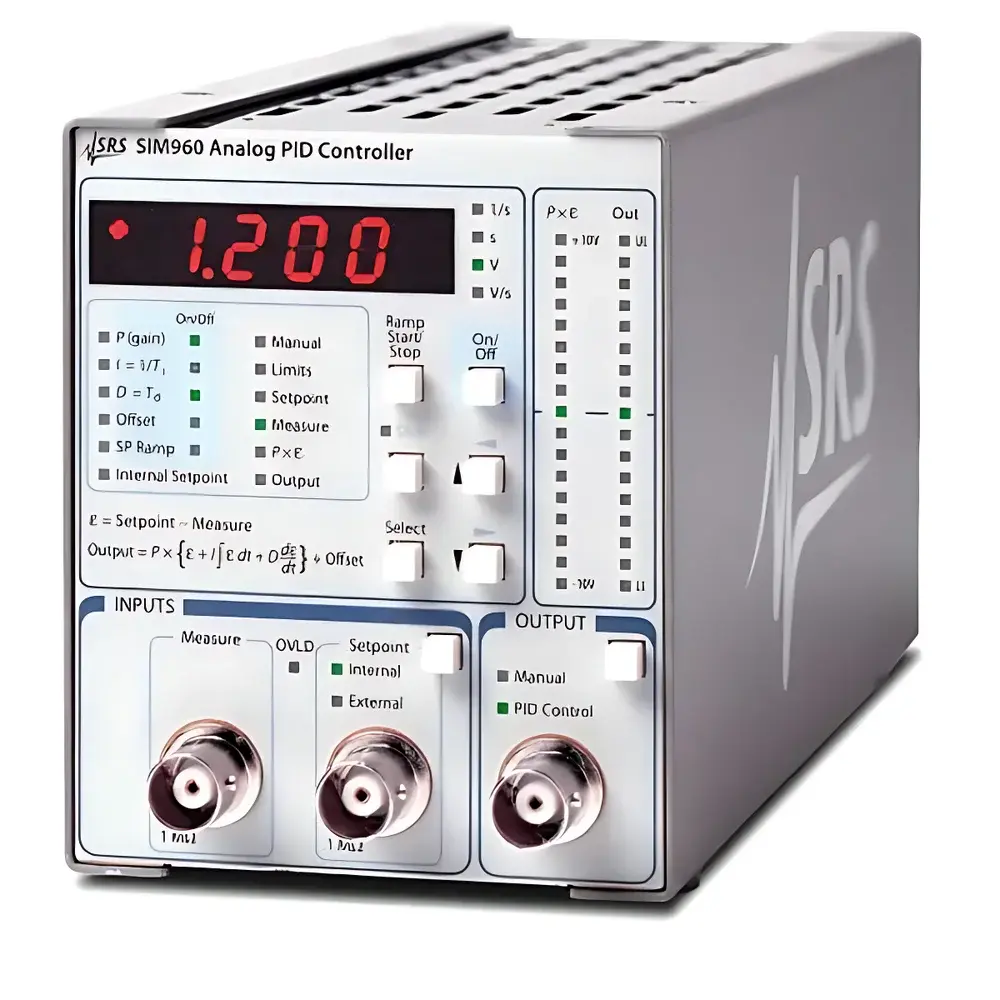
SRS SIM960 Analog PID Controller
| Brand | Stanford Research Systems |
|---|---|
| Origin | USA |
| Model | SIM960 |
| Input Range | ±10 V (single-ended), ±1 V (differential) |
| Proportional Gain | 10⁻¹–10³ |
| Integral Gain | 10⁻¹–10⁵ s⁻¹ |
| Derivative Gain | 10⁻⁷–10⁻¹ s |
| Control Bandwidth | 100 kHz |
| Input Noise Density | 8 nV/√Hz (above 10 Hz) |
| Output Slew Rate | User-Programmable via Internal Ramp Generator |
| Output Clamping | Adjustable Upper/Lower Limits |
| Anti-Windup | Active Integral Anti-Saturation Circuitry |
Overview
The SRS SIM960 Analog PID Controller is a high-performance, low-noise feedback control module engineered for precision stabilization and dynamic regulation in demanding scientific instrumentation environments. Unlike digital PID controllers constrained by sampling rates and quantization noise, the SIM960 implements true analog signal processing with digitally configurable parameters—enabling continuous-time control loops with no discrete-time artifacts. Its 100 kHz closed-loop bandwidth supports ultrafast response in applications such as laser frequency locking, cryogenic temperature regulation, atomic force microscope (AFM) tip-sample distance control, and quantum optics feedback systems. The controller operates either standalone with external ±15 V DC power or integrated into the modular SIM900 mainframe, offering flexible deployment without compromising signal integrity. Designed and manufactured in the United States by Stanford Research Systems, the SIM960 adheres to rigorous analog circuit design principles—including fully differential front-end architecture, precision trimmable op-amp stages, and shielded internal routing—to minimize ground loops, crosstalk, and thermal drift.
Key Features
- True analog control path with digitally accessible parameter settings—eliminates phase lag and aliasing inherent in sampled-data systems
- Ultra-low input-referred noise density of 8 nV/√Hz above 10 Hz, optimized for weak-signal feedback from photodiodes, resistance thermometers, and SQUID sensors
- Wide dynamic gain range: proportional gain adjustable from 0.1 to 1000; integral action from 0.1 s⁻¹ to 100,000 s⁻¹; derivative time constant from 10 ns to 10 s
- Programmable ramp generator for smooth setpoint transitions—prevents overshoot and mechanical shock in piezo-driven stages or thermal actuators
- Hardware-enforced output clamping with independent upper and lower limits, ensuring actuator safety and preventing integrator windup
- Active anti-windup circuitry that dynamically disables integration during saturation, enabling rapid recovery without manual reset or hysteresis
- Front-panel BNC connectors for error input, reference input, and analog output—fully compatible with standard lab instrumentation grounding practices
Sample Compatibility & Compliance
The SIM960 interfaces seamlessly with a broad spectrum of transducers and actuators used across physics, materials science, and quantum engineering laboratories. It accepts inputs from platinum resistance thermometers (PRTs), silicon diode sensors, thermocouples (with external conditioning), quadrant photodiodes, lock-in amplifier outputs, and capacitive displacement sensors. Output compatibility includes piezoelectric translators (PZTs), current-controlled laser diodes, resistive heaters, and magnetic field coils. While not certified for industrial process control under IEC 61508 or ISA-84, the SIM960 meets laboratory-grade electromagnetic compatibility (EMC) requirements per FCC Part 15 Class B and EU Directive 2014/30/EU. Its analog architecture inherently supports traceable calibration protocols aligned with ISO/IEC 17025-accredited metrology workflows, and its parameter logging capability (via SIM900 host interface) supports GLP-compliant audit trails when integrated into validated experimental setups.
Software & Data Management
When installed in the SIM900 mainframe, the SIM960 is fully controllable via RS-232 or USB using the SRS Instrument Control Software (ICS), which provides GUI-based tuning, real-time waveform monitoring, and scriptable parameter sweeps. All settings—including P/I/D coefficients, clamp thresholds, ramp rate, and filter corner frequencies—are stored non-volatilely and survive power cycles. The controller supports SCPI command syntax for integration into Python (PyVISA), MATLAB, or LabVIEW automation frameworks. Though the SIM960 itself performs no digital signal acquisition, its analog output can be digitized using external DAQ systems compliant with NIST-traceable calibration standards. For FDA-regulated research environments, the SIM900 chassis firmware supports time-stamped configuration logging and user-access-level permissions—laying foundational infrastructure for 21 CFR Part 11 compliance when paired with appropriate electronic lab notebook (ELN) systems.
Applications
- Laser power and wavelength stabilization via feedback to diode current or cavity piezo
- Cryostat temperature regulation using RuO₂ sensor inputs and resistive heater outputs
- Scanning probe microscopy (SPM) z-feedback loops requiring sub-nanometer positioning resolution and >50 kHz bandwidth
- Atomic vapor cell frequency locking in atomic clocks and magnetometers
- High-finesse optical cavity length control for gravitational wave detector R&D
- Superconducting qubit bias line stabilization with minimized Johnson-Nyquist noise coupling
FAQ
Can the SIM960 operate independently without the SIM900 mainframe?
Yes—the SIM960 accepts ±15 V DC power via its rear-panel screw terminals and functions identically in standalone mode, retaining full front-panel control and BNC I/O access.
What is the maximum recommended cable length between the SIM960 and a remote sensor?
For optimal noise immunity in differential mode, keep coaxial cables under 2 m; single-ended connections should not exceed 1 m unless actively guarded and shielded.
Does the SIM960 support external trigger synchronization for multi-channel PID networks?
No—the SIM960 lacks dedicated sync inputs or clock distribution; however, multiple units can be coordinated via shared reference voltage or TTL-gated setpoint modulation through auxiliary inputs.
Is factory recalibration available, and what is the typical recalibration interval?
Stanford Research Systems offers NIST-traceable recalibration services; annual verification is recommended for applications requiring <0.5% gain stability or sub-10 nV/√Hz noise performance.
How does the anti-windup circuit differ from simple output clamping?
Clamping limits output voltage but leaves the integrator running—causing delayed recovery. The SIM960’s active anti-windup halts integration *during* saturation and resumes only after the error signal re-enters the linear region, ensuring monotonic step response.