
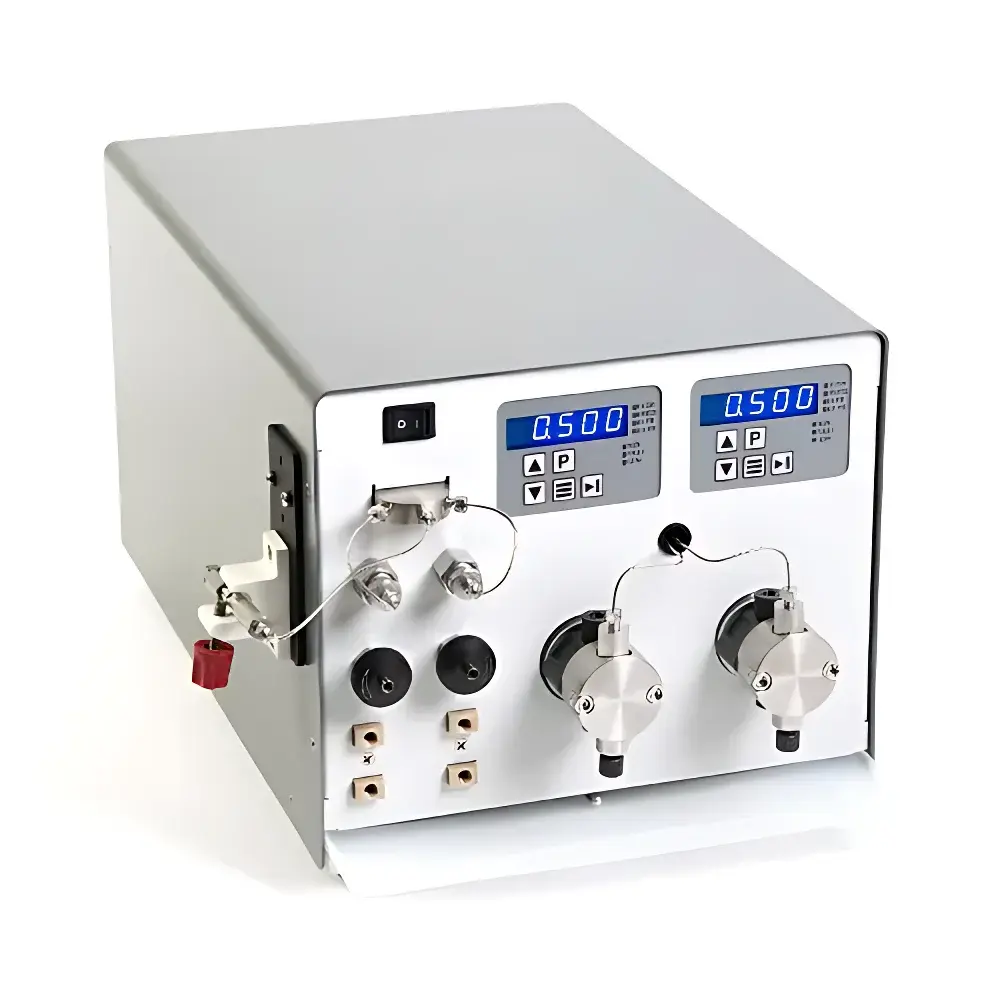
SSI BLS Class High-Pressure Binary Gradient Pump
| Brand | SSI |
|---|---|
| Origin | Imported |
| Model | BLS Class |
| Flow Rate | 0.000–10.00 mL/min (up to 6,000 psi) |
| Maximum Pressure | 6,000 psi (5,000 psi with PEEK fluidic path) |
| Pulsation | ≤2% at 1 mL/min & 1,000 psi (with pulse dampener) |
| Flow Accuracy | ±2% of full scale |
| Flow Precision | ≤0.2% RSD |
| Fluid Path Materials | Stainless steel, PEEK, optional titanium |
| Dimensions | 22.9 × 25.4 × 43.2 cm (H × W × D) |
| Weight | 13.6 kg |
| Power | 100–240 VAC ±10%, 50–60 Hz |
| Control Interfaces | RS-232, Micro-USB, analog (0–10 V / 4–20 mA), discrete Run/Stop |
Overview
The SSI BLS Class High-Pressure Binary Gradient Pump is an engineered solution for precise, reproducible solvent delivery in high-performance liquid chromatography (HPLC), ultra-high-performance liquid chromatography (UHPLC), and method development applications requiring robust gradient formation under elevated backpressures. Based on dual single-head positive displacement piston architecture, the system employs belt-driven pump mechanisms with precision-machined cam profiles and electronic fast-refill capability—enabling low-pulsation flow across its operational range. Each pump head operates independently yet synchronously, supporting linear, step, or custom nonlinear gradient profiles via integrated firmware control. The system is designed for long-term stability in regulated environments, with pressure transducers, leak detection circuitry, and hardware-level fault monitoring ensuring compliance with GLP and GMP operational expectations.
Key Features
- Dual independent high-pressure piston pumps housed in a unified, service-accessible enclosure with drip tray and integrated leak sensor
- Low-pulsation fluid delivery (≤2% at 1 mL/min, 1,000 psi) achieved via shaped cam actuation, electronic refill optimization, and optional external pulse dampeners
- Stainless steel and PEEK wetted materials as standard; titanium pump heads and sapphire/ruby check valves available for aggressive solvents and extended service life
- Integrated SSI Gradient Control Board featuring embedded GUI software for autonomous method execution—no continuous PC connection required after method download
- Real-time pressure monitoring with built-in transducer, bulkhead-mounted outlet filters, and a compact high-pressure mixing chamber (low dead volume)
- Comprehensive control interface suite: RS-232 serial command set, Micro-USB for configuration, analog 0–10 V / 4–20 mA input/output, and discrete Run/Stop I/O
- Prime-Purge valves per channel for rapid solvent exchange and system priming without disassembly
Sample Compatibility & Compliance
The BLS Class accommodates a broad range of HPLC-compatible mobile phases—including aqueous buffers, organic modifiers (acetonitrile, methanol, THF), and corrosive additives (TFA, HFIP)—when configured with appropriate fluidic materials. PEEK-based configurations support pressures up to 5,000 psi, while stainless steel and titanium variants maintain integrity at the full 6,000 psi rating. All electrical and mechanical designs conform to IEC 61010-1 safety standards for laboratory equipment. Firmware supports audit-trail-capable operation when integrated into systems compliant with FDA 21 CFR Part 11 requirements—method parameters, run logs, and error events are timestamped and non-erasable upon configuration lock. The system meets ASTM D7250 and ISO 13843 guidelines for pump performance verification under gradient conditions.
Software & Data Management
The embedded Gradient Control Board runs proprietary firmware with a Windows-compatible GUI application for method authoring, calibration, and diagnostics. Users define gradient programs—including solvent selection valve timing, flow rate ramps, pressure limits, and event-triggered actions—then download them directly to the board’s non-volatile memory. Once deployed, the pump executes gradients autonomously with local real-time monitoring of flow, pressure, and status flags. Serial commands (ASCII protocol over RS-232 or USB CDC) enable integration into third-party instrument control frameworks (e.g., LabVIEW, Python-based sequencing engines). All method files are stored in plain-text XML format for version control, backup, and regulatory documentation. Audit logs record user login, method upload, start/stop events, and fault conditions—exportable via USB or serial dump for QA review.
Applications
- HPLC/UHPLC method development and validation, especially for multi-solvent screening and robustness testing
- Preparative chromatography requiring stable binary gradients at high flow rates (up to 40 mL/min at reduced pressure)
- Hyphenated techniques such as LC-MS and LC-ICP-MS where low pulsation and solvent compatibility are critical for signal stability
- Process analytical technology (PAT) deployments where embedded autonomy reduces dependency on centralized control infrastructure
- Academic and industrial QC labs performing USP , EP 2.2.46, or JP 6.03-compliant chromatographic assays
FAQ
What is the maximum operating pressure for PEEK fluidic paths?
The BLS Class supports up to 5,000 psi when configured with PEEK pump heads and tubing—optimized for compatibility with moderately aggressive solvents while maintaining thermal and chemical stability.
Can the pump operate without a connected computer after method upload?
Yes. The Gradient Control Board stores and executes methods locally; only initial setup, calibration, and firmware updates require PC connectivity.
Is analog control (0–10 V / 4–20 mA) supported for remote flow rate modulation?
Yes—both voltage and current inputs are accepted for real-time flow adjustment, enabling seamless integration with PLC-based process control systems.
How is leak detection implemented?
A capacitive leak sensor in the drip tray triggers an immediate hardware interrupt, halting pump operation and logging the event with timestamp and channel identification.
Are calibration certificates traceable to NIST standards available?
Factory calibration reports—including flow accuracy verification at multiple points using gravimetric measurement—are provided with each unit; NIST-traceable calibration services are available upon request through authorized SSI service centers.



