
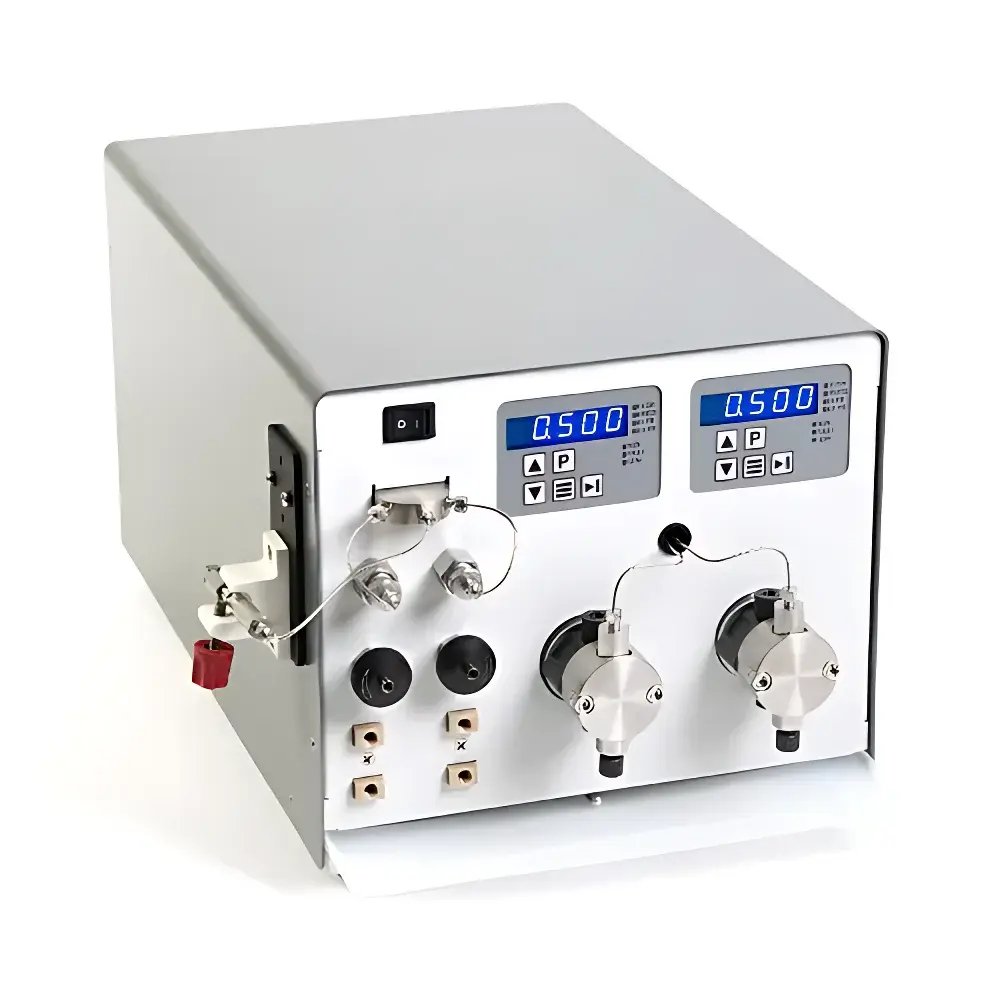
SSI BLS010SFT1A High-Pressure Binary Gradient Pump
| Brand | SSI |
|---|---|
| Origin | Imported |
| Model | BLS010SFT1A |
| Flow Rate | 0.000–10.00 mL/min |
| Maximum Pressure | 6,000 psi (414 bar) |
| Pulsation | ≤2% at 1 mL/min & 1,000 psi (with dampener) |
| Flow Accuracy | ±2% of full scale (≥0.20 mL/min, 20% IPA/water, 1,000 psi) |
| Flow Precision | ≤0.2% RSD |
| Fluid Path Materials | Stainless steel, PEEK, optional titanium |
| Dimensions | 22.9 × 25.4 × 43.2 cm (H×W×D) |
| Weight | 13.6 kg |
| Power | 100–240 VAC, 50–60 Hz |
| Control Interfaces | RS-232, Micro-USB, Analog (0–10 V / 4–20 mA), Run/Stop I/O |
Overview
The SSI BLS010SFT1A is a high-precision, dual-solvent, high-pressure binary gradient pump engineered for demanding liquid chromatography applications—including method development, preparative HPLC, and UHPLC-compatible workflows requiring stable, low-pulsation solvent delivery. Based on positive displacement piston technology with belt-driven cam mechanisms and electronic fast-refill capability, the system delivers exceptional flow stability across its operational range (0.000–10.00 mL/min at up to 6,000 psi). Its design adheres to fundamental fluidic principles of constant-volume displacement and pressure-compensated refill cycles, minimizing compressibility effects common in high-pressure mobile phase delivery. The integrated high-pressure, low-volume mixing chamber enables rapid gradient formation with minimal dwell volume—critical for reproducible retention time alignment across method transfer and multi-system validation.
Key Features
- Dual independent single-head piston pumps housed in a unified, service-accessible enclosure with integrated drip tray and leak detection sensor
- Belt-driven cam mechanism with shaped cam profile and electronic fast-refill for ultra-low pulsation (≤2% at 1 mL/min, 1,000 psi, with pulse dampeners installed)
- Fluidic path constructed from chemically inert, high-strength materials: 316 stainless steel, PEEK, and optional titanium; wetted components include sapphire/ruby check valves and UHMWPE seals
- Onboard SSI Gradient Control Board with embedded GUI software for autonomous method execution—gradient profiles stored locally eliminate dependency on continuous PC connection
- Real-time pressure monitoring via integrated piezoresistive transducer with configurable overpressure shutdown and alarm thresholds
- Prime-Purge valves per channel, bulkhead-mounted outlet filters (0.2 µm), and modular solvent selection valve control (2 valves supported)
- Multiple timing events, leak detection logic, and programmable status reporting via serial command set (ASCII protocol over RS-232 or Micro-USB)
Sample Compatibility & Compliance
The BLS010SFT1A supports a broad range of HPLC- and LC-MS-compatible solvents, including aqueous buffers, acetonitrile, methanol, isopropanol, and aggressive media such as trifluoroacetic acid (TFA) or hydrochloric acid—provided compatible fluid path options (e.g., titanium head assemblies) are selected. Its mechanical architecture and pressure rating comply with ISO 13485–aligned manufacturing controls for laboratory instrumentation. While not certified as medical device hardware, the system’s deterministic firmware behavior, non-volatile method storage, and hardware-level leak/overpressure interlocks support GLP and GMP-aligned environments. Audit trail functionality is enabled via external logging of serial commands and analog I/O states; when integrated into validated chromatography data systems (CDS), it meets FDA 21 CFR Part 11 requirements for electronic records and signatures through appropriate system-level configuration.
Software & Data Management
The embedded Gradient Control Board runs proprietary firmware with a Windows-compatible GUI application for method creation, simulation, and download. Users define gradient profiles (time-based %B, flow rate ramps, valve switching events), set pressure limits, configure purge cycles, and assign timed maintenance actions—all compiled into a binary method file loaded directly onto the board’s flash memory. Once deployed, the pump executes gradients autonomously without host computer supervision. For integration into automated labs, ASCII command sets allow remote control of flow rate, start/pause, pressure readback, and fault status polling via RS-232 or Micro-USB. Analog interfaces (0–10 V for flow setpoint, 4–20 mA for actual flow feedback) enable seamless interfacing with PLCs or legacy process controllers. All communication protocols are documented in the publicly available SSI Command Reference Manual (Rev. 4.2+).
Applications
- Method development for reversed-phase, HILIC, and ion-pairing chromatography where gradient reproducibility and dwell volume consistency are critical
- Preparative-scale purification workflows requiring high-pressure solvent delivery at >5 mL/min with sub-0.2% RSD flow precision
- Multi-dimensional LC (LC×LC) coupling where precise, low-dwell-volume gradient generation minimizes modulation band broadening
- Automated QC/QA laboratories integrating pumps into unattended 24/7 operation sequences with hardware-triggered start/stop and leak-responsive shutdown
- Custom hyphenated systems—e.g., LC–ICP-MS or LC–electrochemical detection—where analog synchronization and real-time pressure telemetry are essential
FAQ
What is the minimum programmable flow rate increment?
The system supports 0.001 mL/min resolution across its full range (0.000–10.00 mL/min).
Can the pump operate with only one solvent channel active?
Yes—either channel may be disabled independently via software or hardware jumper; the inactive channel enters standby mode with automatic valve isolation.
Is the pressure transducer calibrated traceable to NIST standards?
Factory calibration is performed using NIST-traceable deadweight testers; calibration certificates are available upon request with optional IQ/OQ documentation packages.
Does the system support gradient delay volume compensation?
While the pump itself does not perform algorithmic dwell volume correction, its fixed, low internal dwell volume (<120 µL from mixer outlet to outlet fitting) enables accurate external compensation within CDS software during method translation.
What maintenance intervals are recommended for piston seals and check valves?
Under typical HPLC use (aqueous/organic solvents, <4,000 psi average), sapphire/ruby check valves require inspection every 6 months; PEEK piston seals are rated for ≥10,000 operating hours and should be replaced based on flow accuracy drift exceeding ±2% FS.



