
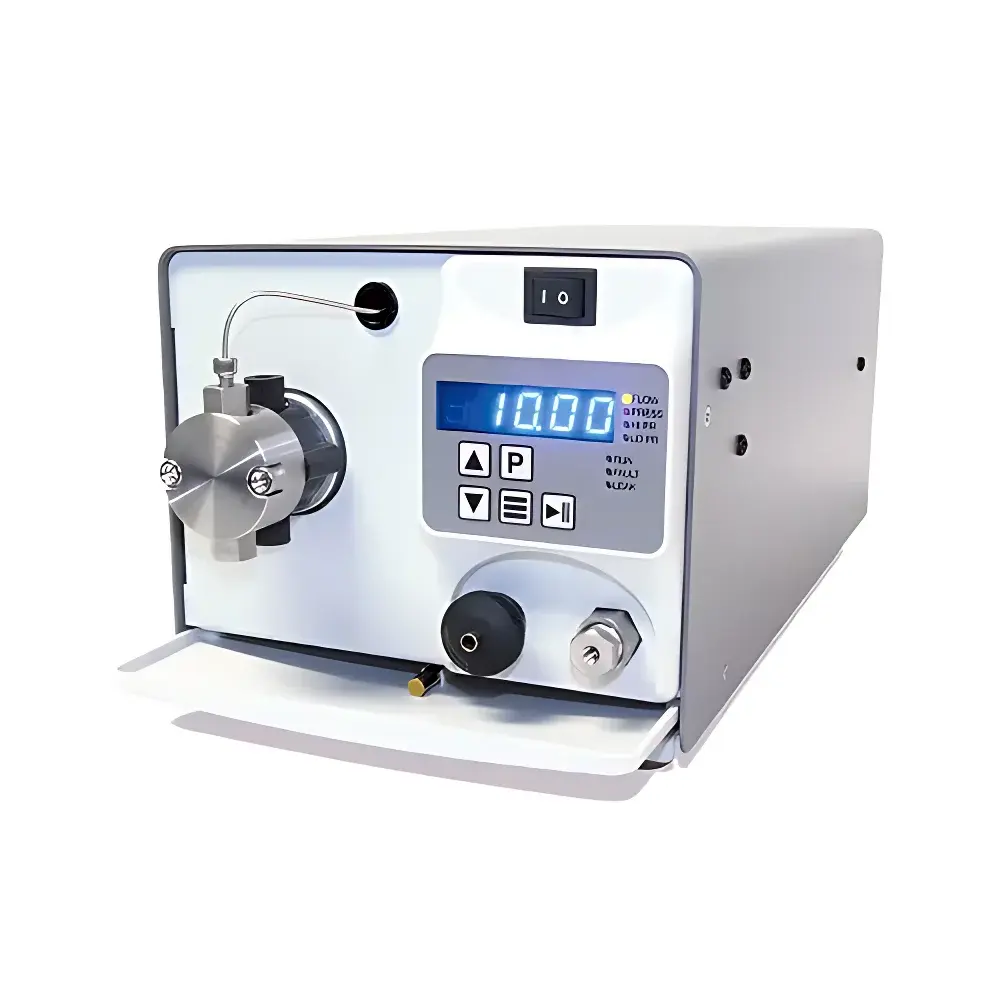
SSI LS Class Single-Head Constant Flow HPLC Pump
| Brand | SSI |
|---|---|
| Model | LS Class |
| Flow Rate | 10 mL/min |
| Maximum Pressure | 6,000 psi |
| Drive Type | Micro-stepping Motor |
| Pump Mechanism | Positive Displacement Single Piston |
| Pulsation | ≤2% (at 1 mL/min, 1,000 psi |
| Flow Accuracy | <2% (for 0.20–0.80 mL/min at 1,000 psi, 20% IPA/water |
| Flow Precision | 0.2% RSD |
| Fluid Path Materials | Stainless Steel, PEEK, optional Titanium, Sapphire, Ruby, UHMWPE, PTFE |
| Dimensions | 16.5 cm H × 17.8 cm W × 40.6 cm D |
| Weight | 6.9 kg |
| Power Supply | 100–240 VAC ±10%, 50–60 Hz |
| Control Interfaces | RS-232, Micro USB 2.0, Analog (0–10 V / 4–20 mA), Front Panel Keypad, Run/Stop |
Overview
The SSI LS Class Single-Head Constant Flow HPLC Pump is a precision-engineered positive displacement piston pump designed for high-pressure liquid delivery in analytical and preparative chromatographic systems. Utilizing a cam-driven single-piston architecture combined with micro-stepping motor control, the LS Class delivers stable, low-pulsation flow across its operational range—critical for baseline stability in UV/VIS detection and reproducible retention time alignment in gradient HPLC methods. Its pressure capability of up to 6,000 psi (414 bar) supports modern sub-2 µm particle column applications, while its modular fluid path—standard in stainless steel and PEEK, with optional titanium, sapphire, and ruby components—ensures chemical compatibility with aggressive solvents (e.g., TFA, HFIP) and biological buffers. Unlike peristaltic or dual-piston designs, the LS Class eliminates check valve-induced variability through deterministic volumetric displacement, making it especially suitable for method-critical workflows where flow fidelity directly impacts peak shape, resolution, and quantitative accuracy.
Key Features
- Single-piston positive displacement mechanism with advanced cam profile for inherently low pulsation (≤2% at 1 mL/min, 1,000 psi, measured with integrated pulse dampener)
- Micro-stepping motor drive enabling precise speed modulation and repeatable flow setpoints without encoder feedback dependency
- Automatic pressure compensation logic that maintains programmed flow rate under variable backpressure conditions—essential for gradient elution and column aging compensation
- Integrated Prime-Purge valve for rapid solvent exchange, air bubble removal, and system conditioning without external tools or disassembly
- Front-panel interactive keypad with real-time status display (flow, pressure, error codes) and intuitive parameter navigation
- Dual digital control interfaces: RS-232 and Micro USB 2.0 support full remote operation, firmware updates, and audit-trail-capable logging when paired with compliant LIMS or CDS platforms
- Jacketed pump head option available for temperature-sensitive applications (e.g., chiral separations, polymer analysis), enabling active thermal stabilization between 4 °C and 60 °C
Sample Compatibility & Compliance
The LS Class accommodates a broad range of mobile phases—including aqueous buffers, organic modifiers (acetonitrile, methanol), corrosive acids (0.1% TFA), and high-salinity solutions—thanks to its chemically inert fluid path options. Standard wetted materials (316 stainless steel, PEEK) comply with USP Class VI and ISO 10993-5 biocompatibility requirements, supporting bioseparation workflows such as monoclonal antibody purification and peptide mapping. Optional titanium heads extend compatibility to halogenated solvents and sodium hypochlorite-based cleaning protocols. The pump meets electromagnetic compatibility standards per IEC 61326-1 and safety requirements per IEC 61010-1. When operated within validated configurations and logged via RS-232 with timestamped event records, the LS Class supports 21 CFR Part 11 compliance for electronic records and signatures in regulated GxP environments (GLP, GMP).
Software & Data Management
The LS Class operates autonomously or integrates seamlessly into third-party chromatography data systems (CDS) via ASCII command protocol over RS-232 or Micro USB. All operational parameters—including flow setpoint, pressure limit, prime/purge duration, and analog input scaling—are programmable and persist across power cycles. Real-time telemetry (actual flow, sensed pressure, motor load, temperature if jacketed) is continuously streamed and can be archived for trend analysis, preventive maintenance scheduling, and root-cause investigation during method transfer or troubleshooting. Optional OEM SDK enables custom GUI development for OEM integrators requiring embedded pump control within larger analytical platforms.
Applications
- Analytical-scale reversed-phase, HILIC, and ion-pairing HPLC with sub-2 µm columns
- Semi-preparative purification (up to 100 mL/min, 600 psi) of natural products, synthetic intermediates, and oligonucleotides
- Flow-through detector calibration and reference standard delivery in gravimetric or volumetric verification protocols
- Controlled reagent dosing in automated synthesis reactors and continuous-flow chemistry modules
- Mobile phase delivery in LC-MS systems requiring ultra-low pulsation and minimal dwell volume
- Method development labs requiring interchangeable flow modules (5/10/40/100 mL/min variants) on a common platform architecture
FAQ
What is the minimum programmable flow rate for the LS Class 10 mL/min model?
The LS Class supports flow programming from 0.000 mL/min upward, with resolution of 0.001 mL/min for the 10 mL/min variant.
Can the LS Class be used with tetrahydrofuran (THF) or dimethyl sulfoxide (DMSO)?
Yes—when configured with PEEK or titanium fluid paths, the pump is compatible with THF and DMSO; however, prolonged exposure to DMSO above 60 °C requires validation of seal longevity.
Does the pump support gradient mixing?
No—the LS Class is a single-channel constant-flow pump. Gradient formation requires external low-dead-volume mixing modules or multi-pump synchronization via external controller.
Is analog control (0–10 V / 4–20 mA) isolated from digital interfaces?
Yes—both analog inputs are galvanically isolated to prevent ground-loop interference in multi-instrument rack installations.
What maintenance intervals are recommended for the piston seal and check valves?
Under typical HPLC use (aqueous/organic solvents, <4,000 psi), piston seals require replacement every 6–12 months; sapphire/ruby check valves typically exceed 20,000 cycles before performance degradation.



