
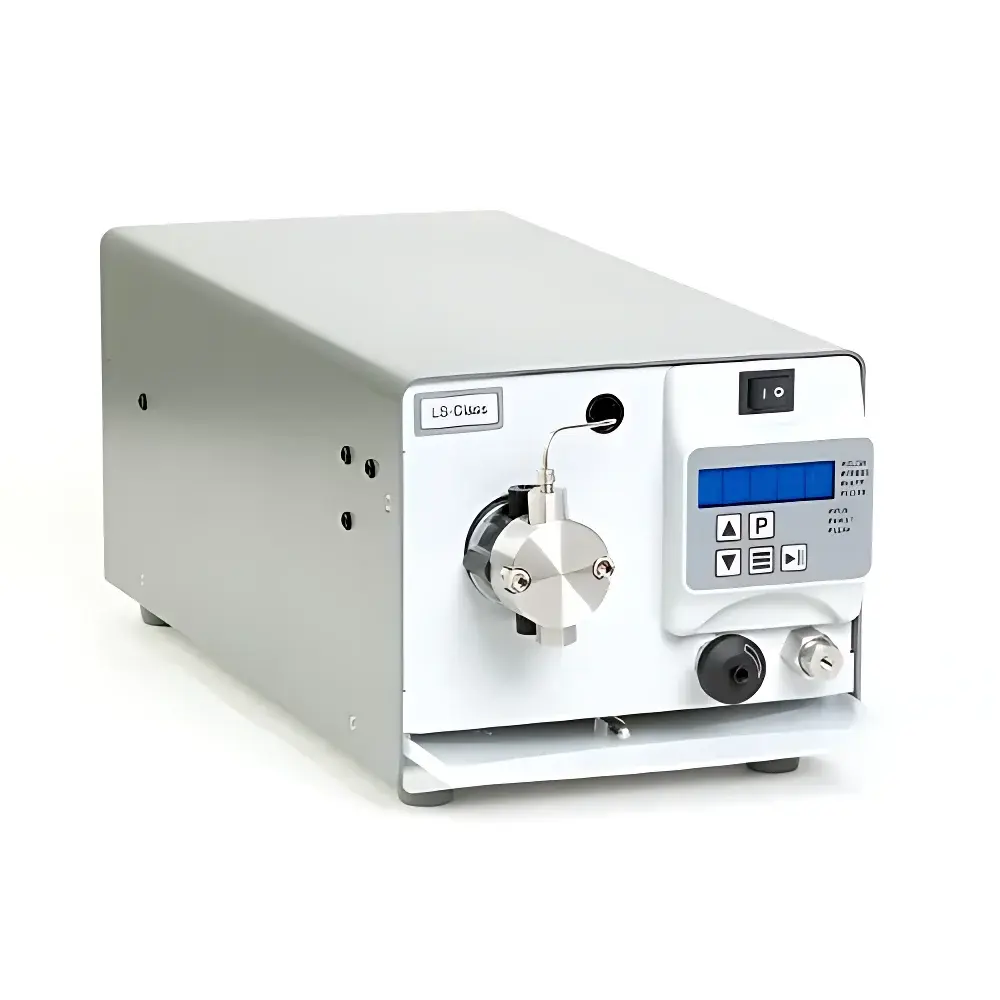
SSI LS Lite High-Pressure Constant Flow Pump LL010SFP1A
| Brand | SSI |
|---|---|
| Origin | Imported |
| Model | LL010SFP1A |
| Flow Rate | 0.00–10.00 mL/min (up to 6,000 psi |
| Pressure Rating | 6,000 psi |
| Flow Accuracy | <2% deviation (at ≥0.20 mL/min, 20% IPA/water, 1,000 psi) |
| Flow Precision | ≤0.2% RSD |
| Pulsation | ≤2% (at 1 mL/min, 1,000 psi) |
| Fluid Path Materials | Stainless Steel, PEEK, Sapphire, Ruby, UHMWPE, PTFE |
| Dimensions | 16.5 × 17.8 × 40.6 cm (H×W×D) |
| Weight | 6.9 kg |
| Power Input | 100–240 VAC ±10%, 50–60 Hz |
| Control Interface | Micro-USB, front-panel keypad with Run/Stop, integrated prime/purge valve, outlet filter, drip tray |
Overview
The SSI LS Lite High-Pressure Constant Flow Pump LL010SFP1A is a precision-engineered isocratic liquid delivery system designed for robust performance in routine high-performance liquid chromatography (HPLC), semi-preparative LC, and general laboratory fluid metering applications. Built upon a single-piston reciprocating architecture, the pump delivers stable, pulse-minimized flow through an integrated low-dead-volume pulse dampener and rapid refill mechanism—ensuring consistent volumetric displacement across its operational range. Its maximum pressure rating of 6,000 psi (414 bar) supports compatibility with sub-2 µm particle-packed columns and high-backpressure method conditions, while the dual-pressure fluid path configuration—6,000 psi for stainless steel and 5,000 psi for PEEK—enables flexible selection based on solvent compatibility and biocompatibility requirements. The pump operates without gradient capability, making it purpose-built for isocratic methods where flow stability, repeatability, and long-term reliability are prioritized over compositional modulation.
Key Features
- Single-piston design with optimized cam profile and ceramic-coated plunger for extended seal life and minimal wear under continuous operation
- Low-dead-volume passive pulse dampener delivering ≤2% pulsation at 1 mL/min and 1,000 psi—critical for baseline stability in UV and electrochemical detection
- Front-panel interactive keypad with intuitive menu navigation, real-time status display, and dedicated Run/Stop control
- Integrated prime/purge valve enabling rapid system priming, bubble removal, and solvent exchange without external tools or disassembly
- Standard outlet filter (0.5 µm) and removable drip tray for containment of minor leaks and maintenance of lab bench integrity
- Micro-USB interface supporting bidirectional communication for remote monitoring, firmware updates, and integration into automated workflows via host PC or PLC
- Fluid path constructed from chemically inert, USP Class VI-certified materials: 316 stainless steel, PEEK, sapphire, ruby, UHMWPE, and PTFE—validated for use with aggressive solvents (e.g., THF, DCM, strong acids/bases) and bioactive samples
Sample Compatibility & Compliance
The LL010SFP1A is validated for use with aqueous, organic, and mixed mobile phases common in reversed-phase, ion-exchange, and size-exclusion chromatography. Its PEEK-compatible pressure rating (5,000 psi) allows safe operation with bio-inert flow paths for protein, peptide, and oligonucleotide separations—meeting key requirements for GLP-compliant bioanalytical labs. While not certified to ISO/IEC 17025 or FDA 21 CFR Part 11 out-of-the-box, the pump’s deterministic control logic, non-volatile parameter storage, and USB audit trail capability support traceable operation when deployed within validated systems adhering to ASTM E2500, USP , and ICH Q2(R2) guidelines. All wetted materials comply with USP and cytotoxicity testing standards.
Software & Data Management
The pump operates autonomously via front-panel controls but also supports host-based supervision through a vendor-provided Windows-compatible configuration utility. This software enables parameter upload/download, real-time flow/pressure logging (sampled at 10 Hz), event timestamping (power-on, Run/Stop, error triggers), and export of CSV-formatted datasets for post-acquisition analysis. No proprietary drivers are required—standard CDC-class USB serial emulation ensures plug-and-play compatibility with LabVIEW, Python (pySerial), and MATLAB environments. Audit logs retain last 100 operational events with timestamps and error codes, satisfying basic ALCOA+ data integrity principles for non-GxP environments.
Applications
- Routine isocratic HPLC analysis of pharmaceutical actives, environmental contaminants, and food additives
- Semi-preparative purification of natural products and synthetic intermediates (≤10 mL/min, ≤6,000 psi)
- Calibration standard delivery in elemental analysis (ICP-OES, ICP-MS) and flow injection analysis (FIA)
- Controlled reagent dispensing in microfluidic assay development and enzymatic kinetic studies
- Mobile phase delivery in legacy HPLC systems lacking built-in pump control or requiring modular expansion
- Teaching laboratories requiring rugged, serviceable instrumentation for chromatography fundamentals instruction
FAQ
What is the minimum programmable flow rate?
The pump supports flow settings from 0.000 mL/min upward, with resolution of 0.001 mL/min in the 0.000–5.000 mL/min range and 0.01 mL/min from 5.00–10.00 mL/min.
Can this pump be used with tetrahydrofuran (THF) or chloroform?
Yes—stainless steel and sapphire/ruby components are compatible with THF; chloroform requires full PEEK fluid path configuration (model-dependent) and must remain below 5,000 psi.
Is firmware upgradable in the field?
Yes—micro-USB interface permits secure firmware updates using the official SSI configuration utility; version history and release notes are available via registered distributor portal.
Does the pump include pressure sensing or over-pressure protection?
No—LL010SFP1A is a constant-flow device without integrated pressure transduction or automatic shutdown; external pressure switches or system-level controllers are recommended for safety-critical deployments.
What maintenance intervals are recommended?
Plunger seals and check valves should be inspected every 6 months or after 500 hours of operation; replacement kits and torque specifications are documented in the OEM service manual (Revision D, 2023).



