
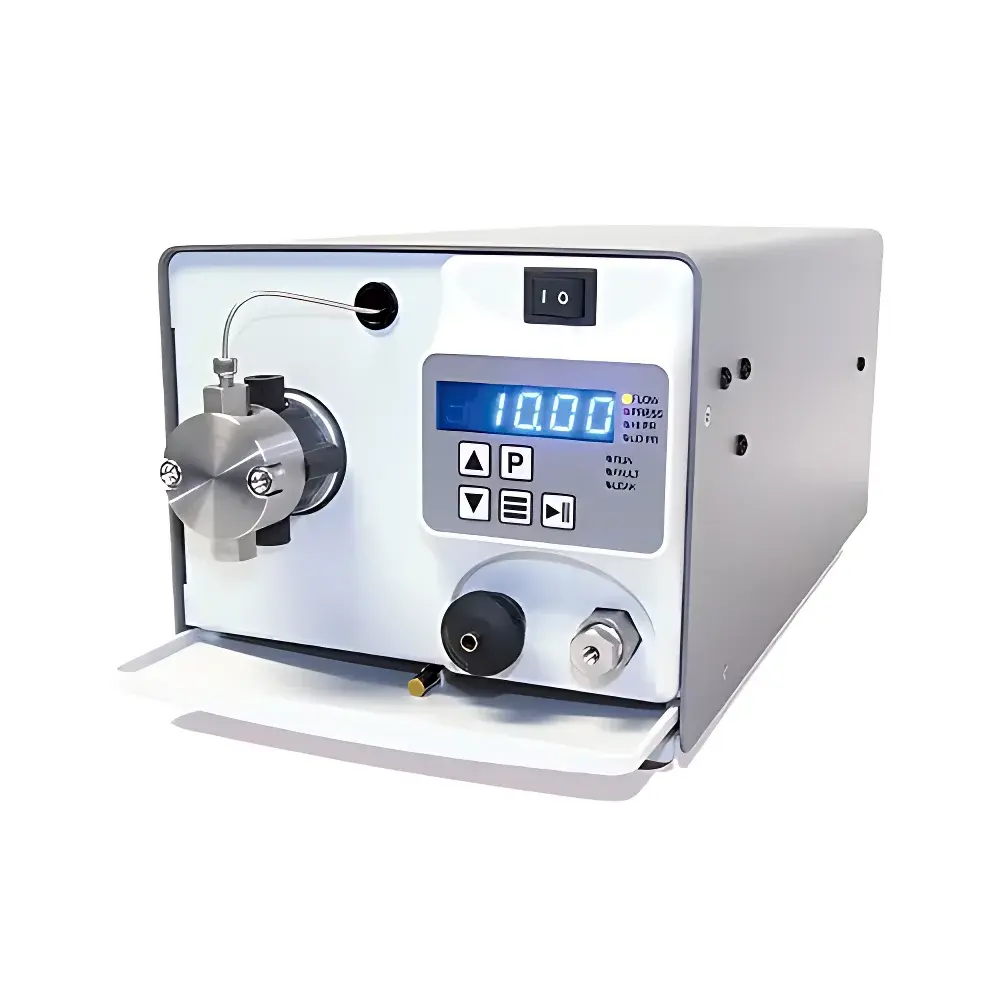
SSI LS010SFT1A High-Pressure Constant Flow Pump for HPLC and Precision Fluid Delivery
| Brand | SSI |
|---|---|
| Origin | Imported |
| Manufacturer Type | Authorized Distributor |
| Model | LS010SFT1A |
| Flow Rate | 0.00–10.00 mL/min |
| Maximum Pressure | 6,000 psi (414 bar) |
| Flow Accuracy | <2% at ≥0.20 mL/min (20% IPA/water, 1,000 psi) |
| Flow Precision | 0.2% RSD |
| Pulsation | ≤2% (1 mL/min, 1,000 psi, with pulse dampener) |
| Pressure Accuracy | ±2% FS |
| Fluid Path Materials | Stainless Steel, PEEK, optional Titanium, Sapphire, UHMWPE, PTFE |
| Dimensions | 16.5 × 17.8 × 40.6 cm (H × W × D) |
| Weight | 6.9 kg |
| Power Input | 100–240 VAC ±10%, 50–60 Hz |
| Control Interfaces | RS-232, Micro USB 2.0, Analog (0–10 V / 4–20 mA), Front Panel Keypad, Run/Stop Toggle |
Overview
The SSI LS010SFT1A is a high-performance, single-piston positive displacement pump engineered for precise, low-pulsation fluid delivery in demanding analytical and preparative applications. Based on proven cam-driven piston mechanics and micro-stepping motor control, it operates on the principle of volumetric displacement—ensuring consistent stroke volume per revolution independent of backpressure or fluid viscosity. This architecture delivers exceptional flow stability across its full operational range (0.00–10.00 mL/min) while maintaining pressure capability up to 6,000 psi (414 bar), making it suitable for ultra-high-pressure liquid chromatography (UHPLC), semi-preparative LC, solvent metering, and controlled reagent dispensing. Its design prioritizes mechanical robustness, long-term calibration retention, and compatibility with aggressive solvents and bioactive samples—supported by fluidic pathways constructed from chemically inert, USP Class VI-compliant materials including PEEK, 316 stainless steel, sapphire check valves, and optional titanium components.
Key Features
- Single-piston positive displacement mechanism with advanced cam profile for minimal flow pulsation (≤2% at 1 mL/min, 1,000 psi with integrated pulse dampener)
- Micro-stepping stepper motor control enabling fine-resolution flow programming and high positional repeatability
- Automatic pressure compensation to maintain set flow rate under variable system resistance
- Integrated Prime-Purge valve for rapid solvent exchange and air removal without disassembly
- Jacketed pump head option available for temperature-sensitive applications requiring thermal stabilization (e.g., viscous polymer solutions or crystallization studies)
- Dual digital control interfaces: RS-232 and Micro USB 2.0 for full remote operation, real-time status monitoring, and firmware updates
- Analog I/O support (0–10 V DC and 4–20 mA) for seamless integration into PLC-controlled or custom automation environments
- Front-panel interactive keypad with LCD display for local parameter adjustment and diagnostic feedback
Sample Compatibility & Compliance
The LS010SFT1A supports broad chemical compatibility through standardized fluid path configurations. Standard wetted materials meet ASTM F2136 and ISO 10993-5 cytotoxicity requirements, and are compatible with common HPLC solvents (acetonitrile, methanol, THF, aqueous buffers), halogenated organics, and moderately corrosive media. Optional titanium heads extend compatibility to chlorinated solvents and acidic/basic mobile phases used in ion chromatography or peptide purification. All models comply with CE marking directives (EMC 2014/30/EU, LVD 2014/35/EU) and are designed to support GLP/GMP workflows—featuring non-volatile memory for method storage, audit-trail-capable event logging (when paired with compliant software), and configurable password protection for critical parameters. While not FDA 21 CFR Part 11–certified out-of-the-box, the pump’s deterministic control architecture and deterministic communication protocols enable validation-ready integration into regulated environments.
Software & Data Management
The LS010SFT1A communicates via ASCII-based command sets over RS-232 or Micro USB, supporting bidirectional data exchange including real-time flow/pressure readings, error codes, motor status, and valve position. Third-party software platforms—including LabVIEW, MATLAB, Python (pySerial), and commercial chromatography data systems (CDS)—can interface directly using documented SCPI-like syntax. SSI provides a Windows-compatible configuration utility for firmware updates, calibration offset entry, and I/O mapping. For automated method execution, users may implement time-programmed flow gradients or pressure-triggered events via external scripting. All communication channels retain full traceability: timestamps, command origin (local vs. remote), and response acknowledgments are preserved in system logs when enabled through host software.
Applications
- High-resolution reversed-phase and HILIC separations in analytical and method development labs
- Semi-preparative purification of peptides, oligonucleotides, and natural products under elevated backpressures
- Controlled reagent delivery in flow chemistry reactors and continuous manufacturing modules
- Calibration and verification of mass flow meters and inline sensors
- Long-duration stability testing requiring uninterrupted flow over 72+ hours
- Environmental analysis workflows involving EPA Method 8081/8270-compliant extraction and injection sequences
FAQ
What is the minimum programmable flow rate?
The LS010SFT1A supports flow rates as low as 0.000 mL/min (standby), with stable delivery beginning at 0.001 mL/min under typical operating conditions.
Can this pump be used with aqueous sodium hydroxide solutions?
Yes—when equipped with the optional titanium pump head and sapphire/PTFE seals, it is compatible with ≤1 M NaOH at ambient temperatures; stainless steel variants are limited to ≤0.1 M NaOH.
Is analog control suitable for closed-loop pressure regulation?
No—the analog input accepts only flow setpoint commands (0–10 V = 0–10 mL/min); pressure feedback must be processed externally and translated into flow adjustments via host software.
Does the pump include built-in leak detection?
No—leak detection requires external pressure transducers or flow sensors integrated into the fluidic system; the pump reports only motor stall and overpressure fault conditions.
How often does the pump require recalibration?
Under normal use (≤8 h/day, non-abrasive solvents), factory calibration remains valid for 12 months; annual verification against gravimetric or certified flow standards is recommended for GxP applications.



