
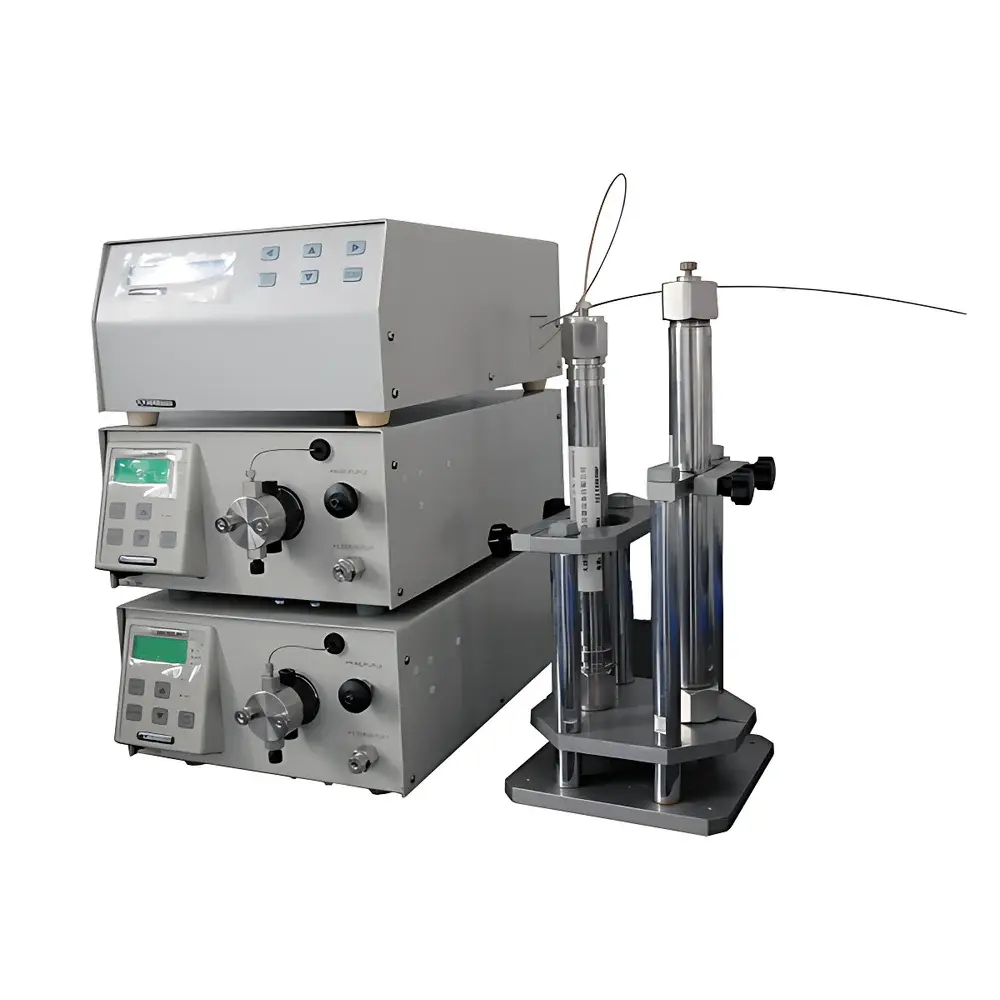
SSI PC-2000 Dual-Pump High-Pressure Analytical and Semi-Preparative Liquid Chromatography System
| Origin | USA |
|---|---|
| Manufacturer Type | Authorized Distributor |
| Origin Category | Imported |
| Model | PC-2000 |
| Instrument Type | Conventional High-Performance Liquid Chromatograph (HPLC) |
| Maximum Pressure | 6000 psi |
| Flow Rate Range | 0.01–19.98 mL/min |
| Gradient Accuracy | ±0.1% |
| Baseline Noise | 1 × 10⁻⁵ AU |
| Baseline Drift | 2 × 10⁻⁴ AU/hr |
| Detector | SSI Model 500 UV-Vis Variable Wavelength Detector |
Overview
The SSI PC-2000 is a dual-pump, high-pressure liquid chromatography system engineered for rigorous analytical quantification and semi-preparative fraction collection in research laboratories and quality control environments. Built upon SSI’s legacy as the world’s first and only dedicated manufacturer of liquid chromatography instrumentation, the PC-2000 implements true binary gradient delivery via two independently controllable high-pressure pumps—eliminating the need for low-pressure mixing manifolds and associated dwell volume variability. Its core architecture follows classical HPLC principles: solvent delivery under precise pressure regulation, sample introduction via fixed-loop or syringe-driven injection, separation on packed analytical or semi-preparative columns (typically 4.6 mm to 21.2 mm i.d.), and real-time detection using a variable-wavelength UV-Vis photometer. The system operates within ISO/IEC 17025-compliant workflows and supports method development aligned with ICH Q2(R2), USP , and ASTM D7913 standards for chromatographic validation.
Key Features
- True high-pressure binary gradient generation with independent pump control—enabling reproducible gradient delay times and minimal system dispersion.
- Flow rate programmability from 0.01 to 19.98 mL/min, supporting both narrow-bore analytical runs (e.g., 2.1 mm i.d. columns at ≤1 mL/min) and semi-preparative separations (e.g., 10–21.2 mm i.d. columns at 5–20 mL/min).
- Zero-dead-volume fluidic path design: all connections utilize stainless-steel zero-dead-volume fittings; no external degasser required due to integrated pulse-dampening and solvent saturation optimization.
- Modular architecture allows physical and operational decoupling into two independent HPLC units—each retaining full pressure, flow, and gradient capability for parallel method development or instrument redundancy.
- SSI Model 500 UV-Vis detector features rapid wavelength switching (≤100 ms), no warm-up requirement, and baseline stability validated per USP photometric accuracy protocols.
Sample Compatibility & Compliance
The PC-2000 accommodates a broad range of sample matrices—including small-molecule pharmaceuticals, natural product extracts, polymer additives, and environmental contaminants—when paired with reversed-phase (C18, C8), HILIC, or ion-exchange columns. It complies with FDA 21 CFR Part 11 requirements when configured with audit-trail-enabled chromatography data systems (CDS), and supports GLP/GMP documentation through electronic signature-capable software modules. All wetted parts are 316L stainless steel or PEEK, ensuring compatibility with aqueous, organic, and mildly corrosive mobile phases (pH 1.5–10.5). System qualification follows IQ/OQ/PQ protocols per ASTM E2500 and ISO 9001:2015 Annex A.2 guidance.
Software & Data Management
The system integrates with SSI ChromaLink™ workstation software—a Windows-based platform compliant with 21 CFR Part 11 Annex 11. It provides method editor with gradient programming, real-time chromatogram overlay, peak integration using tangent skim and valley-to-valley algorithms, and customizable report templates meeting ALCOA+ data integrity criteria. Raw data (.chd) files are stored in vendor-neutral format; export options include CSV, PDF, and XML for LIMS interfacing. Audit trails record all user actions—including parameter changes, sequence edits, and reprocessing events—with time-stamped, immutable entries.
Applications
- Pharmaceutical QC: Assay and related substances testing per USP monographs using isocratic or gradient elution.
- Natural products isolation: Fraction collection triggered by UV threshold or time windows for subsequent NMR or MS analysis.
- Polymer characterization: Gel permeation chromatography (GPC) mode with differential refractometry (optional RI detector support).
- Environmental analysis: PAHs, PCBs, and pesticide residue quantification in soil/water extracts following EPA Method 8330B.
- Method transfer: Seamless migration between analytical and semi-preparative scales due to consistent fluidic dynamics and column hardware interchangeability.
FAQ
Can the PC-2000 be used for GMP-regulated stability studies?
Yes—when deployed with 21 CFR Part 11-compliant software, electronic signatures, and documented IQ/OQ/PQ, it meets ICH Q5C and Q5E requirements for stability-indicating methods.
Is the Model 500 detector compatible with post-column derivatization?
Yes—the detector’s flow cell accepts standard 0.5 mm i.d. tubing; optional heated flow cells and low-diffusion connectors support derivatization reaction integration.
What maintenance intervals are recommended for the dual-pump module?
Piston seal replacement every 6 months under continuous operation; check valve cleaning every 200 hours; annual calibration of flow and pressure sensors per ASTM E2656.
Does the system support third-party detectors such as ELSD or ECD?
Yes—via analog voltage input (±1 V) and TTL trigger output; detector power and signal conditioning are externally supplied per manufacturer specifications.
How is gradient delay volume minimized in this architecture?
By eliminating low-pressure mixing chambers and using direct high-pressure blending upstream of the injector, the system achieves an effective dwell volume of ≤120 µL—critical for fast-gradient LC-MS method transfer.







