
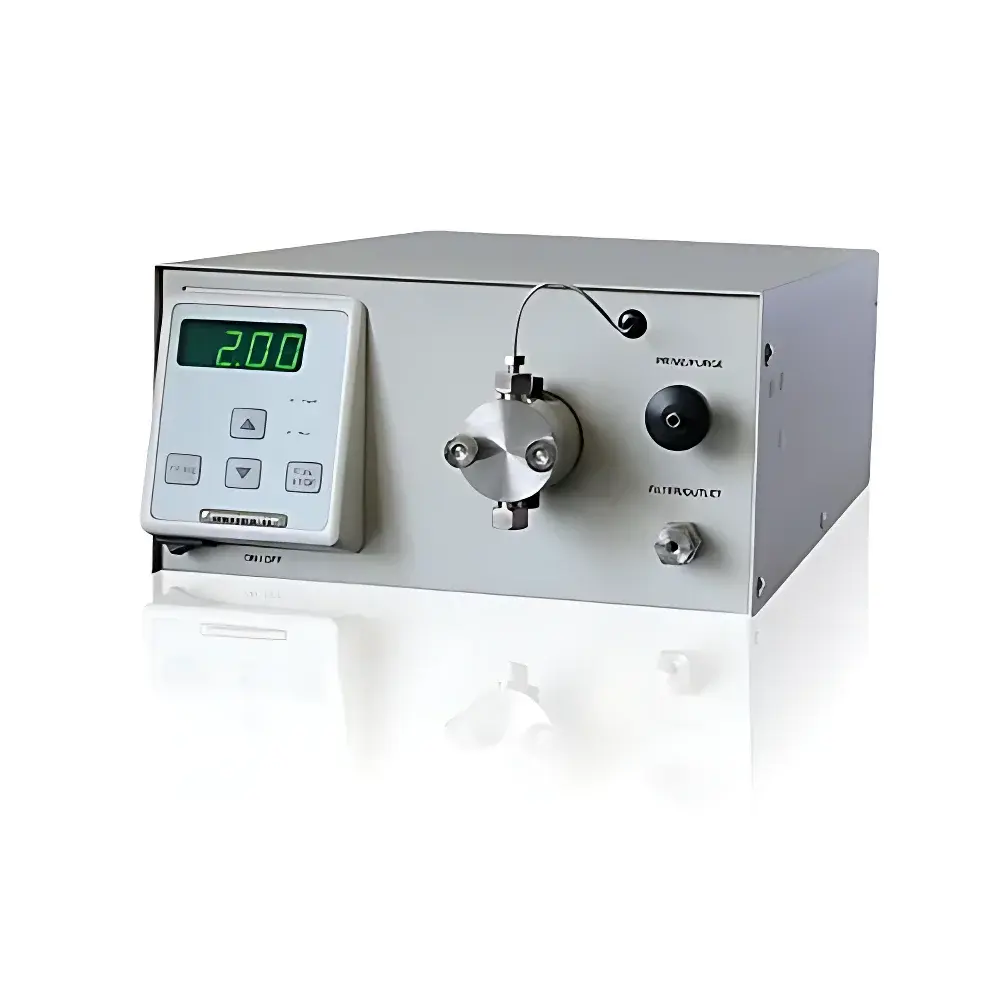
SSI Series II Constant Flow Piston Pump
| Brand | SSI |
|---|---|
| Origin | Imported |
| Manufacturer Type | Authorized Distributor |
| Model | Series II |
| Flow Ranges | 0.001–5 mL/min, 0.01–10 mL/min, or 0.1–40 mL/min |
| Maximum Pressure | 6000 psi (316 SS), 5000 psi (PEEK), 1500 psi (low-pressure configuration) |
| Accuracy | ±2% |
| Flow Precision | ≤0.2% RSD |
| Integrated Components | Pulse Dampener (low-dead-volume), Online Auto-Cleaning System, Internal Bypass Valve, RS232 Digital Interface |
| Fluid Path Materials | Selectable 316 Stainless Steel or PEEK (biocompatible) |
| Power Supply | 115 V / 230 V, 50 / 60 Hz |
| Dimensions | 140 H × 254 W × 432 D mm |
| Weight | 11 kg |
Overview
The SSI Series II Constant Flow Piston Pump is an engineered solution for precise, pulse-free solvent delivery in analytical and semi-preparative liquid chromatography systems. Based on a single-piston positive displacement architecture, it employs advanced fluidic design—including a low-dead-volume pulse dampener and rapid fill technology—to achieve stable, continuous flow without mechanical pulsation across its full operating range. Unlike dual-piston or diaphragm-based designs, the Series II leverages deterministic volumetric displacement with real-time pressure feedback to maintain flow integrity under variable backpressure conditions typical of packed-column separations. Its modular construction supports seamless integration into existing HPLC, UHPLC, and preparative LC platforms while meeting the operational demands of method development, QC testing, and GLP-compliant workflows.
Key Features
- Three selectable flow ranges—0.001–5 mL/min, 0.01–10 mL/min, and 0.1–40 mL/min—optimized for analytical sensitivity, method scalability, and preparative throughput.
- High-pressure capability up to 6000 psi with 316 stainless steel wetted parts; reduced maximum pressure (5000 psi) when configured with PEEK fluidic components for metal-sensitive applications including protein analysis, oligonucleotide purification, and ion chromatography.
- Integrated online auto-cleaning system positioned immediately downstream of the piston seal, utilizing mobile phase flow to flush particulate buildup during operation—reducing seal wear and extending service intervals.
- Tool-free seal replacement in under five minutes, enabled by a purpose-engineered compression geometry that eliminates torque-dependent assembly procedures.
- One-touch priming, purge, and degassing sequence—supporting both automated and manual fluid path conditioning for rapid mobile phase switching or system reconfiguration.
- Digital step-motor control ensures repeatable flow delivery with ≤0.2% RSD and ±2% absolute accuracy across all calibrated ranges, traceable to NIST-traceable volumetric standards.
Sample Compatibility & Compliance
The Series II pump accommodates a broad spectrum of solvents—including aqueous buffers, acetonitrile, methanol, THF, and aggressive acids/bases—when paired with appropriate wetted materials. PEEK fluid paths provide inertness for biomolecules and chelating agents, while 316 stainless steel ensures durability in high-salt or high-temperature environments. The pump complies with general laboratory safety requirements per IEC 61010-1 and supports audit-ready operation through configurable RS232 logging (flow, pressure, error codes). While not pre-certified for FDA 21 CFR Part 11, its digital interface enables integration with validated LIMS or CDS platforms supporting electronic signature and data integrity protocols required under GMP/GLP frameworks.
Software & Data Management
Control is facilitated via RS232 serial communication using ASCII command protocol, allowing direct integration with third-party chromatography data systems (CDS) such as Chromeleon, Empower, or OpenLab. The pump transmits real-time flow rate, pressure reading, status flags (e.g., “low solvent”, “seal alert”, “overpressure”), and event logs—including auto-clean cycle timestamps and priming sequence completion. No proprietary software is required; users may implement custom scripting (Python, LabVIEW) for remote scheduling, alarm escalation, or periodic calibration verification. All firmware updates are delivered as signed binary packages with version-controlled release notes.
Applications
- Analytical-scale reversed-phase, HILIC, and ion-exchange chromatography requiring sub-microliter precision and long-term baseline stability.
- Semi-preparative purification of peptides, monoclonal antibodies, and small-molecule APIs where gradient fidelity and inter-run reproducibility are critical.
- Method transfer between research, QC, and manufacturing labs due to consistent flow behavior independent of column dimensions or system dwell volume.
- Automated sample preparation workflows involving sequential solvent delivery, fraction collection triggering, or inline dilution modules.
- Environmental and food testing laboratories performing EPA, AOAC, or ISO-standardized extractions where regulatory traceability of pump performance is mandated.
FAQ
What flow ranges are available—and how do I select the correct one for my application?
The Series II offers three factory-configured flow modules. Choose 0.001–5 mL/min for capillary/nano-LC; 0.01–10 mL/min for standard analytical HPLC; and 0.1–40 mL/min for semi-prep or parallel purification setups. Each module uses dedicated piston geometry and drive electronics optimized for linearity and resolution within its range.
Can the pump operate continuously at maximum pressure?
Yes—rated continuous duty at 6000 psi (316 SS) or 5000 psi (PEEK) has been validated per ASTM F2102 accelerated life testing. Thermal management is passive; no active cooling is required under nominal ambient conditions (15–30°C).
Is the auto-cleaning solution compatible with organic solvents?
The cleaning reservoir is designed for aqueous solutions only (e.g., 10% isopropanol in water or dilute phosphoric acid). Organic-rich mobile phases must be purged from the pump head prior to initiating the cleaning cycle to prevent precipitation or seal swelling.
Does the pump support gradient mixing?
No—the Series II is a single-channel constant-flow device. Gradient formation requires external low-dead-volume mixing valves or a separate quaternary pump module; however, its timing accuracy and pressure stability make it ideal as the primary pumping engine in binary or ternary gradient architectures.
How often should the piston seal be replaced under normal use?
With weekly auto-clean cycles and proper mobile phase filtration (≤0.22 µm), typical seal lifetime exceeds 6 months at 4000 psi and 2 mL/min continuous operation. Seal wear is monitored via incremental pressure drift (>±50 psi over 24 h indicates replacement readiness).



