
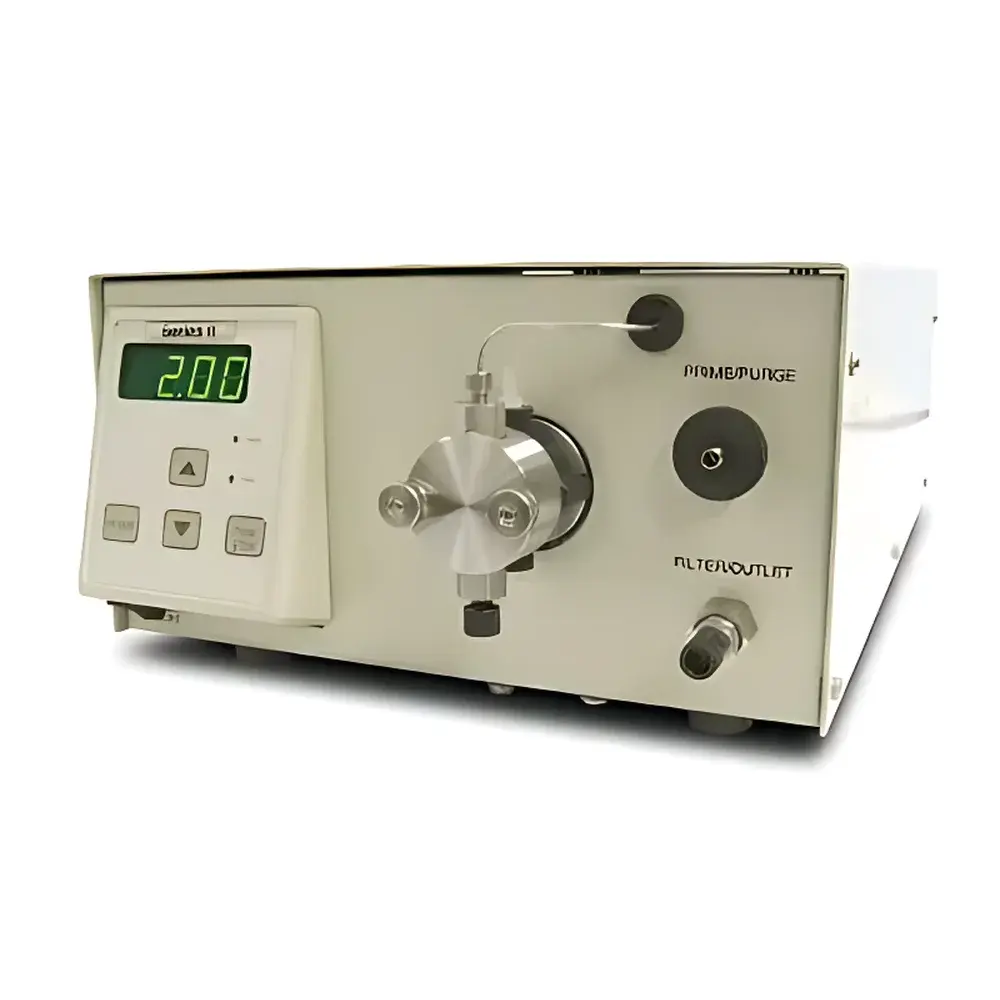
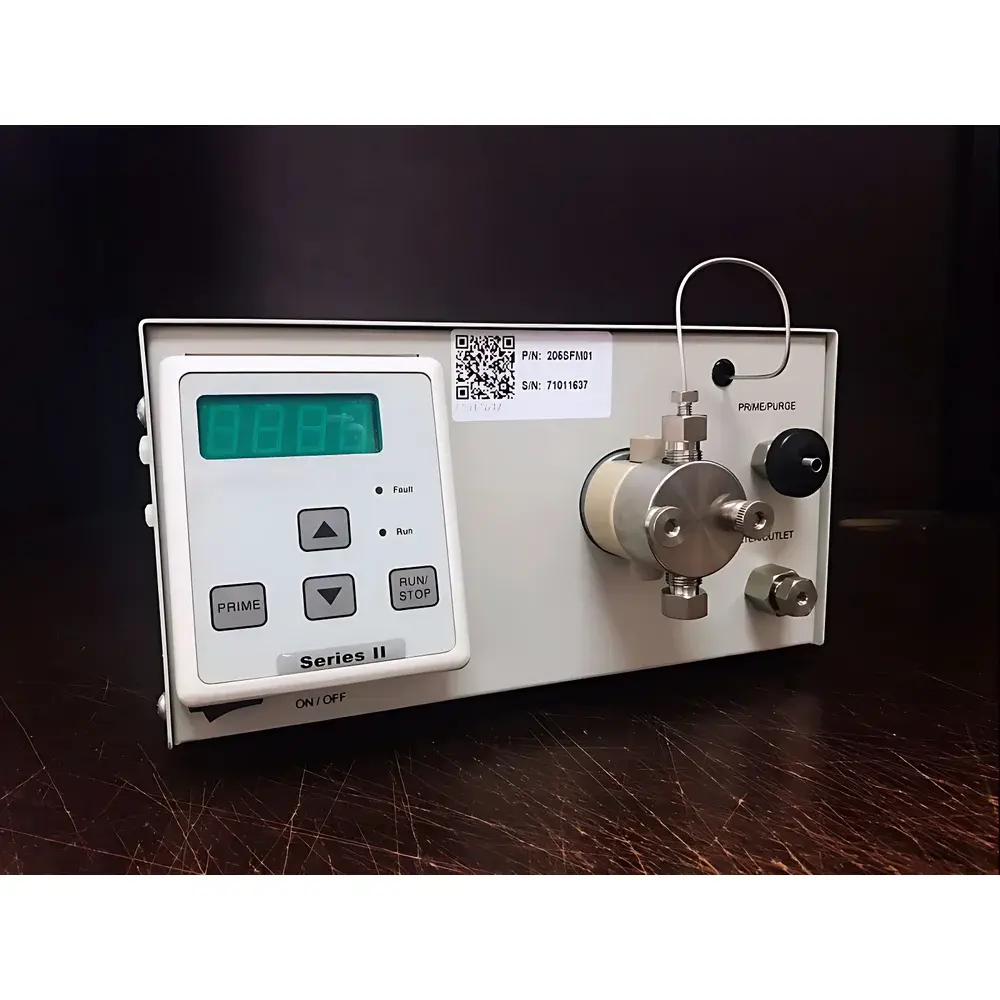
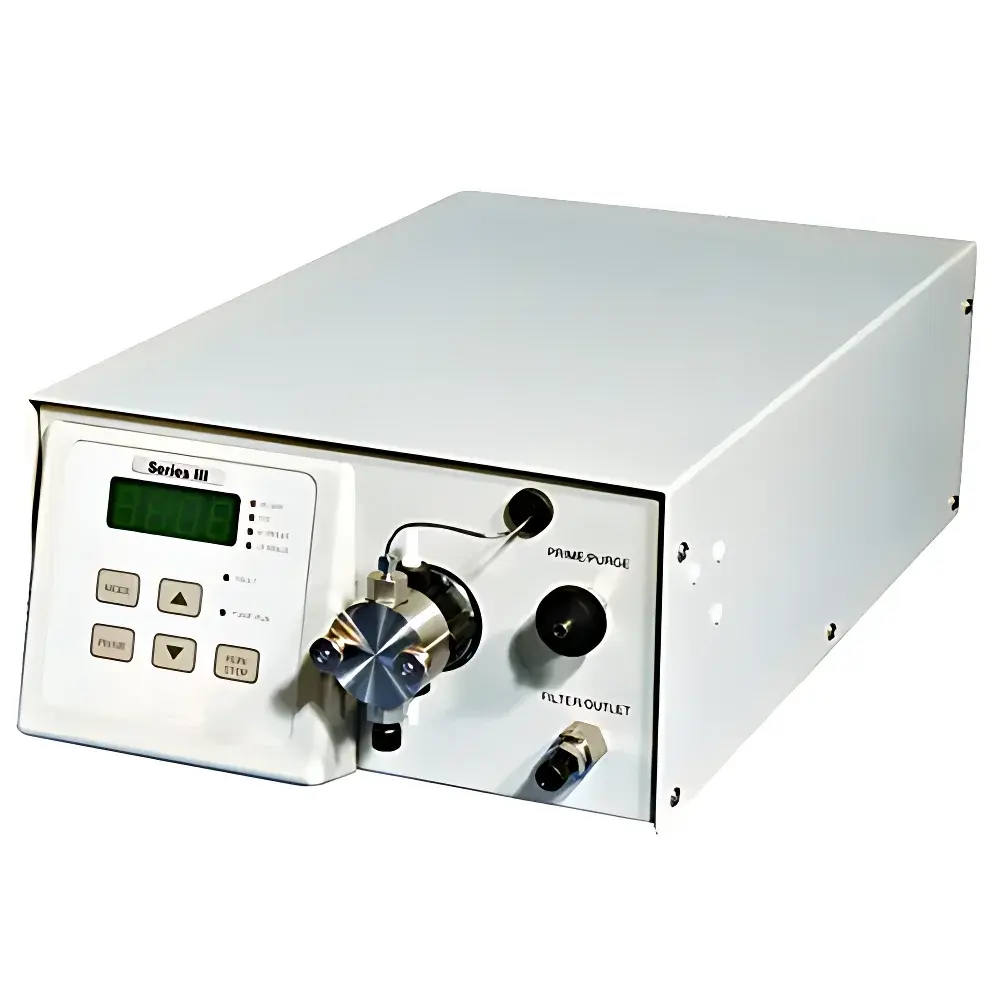
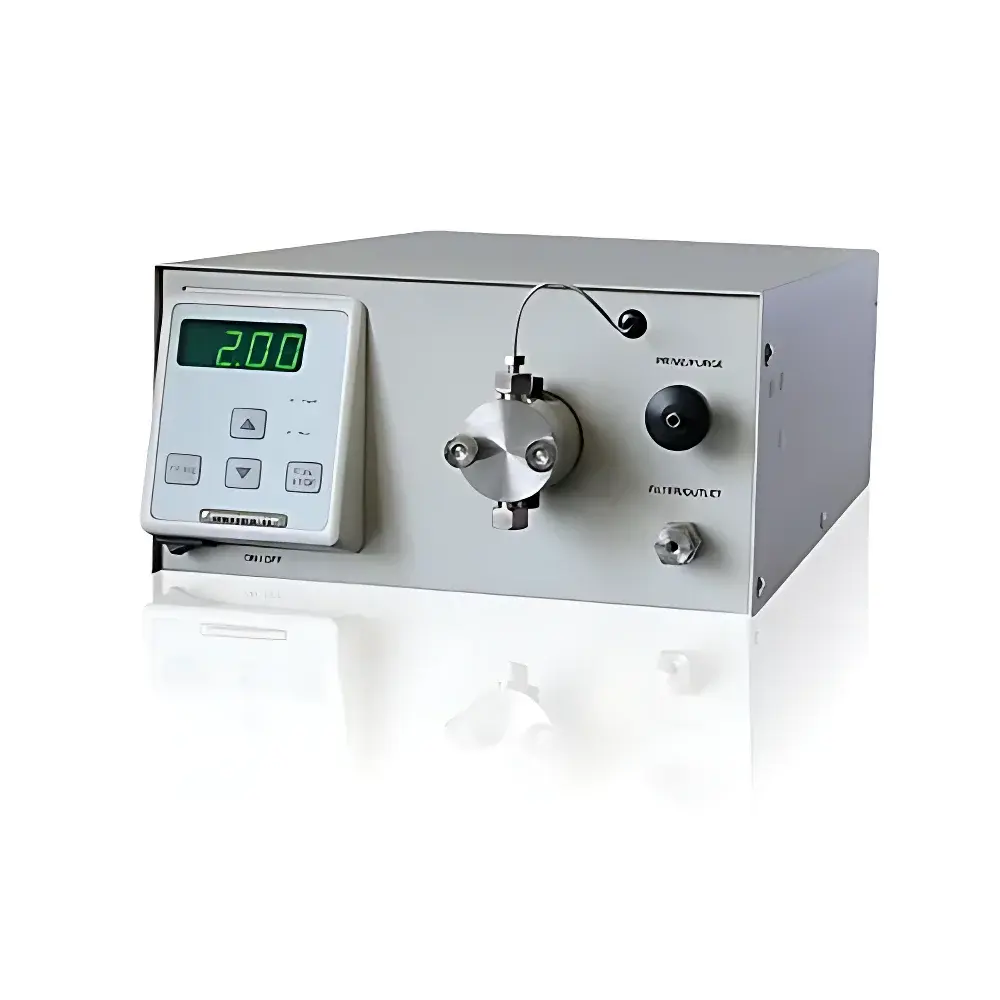
SSI Series II High-Pressure Liquid Chromatography Solvent Delivery Pump
| Brand | SSI |
|---|---|
| Flow Rate | 0.001–5 mL/min / 0.01–10 mL/min / 0.1–40 mL/min |
| Maximum Pressure | 6000 psi (316 SS) / 5000 psi (PEEK) |
| Accuracy | ±2% |
| Flow Precision | ≤0.2% RSD |
| Pulse Damping | Integrated low-dead-volume pulsation damper |
| Auto-Cleaning | On-column seal rinse with programmable solvent flush |
| Materials | 316 stainless steel or PEEK (biocompatible) |
| Communication | RS232 digital interface |
| Power | 115/230 V, 50/60 Hz |
| Dimensions | 140 H × 254 W × 432 D mm |
| Weight | 11 kg |
Overview
The SSI Series II High-Pressure Liquid Chromatography Solvent Delivery Pump is a precision-engineered constant-flow pumping system designed for analytical and semi-preparative HPLC applications. Built upon a single-piston positive displacement architecture, it delivers stable, pulse-free solvent flow across three selectable flow ranges—0.001–5 mL/min, 0.01–10 mL/min, and 0.1–40 mL/min—enabling method scalability from trace-level analysis to milligram-scale purification. Its operation relies on microstepping motor control coupled with real-time pressure feedback, ensuring consistent volumetric delivery under variable backpressure conditions up to 6000 psi (with 316 stainless steel fluidic path) or 5000 psi (with PEEK). The integrated low-dead-volume pulsation damper eliminates flow oscillations without compromising response time, critical for baseline stability in UV, fluorescence, and mass spectrometric detection. Designed for compatibility with ISO 9001-certified manufacturing practices and aligned with GLP/GMP operational expectations, the Series II pump supports traceable, auditable performance in regulated environments.
Key Features
- Three user-selectable flow ranges optimized for analytical, method development, and semi-preparative workflows
- On-the-fly automatic column seal rinsing using mobile phase—activated during idle periods or post-run, reducing seal wear and extending service intervals
- Tool-free seal replacement in under five minutes, minimizing instrument downtime and technician training requirements
- Dual-material fluidic path options: electropolished 316 stainless steel for general organic/aqueous applications or inert PEEK for metal-sensitive biomolecules, chelating agents, or high-pH mobile phases
- One-touch priming, degassing, and solvent changeover via integrated purge/flush protocol—eliminating manual syringe priming or repeated valve actuation
- RS232 digital communication interface supporting remote parameter setting, status monitoring, and event logging compatible with LIMS and chromatography data systems (CDS)
Sample Compatibility & Compliance
The Series II pump accommodates a broad spectrum of HPLC-compatible solvents—including acetonitrile, methanol, water, tetrahydrofuran, and buffered aqueous systems—without degradation of wetted components. PEEK configurations meet USP Class VI biocompatibility requirements and resist corrosion from acidic (pH ≥2) and basic (pH ≤12) mobile phases. The pump’s mechanical design conforms to IEC 61010-1 safety standards for laboratory equipment. When operated within validated methods, its ≤0.2% RSD flow precision satisfies ASTM E2687 and ISO 13877 criteria for quantitative HPLC system suitability. Audit trail functionality (via external CDS integration) supports compliance with FDA 21 CFR Part 11 for electronic records and signatures in pharmaceutical QC laboratories.
Software & Data Management
While the Series II operates as a standalone instrument with front-panel controls, its RS232 interface enables bidirectional communication with third-party chromatography software (e.g., Chromeleon, Empower, OpenLab CDS). Users can configure flow rate, pressure limits, purge cycles, and auto-clean schedules remotely. All operational events—including pressure excursions, seal rinse triggers, and power-on resets—are timestamped and exportable as CSV logs. No proprietary software installation is required; configuration is managed via ASCII command protocol documented in the technical manual. For labs requiring electronic record integrity, the pump’s deterministic behavior and repeatable setpoint execution support ALCOA+ principles (Attributable, Legible, Contemporaneous, Original, Accurate, Complete, Consistent, Enduring, Available) when paired with compliant CDS platforms.
Applications
- Routine QC testing of pharmaceutical actives and excipients per USP and EP 2.2.46
- Stability-indicating assays involving gradient elution and low-wavelength UV detection
- Peptide mapping and monoclonal antibody characterization under denaturing conditions
- Environmental analysis of pesticides and PAHs using reversed-phase C18 columns
- Method transfer between analytical and semi-preparative systems due to identical fluidic dynamics and pressure response profiles
- Integration into automated sample-to-report workflows where pump reliability directly impacts throughput and data continuity
FAQ
What flow ranges are supported, and how are they selected?
Three fixed flow modules are available: 0.001–5 mL/min (analytical), 0.01–10 mL/min (versatile method development), and 0.1–40 mL/min (semi-preparative). Selection is hardware-based—users install the appropriate piston assembly and corresponding firmware calibration file.
Does the pump support gradient mixing?
No—the Series II is a single-channel isocratic pump. Gradient capability requires integration with an external low-pressure or high-pressure mixing module (e.g., SSI GP-100 or compatible third-party quaternary manifold).
How often must the auto-clean solution be replaced?
The reservoir for the on-column seal rinse solution (typically deionized water) should be refreshed weekly to prevent microbial growth or particulate accumulation.
Is PEEK construction suitable for 100% TFA or HFBA mobile phases?
Yes—PEEK exhibits excellent resistance to trifluoroacetic acid (TFA) and heptafluorobutyric acid (HFBA) at typical HPLC concentrations (0.05–0.1%), making it ideal for peptide separations.
Can the pump be integrated into a 21 CFR Part 11-compliant workflow?
Yes—when controlled via validated CDS software with electronic signature, audit trail, and role-based access, the Series II meets predicate rule requirements for instrument-generated data in regulated environments.
Related Products



