
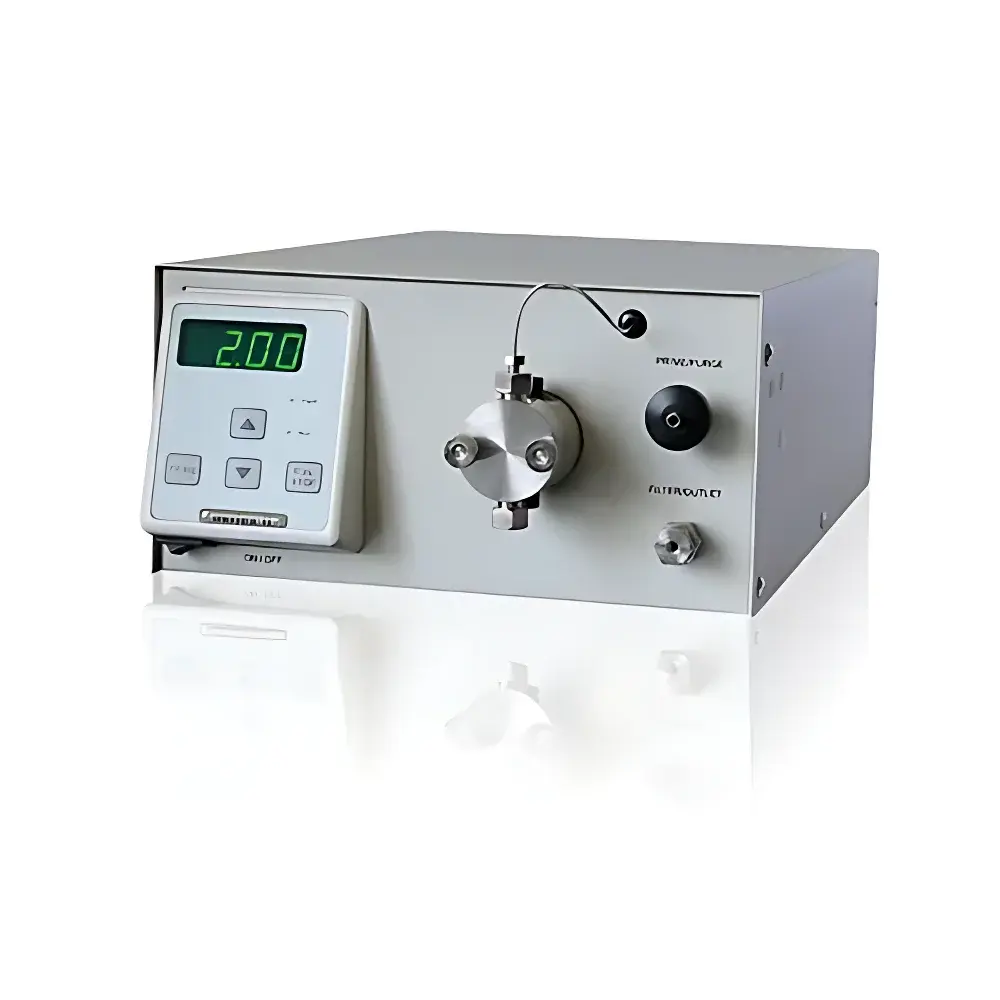
SSI Series II High-Pressure Precision Metering Pump
| Brand | SSI |
|---|---|
| Origin | Imported |
| Manufacturer Type | Authorized Distributor |
| Model | Series II |
| Flow Range | 0.001–5 mL/min, 0.01–10 mL/min, or 0.1–40 mL/min |
| Maximum Pressure | 6000 psi (316 SS), 5000 psi (PEEK), 1500 psi (low-pressure configuration) |
| Accuracy | ±2% |
| Flow Precision | ≤0.2% RSD |
| Pulsation Damping | Integrated low-dead-volume pulsation damper |
| Auto-Cleaning System | On-column solvent-driven self-cleaning mechanism with weekly aqueous solution refresh |
| Seal Replacement | Tool-free, <5-minute procedure |
| Flow Path Materials | Selectable 316 stainless steel or PEEK (biocompatible, metal-free) |
| Communication Interface | RS232 digital output, analog voltage/frequency input |
| Dimensions | 140 H × 254 W × 432 D mm |
| Weight | 11 kg |
| Power Supply | 115 V / 230 V, 50 / 60 Hz |
| Built-in Features | Internal bypass valve, integrated pulse damper, automatic priming/deaeration function |
Overview
The SSI Series II High-Pressure Precision Metering Pump is an engineered solution for demanding liquid delivery applications in analytical chemistry, preparative chromatography, and continuous-flow reaction systems. Based on a single-piston positive displacement architecture, it delivers stable, pulse-free flow through proprietary rapid-fill technology and a low-dead-volume pulsation damper—eliminating flow irregularities inherent to conventional reciprocating pumps. Its pressure capability spans up to 6000 psi when constructed with 316 stainless steel fluidic components, while the PEEK-based configuration supports up to 5000 psi and ensures compatibility with aggressive solvents, biological buffers, and metal-sensitive assays. Designed for integration into both new and legacy instrumentation platforms, the Series II maintains full mechanical and electronic interoperability with standard HPLC, UHPLC, and process-scale fluidic systems without requiring adapter kits or firmware modifications.
Key Features
- Three selectable flow ranges: 0.001–5 mL/min (ultra-low flow for microfluidic and capillary applications), 0.01–10 mL/min (standard analytical scale), and 0.1–40 mL/min (semi-preparative throughput)
- Tool-free seal replacement in under five minutes—no disassembly of pump head or recalibration required
- Integrated, solvent-driven auto-cleaning system positioned immediately downstream of the piston seal; activated by mobile phase flow during operation and refreshed weekly with deionized water
- Dual-material fluid path option: electropolished 316 stainless steel for high-pressure robustness or inert, biocompatible PEEK for trace-metal-free and protein-friendly workflows
- Onboard digital stepping motor control ensures repeatable flow delivery with ≤0.2% RSD across all operating conditions and long-term stability verified per ISO 5725-2 precision protocols
- One-touch automated priming, degassing, and solvent exchange—reducing operator intervention and minimizing system downtime between method changes
Sample Compatibility & Compliance
The Series II accommodates a broad chemical compatibility profile: compatible with aqueous buffers, organic solvents (acetonitrile, methanol, THF), corrosive acids (TFA, HCl), and base-sensitive reagents when configured with PEEK wetted parts. All models comply with CE marking requirements for electromagnetic compatibility (EMC Directive 2014/30/EU) and low-voltage safety (LVD Directive 2014/35/EU). The RS232 interface supports audit-trail-capable data logging when integrated with LIMS or chromatography data systems compliant with FDA 21 CFR Part 11. Mechanical design adheres to ISO 13849-1 for functional safety in laboratory automation environments, and fluidic components meet USP Class VI biocompatibility standards where PEEK is specified.
Software & Data Management
The pump operates as a standalone instrument or integrates seamlessly via RS232 serial communication into third-party control environments—including Agilent ChemStation, Waters Empower, Thermo Chromeleon, and custom LabVIEW or Python-based DAQ systems. Analog inputs (0–5 V or 0–10 V) allow real-time flow rate modulation from external sensors or feedback loops, enabling closed-loop reaction control. Firmware supports non-volatile parameter storage (flow setpoint, pressure limit, purge duration) and retains configuration across power cycles. Event logs—including seal usage time, cleaning cycle timestamps, and overpressure fault history—are timestamped and exportable for GLP/GMP documentation.
Applications
- Analytical and semi-preparative HPLC/UHPLC where precise, low-pulsation eluent delivery is critical to baseline stability and peak resolution
- Continuous-flow synthesis reactors requiring stoichiometric reagent metering at sub-mL/min rates
- Electrochemical detection systems sensitive to hydraulic noise and backpressure fluctuations
- LC-MS interfaces demanding ultra-low flow consistency and minimal carryover between injections
- Quality control laboratories performing USP <621> method validation, where flow accuracy and repeatability are assessed per ICH Q2(R2) guidelines
- Academic research in polymer characterization, nanoparticle formulation, and enzymatic kinetics where solvent compatibility and trace-metal neutrality are essential
FAQ
Can the Series II replace older SSI or third-party HPLC pumps without hardware modification?
Yes—the mounting footprint, tubing port layout, and electrical interface are fully backward-compatible with prior SSI generations and conform to industry-standard DIN 32300 mechanical dimensions.
Is remote monitoring and control supported over Ethernet or USB?
Native communication is RS232 only; however, commercially available RS232-to-Ethernet or RS232-to-USB converters maintain full command fidelity and are widely deployed in regulated environments.
What maintenance schedule is recommended for the auto-cleaning system?
The cleaning reservoir requires replenishment with deionized water once per week; no consumables or filters are involved.
Does the pump support gradient formation when used with multiple units?
While the Series II itself does not generate gradients, two or more synchronized units can be externally coordinated via TTL triggers or analog voltage signals to implement binary or ternary solvent blending.
Are calibration certificates traceable to NIST or other national metrology institutes available?
Factory calibration reports include uncertainty budgets traceable to NIST-certified flow standards; optional UKAS-accredited calibration is available upon request.



