
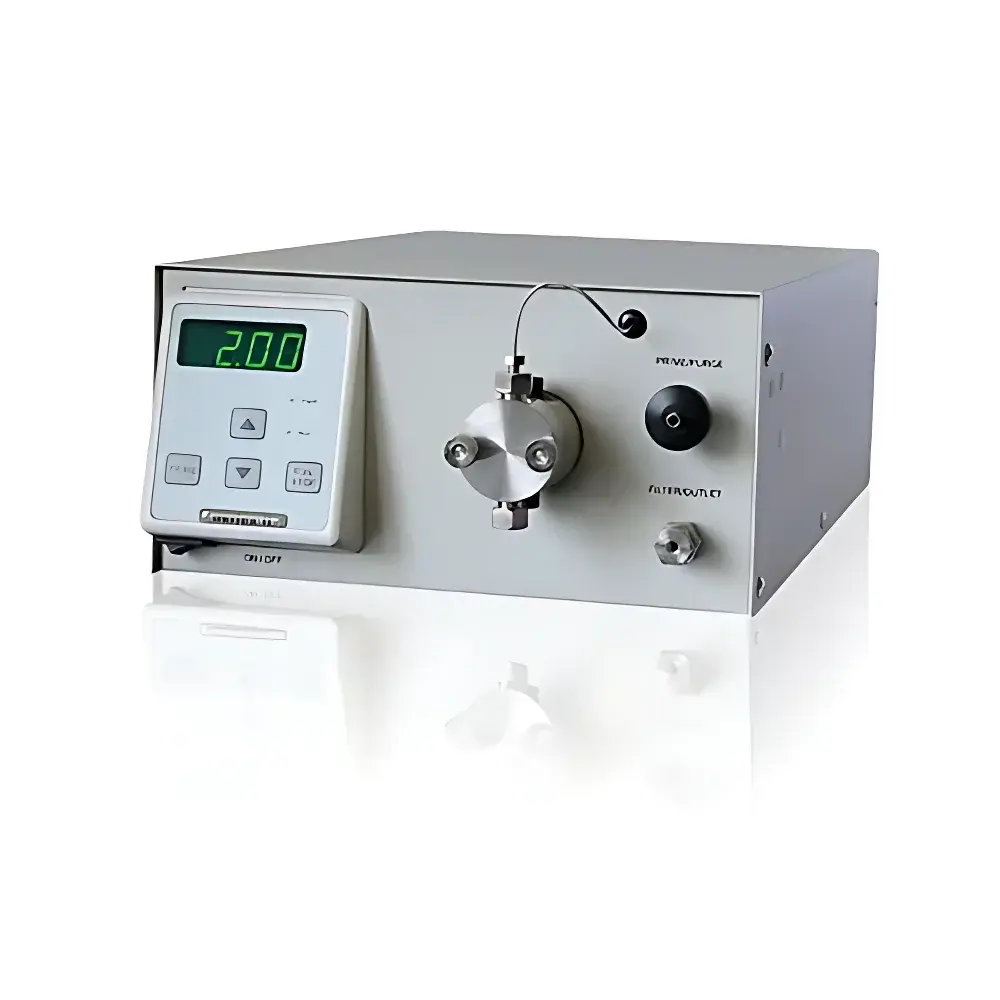
SSI Series II High-Pressure Solvent Delivery Pump
| Brand | SSI |
|---|---|
| Model | Series II |
| Flow Range | 0.001–5 mL/min, 0.01–10 mL/min, or 0.1–40 mL/min |
| Maximum Pressure | 6000 psi (316 stainless steel), 5000 psi (PEEK), 1500 psi (low-pressure configuration) |
| Accuracy | ±2% |
| Flow Precision | ≤0.2% RSD |
| Pulse Damping | Integrated low-dead-volume pulsation damper |
| Auto-Cleaning System | On-column solvent-driven self-cleaning module with weekly aqueous solution refresh |
| Seal Replacement | Tool-free, <5-minute procedure |
| Flow Path Materials | Selectable 316 stainless steel or PEEK (biocompatible) |
| Remote Control Interface | Analog voltage input, frequency input, RS232 serial communication |
| Dimensions | 140 H × 254 W × 432 D mm |
| Weight | 11 kg |
| Power Supply | 115 V / 230 V, 50 / 60 Hz |
Overview
The SSI Series II High-Pressure Solvent Delivery Pump is a precision-engineered constant-flow pump designed for demanding liquid chromatography applications—including analytical HPLC, semi-preparative LC, and method development workflows requiring stable, pulse-free solvent delivery. Based on a single-plunger positive-displacement architecture, the Series II leverages advanced fluidic design principles to minimize flow perturbation: its integrated low-dead-volume pulsation damper and rapid-fill priming mechanism ensure continuous laminar flow across the full operational range, eliminating pressure transients that compromise detector baseline stability and peak shape fidelity. Unlike multi-plunger systems, this design reduces mechanical complexity while maintaining high reproducibility—critical for gradient elution, method transfer, and long-duration runs under GLP-compliant environments.
Key Features
- Three selectable flow ranges (0.001–5 mL/min, 0.01–10 mL/min, 0.1–40 mL/min) accommodate diverse column geometries—from capillary and microbore to standard-bore and semi-prep configurations.
- Pressure capability up to 6000 psi with 316 stainless steel wetted parts, or 5000 psi with chemically inert, biocompatible PEEK fluid paths—enabling compatibility with aggressive solvents (e.g., TFA, HFIP) and biological samples.
- On-axis, solvent-driven auto-cleaning system positioned immediately downstream of the plunger seal; utilizes mobile phase flow to flush particulate and precipitate buildup—extending seal life and reducing unscheduled downtime.
- Tool-free plunger seal replacement in under five minutes—no torque wrenches or alignment fixtures required—minimizing maintenance labor and technician training burden.
- One-touch purge/fill/degas functionality supports rapid mobile-phase switching without manual syringe priming or repeated venting cycles—enhancing lab throughput during method scouting or multi-solvent sequences.
- Digital stepper motor control ensures consistent torque delivery and eliminates drift associated with analog motor drivers, contributing to long-term flow stability and inter-instrument comparability.
Sample Compatibility & Compliance
The Series II pump accommodates a broad spectrum of solvents and sample matrices, including aqueous buffers, organic modifiers (acetonitrile, methanol), corrosive additives (0.1% phosphoric acid, 0.1% trifluoroacetic acid), and viscous mobile phases (e.g., >40% glycerol/water). Its PEEK fluidic path option meets USP Class VI biocompatibility requirements and is suitable for peptide, protein, and oligonucleotide separations where metal ion leaching must be avoided. The pump’s pressure and flow specifications conform to ASTM D3764 (HPLC system performance verification) and support compliance with FDA 21 CFR Part 11 when operated within validated software environments. Internal bypass valves and pressure-limiting firmware safeguards protect columns and detectors from overpressure events—aligning with ISO/IEC 17025 risk management expectations for accredited testing laboratories.
Software & Data Management
RS232 serial interface enables bidirectional communication with third-party chromatography data systems (CDS), including Empower, Chromeleon, and OpenLab CDS. Analog voltage (0–10 V) and frequency inputs allow integration into custom automation platforms or PLC-controlled process lines. All operational parameters—including setpoint flow rate, pressure limit, purge duration, and auto-clean cycle status—are accessible via ASCII command protocol. Audit-trail-capable CDS implementations can log pump start/stop timestamps, pressure excursions (>95% of max), and seal replacement events—supporting GMP traceability requirements. Firmware supports user-defined calibration tables for solvent compressibility compensation, improving accuracy across mixed-mode gradients.
Applications
- Analytical-scale reversed-phase, HILIC, and ion-pair chromatography of pharmaceutical actives and impurities per ICH Q2(R2) validation guidelines.
- Semi-preparative purification of natural products and synthetic intermediates at flow rates up to 40 mL/min with column IDs ≥10 mm.
- Method development for 2D-LC and heart-cutting LC–LC workflows requiring precise, synchronized flow control between dimensions.
- Long-term stability testing of formulations using isocratic elution over 72+ hour runs—leveraging low RSD and minimal seal wear.
- Integration into regulated QC labs performing compendial assays (USP , EP 2.2.46) where pump performance documentation is part of equipment qualification (IQ/OQ/PQ).
FAQ
What flow ranges are available—and how do I select the appropriate one for my application?
The Series II offers three factory-configured flow modules: ultra-low (0.001–5 mL/min) for capillary/nano-LC, mid-range (0.01–10 mL/min) for standard analytical columns (4.6 mm ID), and high-flow (0.1–40 mL/min) for semi-prep and screening applications. Selection depends primarily on column internal diameter and desired linear velocity—not method type alone.
Can the Series II replace my existing HPLC pump without hardware modification?
Yes—the Series II features standardized 1/4-28 UNF inlet/outlet ports, DIN 32983 mounting footprint, and compatible electrical connectors. It functions as a drop-in replacement for most legacy pumps from Waters, Shimadzu, and Agilent—no adapter kits or plumbing rework required.
How often must the auto-cleaning solution be replaced—and what solution is recommended?
The reservoir requires replenishment with deionized water once per week under normal operation. For high-salt or phosphate-buffered mobile phases, daily refresh with 10% methanol/water is advised to prevent crystallization in the cleaning channel.
Is remote monitoring of pump status possible via network protocols?
While native Ethernet or USB is not supported, RS232 output can be bridged to TCP/IP via industrial serial servers (e.g., Moxa NPort), enabling real-time pressure/flow telemetry in SCADA or LabVantage environments.
Does the pump support gradient delay volume minimization?
Yes—its low internal dwell volume (<150 µL, excluding mixer) and direct-drive plunger design reduce gradient lag relative to dual-piston systems, facilitating faster method development and improved resolution in shallow gradients.



