
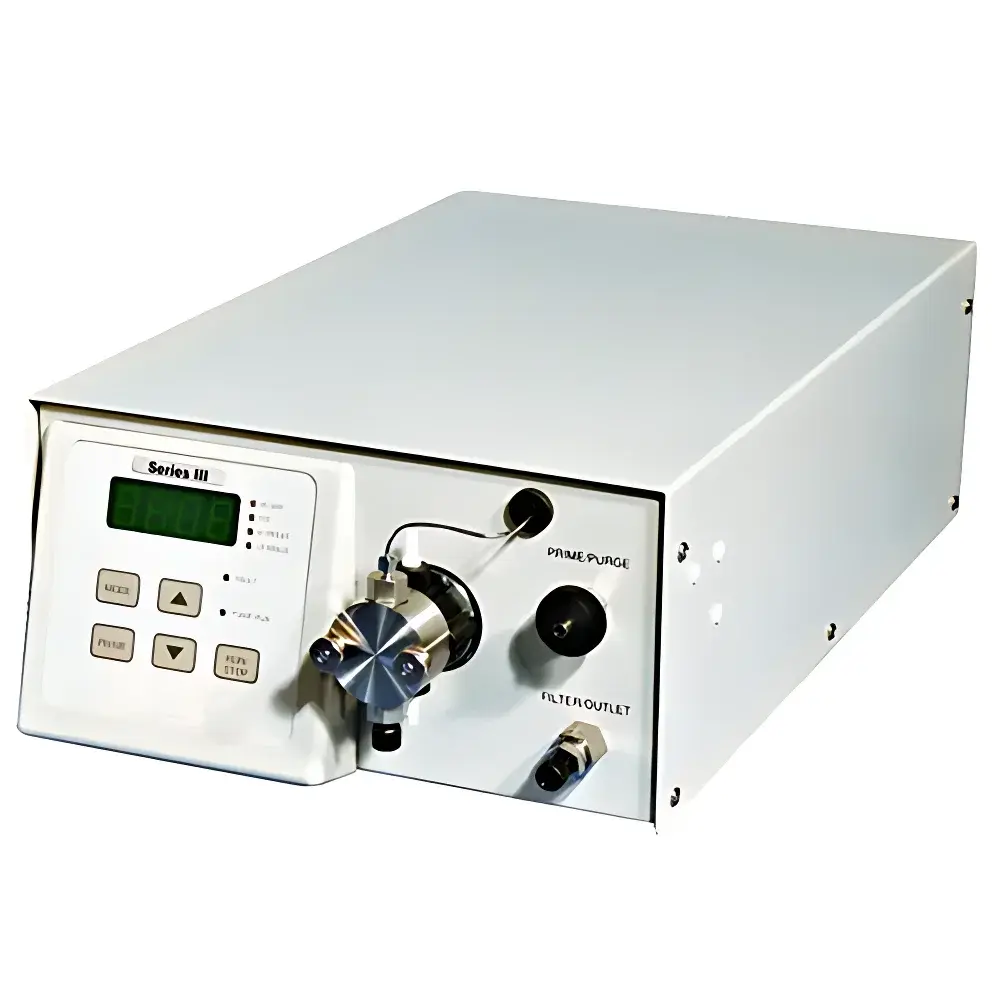
SSI Series III High-Pressure Syringe Pump
| Key | Brand: SSI |
|---|---|
| Model | Series III |
| Flow Rate | 0.1–40 mL/min |
| Maximum Pressure | 1500 psi |
| Accuracy | ±2% |
| Flow Precision | 0.2% RSD |
| Display | LED (flow rate & pressure) |
| Pressure Sensor | Built-in |
| Pulse Damping | Diaphragm-type low-volume damper |
| Self-Cleaning | On-line pump head flush |
| Control Interface | Keypad + RS232 |
| Remote Input | Frequency & voltage analog signals |
| Wetted Materials | PEEK or 316L stainless steel |
| Dimensions | 140 H × 254 W × 432 D mm |
| Weight | 11 kg |
| Power | 115/230 V, 50/60 Hz |
Overview
The SSI Series III High-Pressure Syringe Pump is a precision-engineered constant-flow liquid delivery system designed for demanding analytical and preparative applications requiring stable, pulse-free flow under elevated backpressure. Based on positive displacement plunger pump architecture, it operates via microstepping motor-driven cam mechanisms that translate rotational motion into highly repeatable linear displacement of dual stainless-steel plungers. This mechanical design—combined with an integrated diaphragm-type pulse damper and internal fast-fill cam profile—ensures minimal baseline noise (<0.1% pressure ripple) and exceptional flow stability across its full operating range (0.1–40 mL/min). Unlike peristaltic or gear-based alternatives, the Series III delivers true laminar, non-pulsating flow essential for high-resolution chromatography, kinetic reaction studies, and microfluidic interfacing. Its robust construction, chemically resistant fluid path options (PEEK or 316L SS), and real-time pressure monitoring support operation in aggressive solvent environments—including acetonitrile, THF, chlorinated hydrocarbons, and aqueous buffers—without degradation of performance or seal integrity.
Key Features
- Integrated high-sensitivity pressure transducer with real-time LED display of instantaneous pressure and setpoint limits (high/low)
- Dual-plunger syringe drive mechanism with optimized cam geometry for rapid priming and reduced dwell time between strokes
- On-line self-cleaning function activated via dedicated front-panel key—enables automatic solvent flush of pump head without disassembly
- Modular pump head design with tool-free replacement; compatible with standard Luer-lock or threaded syringe interfaces
- Digital control logic with RS232 serial interface for remote parameter setting, status polling, and synchronization with external instruments (e.g., detectors, fraction collectors)
- Analog remote input support (0–5 V or 0–10 V DC, TTL-compatible frequency) for integration into automated reactor control loops or PLC-managed workflows
- Configurable flow ramping profiles and programmable pause/resume sequences via optional software suite
Sample Compatibility & Compliance
The Series III accommodates a broad spectrum of liquid samples—from aqueous biological buffers and cell culture media to organic solvents and corrosive reagents—through user-selectable wetted material configurations. Standard PEEK fluid paths meet USP Class VI biocompatibility requirements and resist hydrolysis and halogenated solvent swelling. Optional 316L stainless-steel manifolds extend compatibility to high-temperature (>80 °C) and high-pH (>12) applications where polymer degradation may occur. All models comply with IEC 61010-1 for laboratory electrical safety and are CE-marked. When operated within defined pressure and flow envelopes, the pump supports GLP-compliant data integrity practices: audit-trail-capable software (via RS232 logging) enables traceable record retention of flow setpoints, pressure excursions, and operational timestamps—aligning with FDA 21 CFR Part 11 expectations for electronic records in regulated QC/QA environments.
Software & Data Management
The Series III communicates natively via ASCII-based RS232 protocol, enabling direct integration with LabVIEW, MATLAB, Python (pySerial), or custom SCADA platforms. A Windows-compatible configuration utility (supplied on USB drive) provides GUI-based setup of flow profiles, pressure alarms, auto-shutdown thresholds, and calibration offsets. All command-response exchanges are timestamped and logged to CSV files, supporting retrospective analysis of system behavior during method development or troubleshooting. No proprietary runtime environment is required—command syntax follows industry-standard conventions (e.g., “FL=5.2” sets flow to 5.2 mL/min; “PR?” queries current pressure). Firmware updates are performed via serial bootloader, ensuring long-term maintainability without hardware modification.
Applications
- HPLC and UHPLC mobile phase delivery in research-grade systems where gradient accuracy and low pulsation are critical
- Controlled reagent addition in continuous-flow chemical synthesis reactors, including photochemical and electrochemical cells
- Calibration and verification of flow meters, mass spectrometer nebulizers, and microchip-based analytical devices
- Long-duration infusion studies in pharmacokinetic modeling and biomimetic tissue perfusion platforms
- Teaching laboratories for hands-on instruction in fluid mechanics, instrument control theory, and analytical method validation
- Preparative-scale solvent delivery in flash chromatography and parallel reaction screening systems
FAQ
What is the maximum allowable backpressure for continuous operation at 40 mL/min?
At full flow (40 mL/min), the recommended maximum sustained pressure is 1500 psi. Exceeding this limit may reduce seal service life and increase pulsation amplitude beyond specification.
Can the pump be used with viscous solutions such as glycerol/water mixtures?
Yes—viscosities up to 200 cP are supported at reduced flow rates (≤10 mL/min); however, priming time increases and pressure limits must be adjusted downward to prevent motor stall.
Is firmware upgrade capability available in the field?
Yes—firmware updates are delivered as signed binary files and installed via the RS232 interface using the provided bootloader utility.
Does the pump support gradient formation when paired with a second unit?
No standalone gradient capability is built-in, but synchronized dual-pump operation is achievable via external TTL triggering and coordinated RS232 commands from a host PC.
How often should the pump head seals be replaced under normal use?
With typical aqueous/organic solvent usage at ≤1000 psi and daily operation, PEEK-compatible seals require replacement every 6–12 months; stainless-steel configurations extend interval to 18+ months depending on solvent aggressiveness.



