
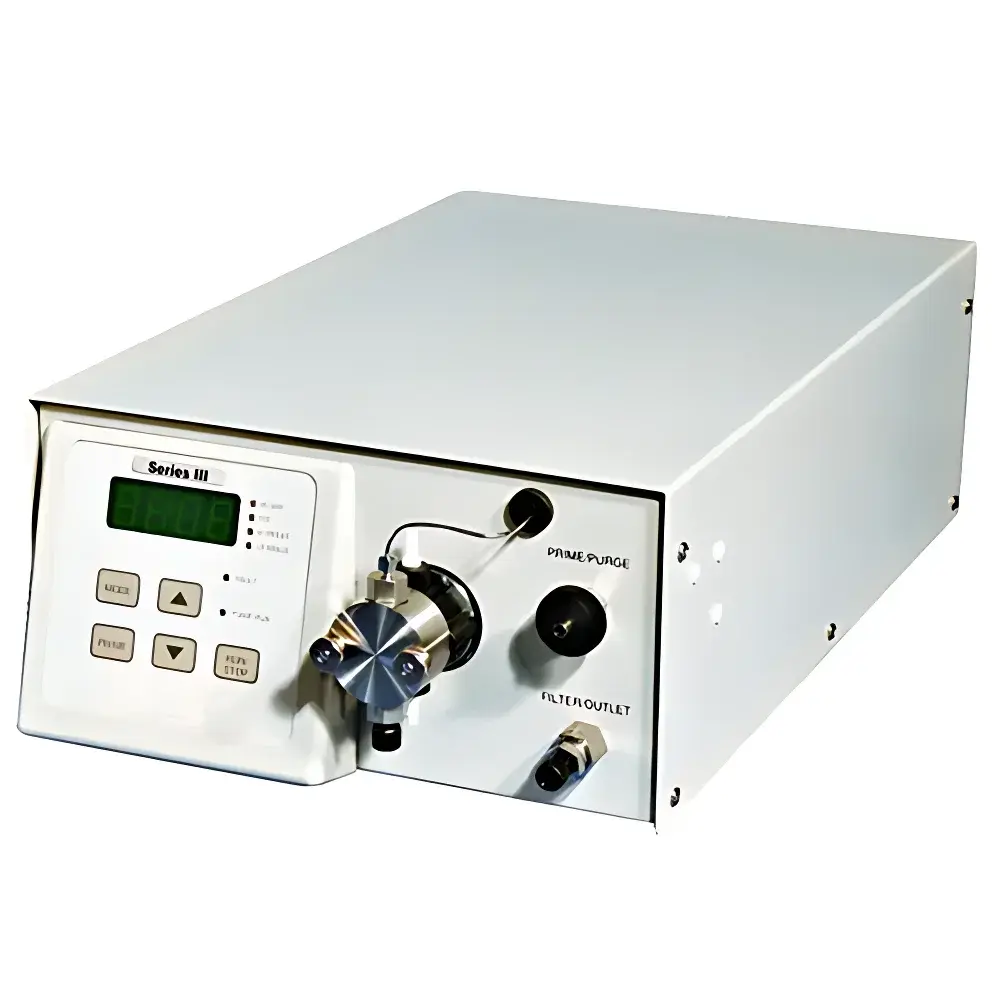
SSI Series III Precision Constant-Flow HPLC Pump
| Brand | SSI |
|---|---|
| Model | Series III |
| Flow Rate | 0.001–5 mL/min (standard range) |
| Maximum Pressure | 6000 psi (stainless steel pump head) |
| Accuracy | ±2% |
| Flow Precision | ≤0.2% RSD |
| Pressure Monitoring | Integrated digital pressure sensor with LED display |
| Pulse Damping | Low-volume diaphragm-type damper |
| Priming Mechanism | Internal fast-fill cam |
| Self-Cleaning | On-line pump head flush function |
| Control Interface | Front-panel keypad (5 dedicated function keys) + RS232 digital communication |
| Remote Input | Frequency and analog voltage input |
| Wetted Materials | PEEK or 316L stainless steel |
| Dimensions | 140 H × 254 W × 432 D mm |
| Weight | 11 kg |
| Power Supply | 115/230 V, 50/60 Hz |
Overview
The SSI Series III Precision Constant-Flow HPLC Pump is an engineered solution for high-pressure, low-pulse liquid delivery in analytical and preparative chromatography, chemical synthesis, and precision dosing applications. Based on proven positive displacement architecture—specifically dual-piston reciprocating design with active pulse suppression—the Series III delivers stable, reproducible flow across its full operating range (0.001–5 mL/min), minimizing baseline noise and column stress during extended runs. Its core innovation lies in the integration of a compact diaphragm-type pulse damper and an internal rapid priming cam mechanism, both contributing to sub-0.2% RSD flow stability and reduced system dwell volume. Unlike open-loop stepper motor-driven pumps, the Series III employs closed-loop digital logic control with real-time pressure feedback, enabling dynamic response to backpressure fluctuations without flow deviation—a critical requirement for gradient elution, multi-solvent systems, and reactive flow chemistry.
Key Features
- Integrated high-resolution pressure transducer with real-time LED display showing instantaneous pressure, user-defined upper/lower limits, and alarm status
- On-line self-cleaning capability via dedicated front-panel “quick flush” function—reducing maintenance intervals and preventing salt/crystalline buildup in pump heads
- Modular pump head design with tool-free replacement; compatible with both PEEK and 316L stainless steel wetted paths for broad chemical resistance (including aggressive organic solvents and aqueous buffers)
- Dedicated five-key membrane keypad for intuitive local operation: flow setpoint, pressure limit adjustment, start/stop, flush activation, and mode selection
- RS232 serial interface supporting bidirectional command/response protocol for integration into automated workflows and LIMS environments
- Remote analog (0–5 V / 0–10 V) and frequency (0–10 kHz) inputs for external flow modulation—enabling synchronization with detectors, fraction collectors, or reactor control systems
- Internal bypass valve and programmable pressure-limit shutdown safeguarding columns and downstream instrumentation
Sample Compatibility & Compliance
The Series III supports continuous operation under GLP-compliant conditions when configured with audit-trail-enabled software (via RS232 logging). Its PEEK fluid path option meets USP Class VI biocompatibility requirements for pharmaceutical process development and cell culture media delivery. Stainless steel variants conform to ASTM F899 for corrosion resistance in chloride-rich or acidic environments. All models comply with IEC 61010-1 for laboratory electrical safety and CE marking for EMC immunity. The pump’s pressure accuracy (±2%) and flow repeatability (≤0.2% RSD) align with ISO 9001 calibration traceability frameworks and are routinely validated per ASTM D7214 for HPLC pump performance verification.
Software & Data Management
While the Series III operates autonomously via front-panel controls, its RS232 interface enables seamless integration with third-party chromatography data systems (CDS) such as Chromeleon, Empower, or custom LabVIEW/Python-based acquisition platforms. Command syntax follows ASCII-based SCPI-like structure, supporting real-time parameter readback (e.g., “READ:FLOW?”, “READ:PRESSURE?”) and non-volatile setting storage. When paired with time-stamped serial logging, the pump satisfies FDA 21 CFR Part 11 requirements for electronic records—including operator ID tagging, change history, and digital signature readiness—provided the host software implements appropriate access controls and audit trail generation.
Applications
- HPLC and UHPLC solvent delivery in analytical and QC laboratories, particularly where gradient robustness and low pulsation are essential for peak shape fidelity
- Continuous-flow chemical synthesis, including catalytic hydrogenation, photochemical reactions, and multistep telescoped processes requiring precise stoichiometric reagent feeding
- Microfluidic system priming and perfusion, especially in organ-on-chip and biomimetic assay platforms demanding nanoliter-level accuracy
- Calibration standard delivery for mass spectrometry infusion systems and elemental analysis (ICP-MS, AAS) sample introduction
- Teaching laboratories for chromatography fundamentals, pump hydraulics, and fluid dynamics principles—leveraging its transparent control architecture and real-time diagnostics
- Industrial pilot-scale formulation development, where reproducibility across batch scales must be preserved from lab to production
FAQ
What materials are available for wetted components, and how do they affect chemical compatibility?
Standard configurations offer either PEEK (ideal for strong acids, bases, and halogenated solvents) or 316L stainless steel (preferred for high-pressure inert applications and elevated temperature operation up to 60°C). Material selection directly impacts maximum allowable pressure—6000 psi for stainless steel, 5000 psi for PEEK.
Can the Series III be integrated into a binary or quaternary gradient system?
Yes—its RS232 interface and analog/frequency remote inputs support synchronized speed modulation between multiple pumps. When combined with a low-dead-volume mixing chamber and proportioning valves, it forms a fully functional gradient delivery module compliant with ISO 13843.
Is pressure sensor calibration traceable to national standards?
Factory calibration is performed using NIST-traceable deadweight testers. Optional annual recalibration services include full metrology report with uncertainty budget and ISO/IEC 17025 accreditation documentation.
Does the pump support automatic leak detection or flow verification routines?
Not natively—but its pressure monitoring and flow setpoint accuracy enable user-defined diagnostic sequences (e.g., pressure ramp test, zero-flow hold test) that can be scripted externally via RS232 and logged for preventive maintenance trending.
Related Products



