
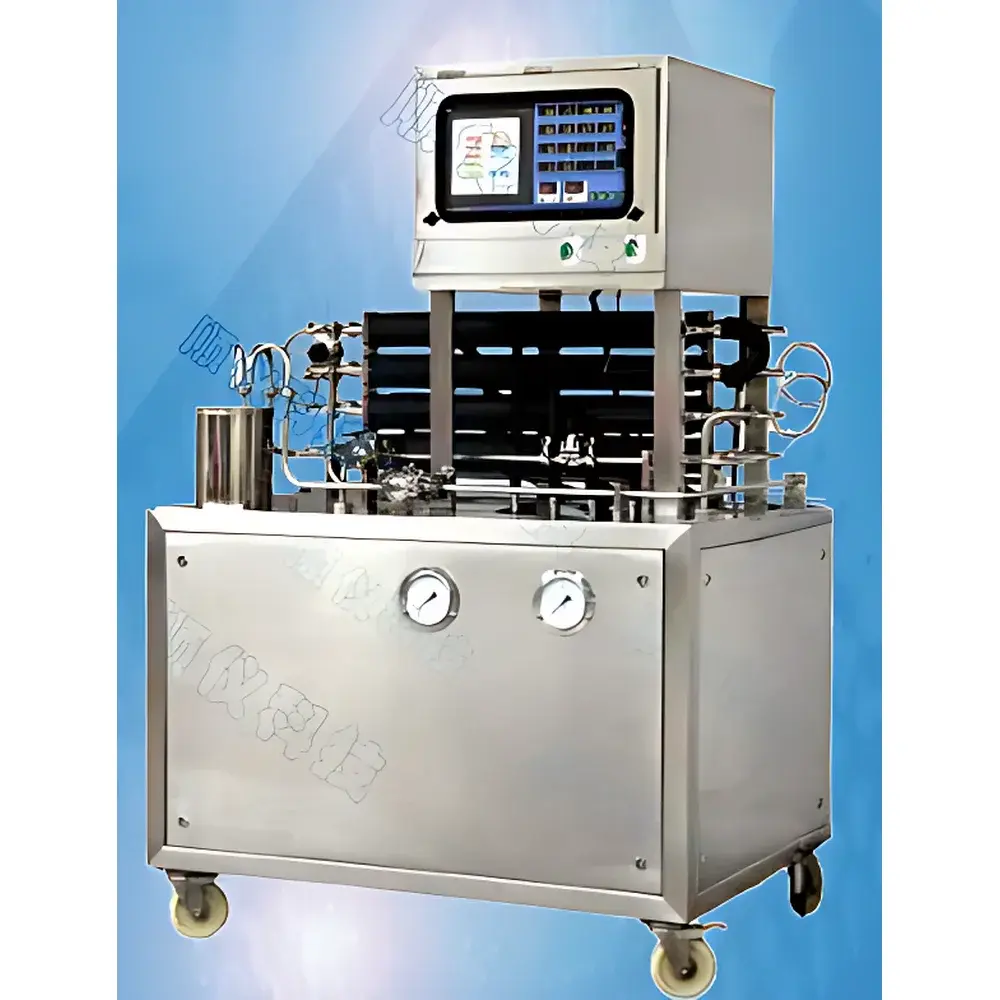
ST-20 Laboratory-Scale Ultra-High Temperature (UHT) Sterilization System
| Origin | Shanghai, China |
|---|---|
| Manufacturer Type | Authorized Distributor |
| Origin Category | Domestic (China) |
| Model | ST-20 |
| Pricing | Available Upon Request |
| Standard Throughput | 20 L/h (adjustable 5–40 L/h) |
| Minimum Batch Volume | 3–5 L |
| Max Sterilization Temp | 150 °C |
| Hold Time Options | 5 s, 15 s, 30 s (at 20 L/h) |
| Fill Temp Range | 20–90 °C |
| SIP Capability | Integrated |
| CIP Flow Rate | 400 L/h |
| Max System Pressure | 10 bar |
| Power Supply | 3-phase, 380 V, 10 kW |
| Dimensions (UHT Unit) | 1600 H × 1200 L × 950 W mm |
| CT-20 Aseptic Filling Chamber | HEPA Filtration Efficiency ≥99.999% @ 0.3 µm |
| Chamber Dimensions | 850 L × 660 W × 2100 H mm |
| Chamber Power | Single-phase, 220–240 V, 50 Hz, 0.25 kW |
Overview
The ST-20 Laboratory-Scale Ultra-High Temperature (UHT) Sterilization System is an engineered platform for thermal process development and validation of liquid food, dairy, plant-based beverages, and functional drinks. It implements direct or indirect UHT processing—typically defined as heating to ≥135 °C for ≤5 seconds—to achieve commercial sterility while preserving sensory and nutritional attributes. Unlike conventional benchtop pasteurizers, the ST-20 replicates full-scale industrial UHT line architecture—including preheating, homogenization (optional), holding tube dynamics, cooling, and aseptic filling—enabling direct scale-up correlation. Its modular design supports both research-driven formulation optimization and regulatory-compliant process mapping per ISO 11133, ISO 22000, and FDA Guidance for Industry on Thermal Processing of Low-Acid Foods. The system operates under fully traceable thermal profiles, with real-time monitoring of inlet/outlet temperatures, flow rate, pressure differentials, and hold time compliance.
Key Features
- Compact footprint (≤3 m²), mobile on casters, requiring only single-point utility connections: potable water supply and 3-phase 380 V power
- PID-controlled temperature regulation with ±0.5 °C accuracy across all thermal zones (preheat, sterilization, cooling)
- Programmable logic controller (PLC) with HMI interface for setting and logging critical process parameters (CPPs): temperature setpoints, residence time, flow rate, pressure
- Integrated steam generator for in-place sterilization (SIP) and hot-water circulation loop for in-place cleaning (CIP) at 400 L/h
- Optional inline high-pressure homogenizer (upstream or downstream of sterilization zone) supporting particle size reduction and emulsion stabilization studies
- Configurable holding tube geometry enabling precise dwell time validation per ASTM E1578-21 (Standard Guide for Validation of Thermal Processes)
Sample Compatibility & Compliance
The ST-20 accommodates Newtonian and non-Newtonian fluids—including milk, soy beverage, fruit nectars, protein-fortified waters, and acidified dairy alternatives—with viscosity ranges up to 500 mPa·s. All wetted surfaces are constructed from AISI 316L stainless steel, electropolished to Ra ≤0.4 µm, compliant with 3-A Sanitary Standards 3-A SSI 03-08 and EC 1935/2004 for food contact materials. The integrated CT-20 Aseptic Filling Chamber maintains ISO Class 5 (Federal Standard 209E Class 100) environment via dual-stage HEPA filtration (99.999% efficiency at 0.3 µm), validated per ISO 14644-1. Full system documentation supports GMP-aligned validation protocols (IQ/OQ/PQ) and satisfies audit requirements for FDA 21 CFR Part 11 electronic records and signatures when paired with compliant data acquisition software.
Software & Data Management
The ST-20 interfaces via Ethernet or RS485 with optional SCADA-grade software for remote parameter configuration, real-time trend visualization, and automated report generation. All thermal and hydraulic data—including time-temperature integrals (TTI), cumulative lethality (F₀ calculations), and pressure transients—are timestamped, encrypted, and stored in CSV or SQL-compatible formats. Audit trails record user logins, parameter modifications, and alarm events with immutable timestamps—fully aligned with ALCOA+ principles (Attributable, Legible, Contemporaneous, Original, Accurate, Complete, Consistent, Enduring, Available). Exported datasets comply with analytical method transfer frameworks used in joint development agreements between R&D labs and contract manufacturing organizations (CMOs).
Applications
- Rapid screening of thermal stability for novel ingredients (e.g., plant proteins, soluble fibers, probiotics)
- Determination of optimal UHT conditions balancing microbial kill (log-reduction validation against Geobacillus stearothermophilus spores) and quality retention (vitamin degradation kinetics, Maillard browning index)
- Shelf-life prediction modeling using accelerated storage trials (ASLT) with microbiological, chemical, and sensory endpoints
- Process qualification for new packaging formats (e.g., PET aseptic bottles, composite cartons) under varying fill temperatures and headspace conditions
- Training platform for food science curricula and industry technician certification programs on thermal processing fundamentals and hazard analysis
FAQ
Can the ST-20 be validated for regulatory submissions?
Yes—its documented design, material certifications, calibration traceability (NIST-traceable PT100 sensors), and data integrity features support IQ/OQ/PQ execution per ICH Q5C and ISO/IEC 17025.
Is homogenization mandatory for UHT processing?
No; the homogenizer is optional and selected based on product rheology and stability objectives—e.g., required for fat globule reduction in dairy analogs but often omitted for low-viscosity acidic beverages.
How is hold time verified during operation?
Hold time is calculated dynamically using calibrated Coriolis mass flow meters and residence time distribution (RTD) mapping conducted during commissioning; real-time verification uses differential temperature and flow algorithms per ISO 13485 Annex C.
Does the system support continuous operation beyond 8 hours?
Yes—designed for extended duty cycles with redundant cooling circuits and thermal overload protection; mean time between failures (MTBF) exceeds 5,000 hours per component-level FMEA.
Can the CT-20 chamber integrate with third-party filling nozzles?
Yes—the chamber includes standardized ISO-KF 40 flanges and programmable motion control inputs compatible with OEM filling valves from Bosch, Krones, and SIG.



