
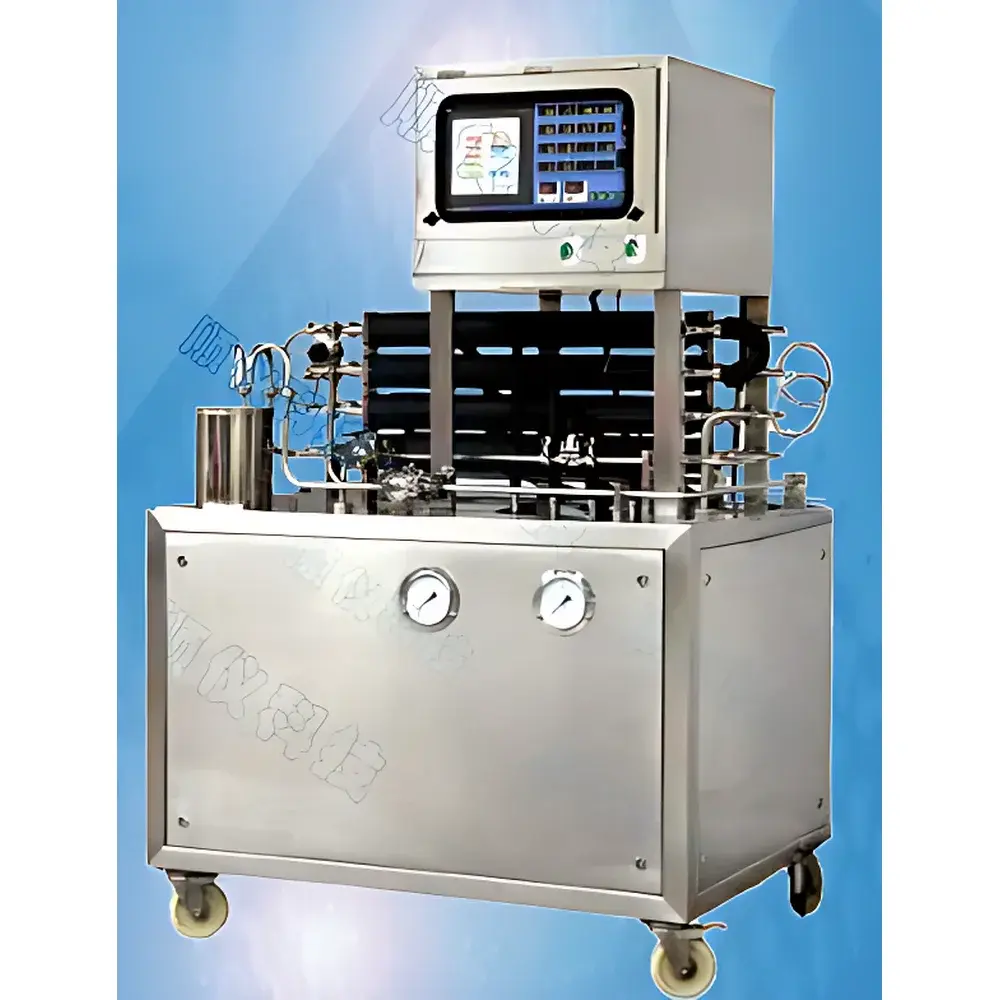
ST-20 Laboratory-Scale Ultra-High Temperature (UHT) Sterilization System with Integrated Aseptic Filling Module
| Origin | Shanghai, China |
|---|---|
| Manufacturer Type | Authorized Distributor |
| Origin Category | Domestic (China) |
| Model | ST-20 |
| Pricing | Upon Request |
| Standard Throughput | 20 L/h (adjustable 5–40 L/h) |
| Minimum Batch Volume | 3–5 L |
| Max Sterilization Temp | 150 °C |
| Hold Time Options | 5 s / 15 s / 30 s (at 20 L/h) |
| Fill Temp Range | 20–90 °C |
| In-line SIP Capability | Yes |
| In-line CIP Flow Rate | 400 L/h |
| Max System Pressure | 10 bar |
| PID Temperature Control Accuracy | ±0.5 °C |
| Power Supply | 3-phase, 380 V, 10 kW |
| Dimensions (UHT Unit) | 1600 H × 1200 L × 950 W mm |
| CT-20 Aseptic Filling Chamber | ISO Class 5 (Fed. Std. 209E Class 100), HEPA Filtration Efficiency: 99.999% @ 0.3 µm |
| Chamber Dimensions | 850 L × 660 W × 2100 H mm |
| Chamber Power | Single-phase, 220–240 V, 50 Hz, 0.25 kW |
Overview
The ST-20 Laboratory-Scale Ultra-High Temperature (UHT) Sterilization System is an engineered platform for process development and pilot-scale validation of thermally sensitive liquid foods and functional beverages. Based on indirect heating via steam-heated plate heat exchangers and precise residence time control in a defined hold tube, the system implements true UHT processing (≥135 °C for ≥1–5 seconds) under continuous flow conditions. It replicates the thermal kinetics, shear profiles, and pressure dynamics of industrial-scale UHT lines—enabling direct scalability without empirical correction factors. Designed for R&D laboratories, quality assurance departments, and contract development organizations, the ST-20 bridges the gap between benchtop formulation trials and commercial manufacturing, supporting regulatory dossier preparation for shelf-stable products under ambient storage conditions.
Key Features
- Compact footprint (≤3 m²) with fully self-contained operation—requires only municipal water supply and three-phase electrical service.
- Fully automated PLC-based control architecture compliant with IEC 61131-3 standards; supports recipe-driven operation with parameter logging at 1 Hz resolution.
- Real-time PID-controlled temperature regulation across preheating, sterilization, and cooling zones; thermal stability maintained within ±0.5 °C during steady-state operation.
- Configurable process sequence: blending → optional in-line homogenization (pre- or post-sterilization) → thermal stabilization → UHT treatment → flash cooling → aseptic filling.
- Integrated Steam-In-Place (SIP) and Clean-In-Place (CIP) subsystems; CIP delivery rate up to 400 L/h with programmable detergent concentration, temperature, and dwell time.
- Dual-interface operation: local HMI panel for manual mode and Ethernet-connected PC software for remote monitoring, data export (CSV/Excel), and audit-trail generation.
- Modular design allows field installation of optional components: chiller unit for sub-ambient cooling, high-pressure homogenizer (up to 2000 bar), and sterile air purge systems.
Sample Compatibility & Compliance
The ST-20 accommodates Newtonian and non-Newtonian fluids including dairy-based emulsions, plant-based beverages, fruit nectars, nutritional suspensions, and low-viscosity functional waters. All wetted surfaces are constructed from AISI 316L stainless steel with Ra ≤ 0.4 µm electropolished finish, meeting EC 1935/2004 and FDA 21 CFR Part 177 requirements for food contact materials. The integrated CT-20 aseptic filling chamber complies with ISO 14644-1 Class 5 (equivalent to Fed. Std. 209E Class 100), utilizing ULPA-grade filtration (99.999% efficiency at 0.3 µm) and laminar airflow velocity control (0.45 ± 0.1 m/s). Full system validation documentation—including IQ/OQ protocols, temperature mapping reports, and microbial challenge studies—can be supplied upon request to support GLP, GMP, and FDA 21 CFR Part 11 compliance.
Software & Data Management
The proprietary ST-Control Suite provides real-time visualization of 28+ process variables—including inlet/outlet temperatures, hold-tube residence time, system pressure, flow rate, and valve positions—via intuitive graphical interface. All operational events (start/stop cycles, alarm triggers, parameter modifications) are timestamped and stored with user ID attribution. Data archives are encrypted and exportable in CSV or PDF formats; raw binary logs retain full sensor resolution for retrospective analysis. Audit trail functionality satisfies ALCOA+ principles (Attributable, Legible, Contemporaneous, Original, Accurate, Complete, Consistent, Enduring, Available) required under pharmaceutical and high-risk food QA frameworks.
Applications
- Formulation optimization: evaluation of stabilizer efficacy, emulsifier performance, and thermal degradation thresholds under controlled UHT conditions.
- Shelf-life prediction: accelerated stability testing using Arrhenius modeling based on validated kinetic parameters derived from ST-20 runs.
- Regulatory submission support: generation of process equivalence data for FDA GRAS notifications, EFSA novel food dossiers, or China NMPA registration files.
- Process validation: verification of lethality (F0) values, cold spot identification, and hold-time distribution profiling per ASTM F1901 and ISO 11135 standards.
- Operator training: hands-on simulation of commercial UHT line operations—including fault recovery, CIP/SIP execution, and deviation handling—without production line downtime.
FAQ
Can the ST-20 be used for low-acid canned food process validation?
Yes—the system supports F0 calculation and real-time thermocouple integration for cold-spot monitoring in accordance with USDA-FSIS and FDA guidance for low-acid foods.
Is third-party calibration certification available for temperature and flow sensors?
Yes—NIST-traceable calibration certificates (per ISO/IEC 17025) can be provided for all primary measurement transducers at time of commissioning.
Does the system meet requirements for organic beverage certification?
All cleaning agents compatible with the CIP system are OMRI-listed; material declarations and process residue testing protocols are available to support USDA NOP compliance.
Can the CT-20 filling chamber accommodate glass bottles and aluminum cans?
Yes—modular tooling kits enable rapid changeover between PET, HDPE, glass, and metal containers; sealing interfaces include induction cap sealers and crimp-on lids.
What level of cybersecurity protection is implemented in the control software?
The ST-Control Suite operates on isolated industrial Ethernet; firmware updates require signed digital certificates, and remote access is restricted to authenticated VPN tunnels with role-based permissions.



