
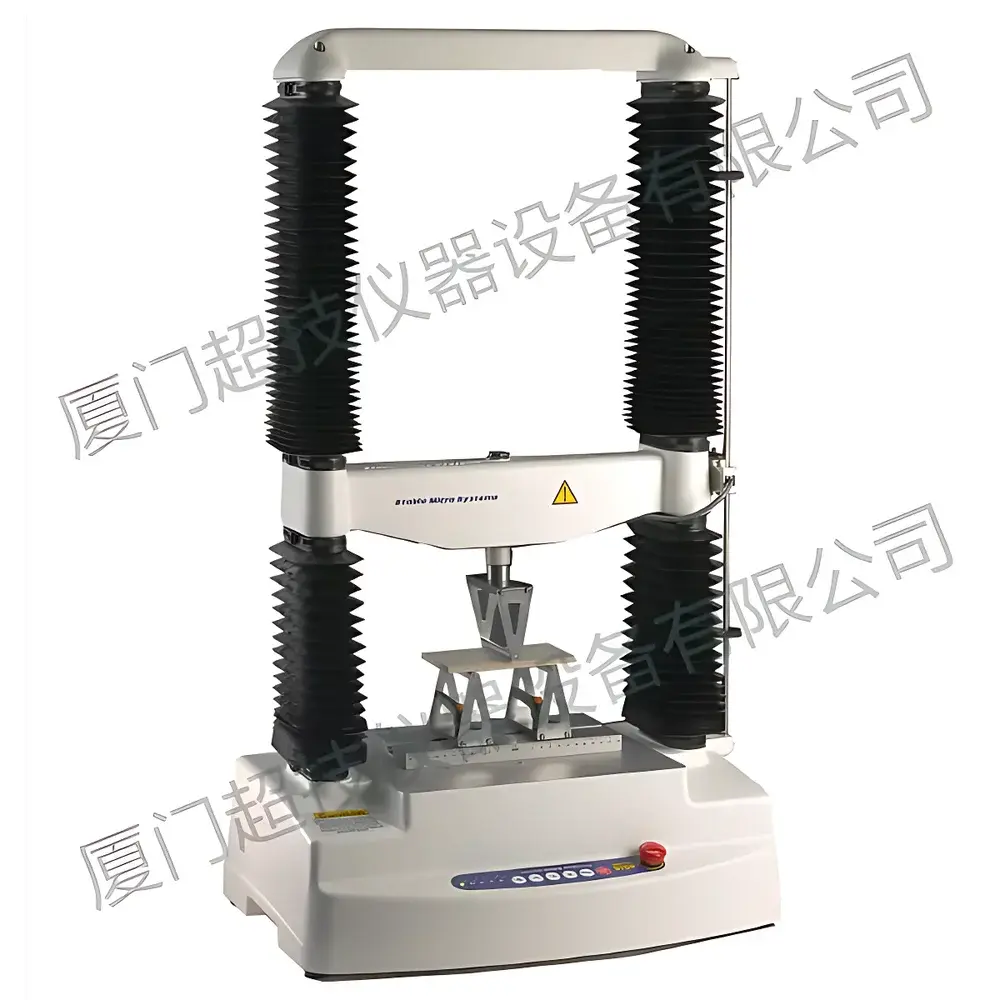
Stable Micro Systems TA.HD Wood Bending and Tensile Strength Tester
| Brand | Stable Micro Systems |
|---|---|
| Origin | United Kingdom |
| Model | TA.HD Wood Mechanical Property Analyzer |
| Force Range | 0.5–50 kgf |
| Force Resolution | 0.1 g |
| Test Speed Range | 0.01–40 mm/s |
| Maximum Travel Distance | 370 mm |
| Position Resolution | 0.001 mm |
| Data Acquisition Rate | >2,000 samples/sec (4-channel simultaneous capture) |
| Compliance | ASTM D143, ISO 3133, ISO 13061-2, EN 384, GB/T 1931–2009, GB/T 1936.1–2009 |
Overview
The Stable Micro Systems TA.HD Wood Mechanical Property Analyzer is a high-precision universal texture testing system engineered for the quantitative mechanical characterization of solid wood and engineered timber products. Operating on the principle of controlled uniaxial compression, three-point bending, and axial tensile deformation, the instrument delivers traceable, reproducible measurements of fundamental mechanical properties—including bending strength (modulus of rupture), tensile strength parallel to grain, splitting strength, fracture distance, rigidity (modulus of elasticity in bending), and hardness under standardized loading configurations. Designed in accordance with international wood testing standards—including ASTM D143 (Standard Test Methods for Small Clear Specimens of Timber), ISO 13061-2 (Physical and mechanical properties of wood — Determination of bending strength), and EN 384 (Structural timber — Determination of characteristic values)—the TA.HD provides metrologically sound data essential for quality assurance, species classification, structural grading, and R&D validation in timber science, forestry engineering, and sustainable construction material development.
Key Features
- High-resolution dual-load-cell architecture enabling seamless switching between low-force (0.5–5 kgf) and high-force (5–50 kgf) measurement ranges without recalibration.
- Sub-micron positional accuracy (0.001 mm) and real-time force resolution of 0.1 g ensure detection of subtle yield points, plastic deformation onset, and brittle fracture events in heterogeneous anisotropic materials.
- Programmable crosshead velocity from 0.01 to 40 mm/s supports quasi-static creep testing, dynamic stiffness evaluation, and compliance with variable-rate test protocols defined in ISO 13061-1 and ASTM D143 Annex A3.
- Modular probe and fixture ecosystem—including 3-point bending jigs (with adjustable span lengths), tensile grips with self-aligning jaws, and Brinell-type indentation anvils—enables rapid reconfiguration for multi-parameter wood property assessment within a single platform.
- Integrated barcode-triggered test execution: scanning a pre-assigned protocol QR code initiates full method recall—including target speed, distance, trigger threshold, and post-test actions—eliminating manual navigation errors and reducing operator dependency.
- Remote operation capability via iOS/Android mobile apps and web-based dashboard; supports live monitoring, real-time data streaming, and automated email delivery of .csv/.xlsx reports upon test completion.
Sample Compatibility & Compliance
The TA.HD accommodates specimens conforming to standard dimensions specified in ISO 3133 (wood—determination of density) and ISO 13061-2 (bending tests), including clear-wood prisms (20 × 20 × 300 mm), notched beams for fracture toughness estimation, and small-diameter roundwood sections. Its rigid frame (stiffness > 25 kN/mm) and low-inertia drive system minimize parasitic deflection during high-load bending tests, ensuring that measured displacement reflects true specimen deformation—not machine compliance. All test methods are fully traceable to national metrology institutes (NMI-UK accredited calibration certificates available), and software audit trails comply with GLP and FDA 21 CFR Part 11 requirements when configured with user authentication and electronic signature modules.
Software & Data Management
Texture Expert Touch™ v4.2 software provides ISO/IEC 17025-aligned data handling: automatic calculation of MOR (MPa), MOE (GPa), tensile stress at break (MPa), specific energy absorption (J/m³), and load–displacement curve derivatives (e.g., linear region slope, post-yield area). Raw data streams (force, position, time, auxiliary channel inputs) are stored in open-format HDF5 files with embedded metadata (operator ID, environmental conditions, calibration timestamp). The system includes over 400 peer-reviewed application notes—indexed by wood species (e.g., Fagus sylvatica, Picea abies, Eucalyptus grandis) and failure mode—and embedded video tutorials demonstrating fixture alignment, specimen centering, and statistical outlier rejection per ISO 5725-2.
Applications
- Quality control of kiln-dried softwood and hardwood lumber for structural grading (e.g., visual and machine stress-rated timber).
- Evaluation of adhesive bond integrity in laminated veneer lumber (LVL) and cross-laminated timber (CLT) panels under transverse shear and delamination modes.
- Assessment of thermal modification effects on bending modulus and fracture energy in heat-treated beech and ash.
- Correlation studies between microdensitometry (X-ray CT) and macro-scale mechanical performance across growth ring orientations.
- Validation of finite element models used in timber connection design (e.g., dowel-type fasteners, moment-resisting joints).
FAQ
Does the TA.HD meet ISO/IEC 17025 requirements for accredited testing laboratories?
Yes—when operated with documented calibration intervals, validated fixtures, and Texture Expert Touch™ configured with audit trail logging and role-based access control, the system satisfies clause 6.4.10 (measurement traceability) and 7.7 (result reporting) of ISO/IEC 17025:2017.
Can the instrument perform both static and cyclic loading protocols for fatigue assessment?
The TA.HD supports programmed multi-cycle ramp-hold sequences (up to 999 cycles) with programmable dwell times and amplitude modulation; however, dedicated high-cycle fatigue testing (>10⁵ cycles) requires optional servo-hydraulic add-on modules.
Is raw force–displacement data exportable in ASCII or MATLAB-compatible formats?
All acquired data is natively saved in HDF5 and CSV formats; MATLAB and Python (via h5py/pandas) APIs are provided for direct script-based analysis and batch processing.
How is specimen alignment verified prior to bending tests?
The system includes a built-in digital level sensor and laser-guided centering aid; alignment verification is performed automatically during the pre-test homing sequence and logged in the test report.
What maintenance intervals are recommended for long-term force accuracy?
Annual NMI-traceable load cell calibration and biannual mechanical inspection (guide rail lubrication, belt tension check, encoder alignment) are advised per SMS Maintenance Protocol MP-TAHD-03 Rev. 2.



