
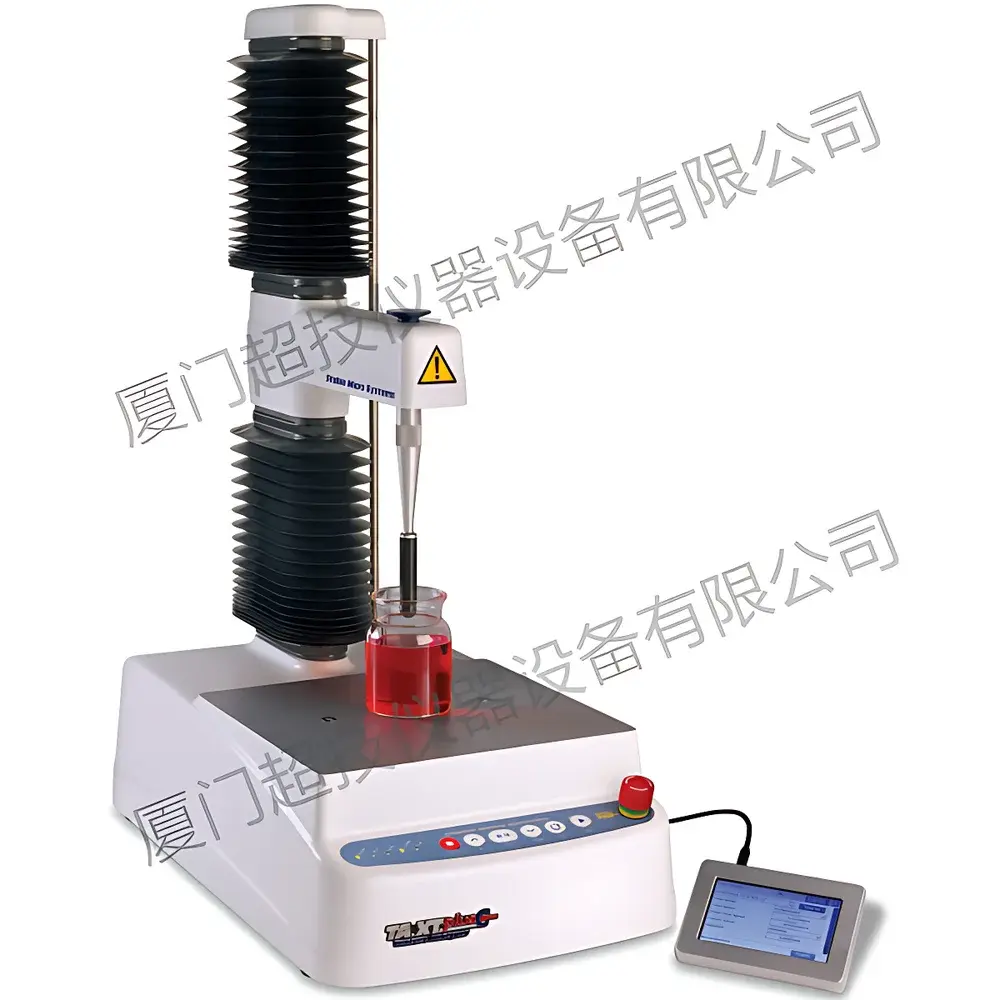
Stable Micro Systems TA.XT Plus Texture Analyzer
| Brand | Stable Micro Systems |
|---|---|
| Origin | United Kingdom |
| Model | TA.XT Plus |
| Force Range | 0.5–50 kgf |
| Force Resolution | 0.1 g |
| Test Speed Range | 0.01–40 mm/s |
| Maximum Travel Distance | 370 mm |
| Position Resolution | 0.001 mm |
| Data Acquisition Rate | >2,000 points/sec (4-channel simultaneous sampling) |
| Compliance | ASTM F2268, ISO 11357-3, USP <1042>, FDA 21 CFR Part 11 (software-enabled audit trail & electronic signature support) |
Overview
The Stable Micro Systems TA.XT Plus Texture Analyzer is a high-precision, universal testing platform engineered for objective mechanical property characterization of soft solids and semi-solids. Based on the fundamental principles of uniaxial compression, tension, penetration, extrusion, and shear—governed by Hooke’s law, Maxwell viscoelastic models, and empirical texture indices—the instrument quantifies critical textural parameters including hardness, cohesiveness, springiness, chewiness, resilience, adhesiveness, and fracturability. Designed specifically for food science laboratories, QC/QA departments, and R&D centers, it delivers repeatable, traceable, and statistically robust measurements essential for product development, shelf-life evaluation, raw material qualification, and regulatory compliance. Its modular architecture supports over 300 standardized probe configurations—from spherical and cylindrical plungers to Kramer shear cells and Volodkevich bite jaws—enabling direct correlation between instrumental outputs and human sensory perception.
Key Features
- High-fidelity load cell with 0.1 g force resolution and calibrated range from 0.5 to 50 kgf, ensuring accurate detection of subtle textural transitions in low-force applications (e.g., fish surimi gel strength) and high-force resistance (e.g., cooked meat tenderness).
- Programmable crosshead movement with velocity control from 0.01 to 40 mm/s and positional accuracy of ±0.001 mm, enabling precise replication of standardized test protocols such as ASTM F2268 (meat tenderness) or ISO 11357-3 (thermal-mechanical behavior).
- Real-time, multi-channel data acquisition at >2,000 Hz—simultaneously capturing force, distance, time, and optional auxiliary inputs (e.g., temperature, humidity)—to resolve transient deformation events during rapid compression or fracture.
- Barcode-triggered test initiation via integrated scanner interface: scanning a pre-assigned protocol barcode automatically loads method parameters, sample ID metadata, and reporting templates—reducing operator error and standardizing workflow across shifts.
- Remote operation capability via Ethernet/Wi-Fi: full software control and real-time monitoring from iOS/Android tablets or laptops; automated post-test email delivery of raw data (.txt), summary reports (.pdf), and statistical exports (.csv).
- Modular probe mounting system compliant with ISO 9001-certified calibration traceability; all mechanical components manufactured to ISO 2768-mK tolerances for long-term dimensional stability.
Sample Compatibility & Compliance
The TA.XT Plus accommodates heterogeneous food matrices—including raw and cooked fish surimi gels, minced meat emulsions, sausages, cured hams, frozen-thawed seafood products, and plant-based analogues—without requiring sample homogenization or pre-conditioning beyond standard equilibration (per AOAC 985.29). Probe selection follows validated methods aligned with Codex Alimentarius guidelines and national standards (e.g., GB/T 22209–2008 for surimi elasticity, SN EN ISO 11036 for meat tenderness). Instrument firmware and Exponent Connect software comply with FDA 21 CFR Part 11 requirements for electronic records and signatures, featuring time-stamped audit trails, user-level access controls, and immutable data archiving—supporting GLP/GMP-regulated environments and third-party audits.
Software & Data Management
Exponent Connect v3.0 provides an ISO/IEC 17025-aligned analysis environment with built-in statistical modules (ANOVA, PCA, correlation heatmaps), customizable report generation, and direct integration with LIMS platforms via ODBC. Over 400 peer-reviewed application notes—including fish gel strength profiling (surimi setting index), Warner-Bratzler shear force validation, and TPA (Texture Profile Analysis) for restructured meat products—are embedded within the software library. All methods adhere to ASTM E1847 and ISO/IEC 17025:2017 validation frameworks, with documented uncertainty budgets for force, displacement, and derived indices. Raw datasets are stored in vendor-neutral ASCII format for third-party reanalysis using MATLAB, Python (NumPy/Pandas), or JMP.
Applications
- Quantification of surimi gel elasticity and breaking strength via controlled compression of cylindrical gels (diameter 25 mm, height 15 mm) using a 5 mm diameter stainless-steel probe at 1 mm/s.
- Warner-Bratzler shear force measurement on cooked meat cores (1.27 cm × 1.27 cm × 3 cm) to assess tenderness consistency across batches and processing variables (marination time, cooking temperature).
- TPA cycle analysis of processed seafood cakes to derive springiness, cohesiveness, and chewiness ratios—correlated against trained sensory panel scores per ISO 13299.
- Evaluation of freeze-thaw stability in aquatic protein gels by tracking changes in fracture stress and energy absorption over multiple cycles.
- Development of texture-matching benchmarks for plant-based seafood alternatives using multi-probe comparative testing (e.g., puncture vs. extrusion).
FAQ
What standards does the TA.XT Plus support for fish surimi testing?
It complies with ISO 11036 (mechanical properties of gels), GB/T 22209–2008 (surimi elasticity index), and internally validated protocols aligned with AOAC Official Method 985.29.
Can the system validate Warner-Bratzler shear force according to USDA specifications?
Yes—using the WBS blade probe (ASTM F2268-compliant geometry) and programmable pre-test dwell time, the system replicates USDA FSIS-defined shear conditions with traceable force calibration.
Is audit trail functionality enabled for regulated environments?
Yes—Exponent Connect v3.0 includes 21 CFR Part 11-compliant electronic signatures, role-based permissions, and immutable audit logs for all method edits, test executions, and data exports.
How is probe calibration maintained across extended use?
Each probe carries a unique serial-numbered calibration certificate traceable to UKAS-accredited standards; annual recalibration services are available through SMS-certified labs in North America, EMEA, and APAC regions.
Does the software support custom statistical modeling beyond built-in reports?
Yes—raw .txt files include timestamped, channel-synchronized values compatible with external statistical packages; Python API extensions are available under NDA for advanced regression and machine learning workflows.







