
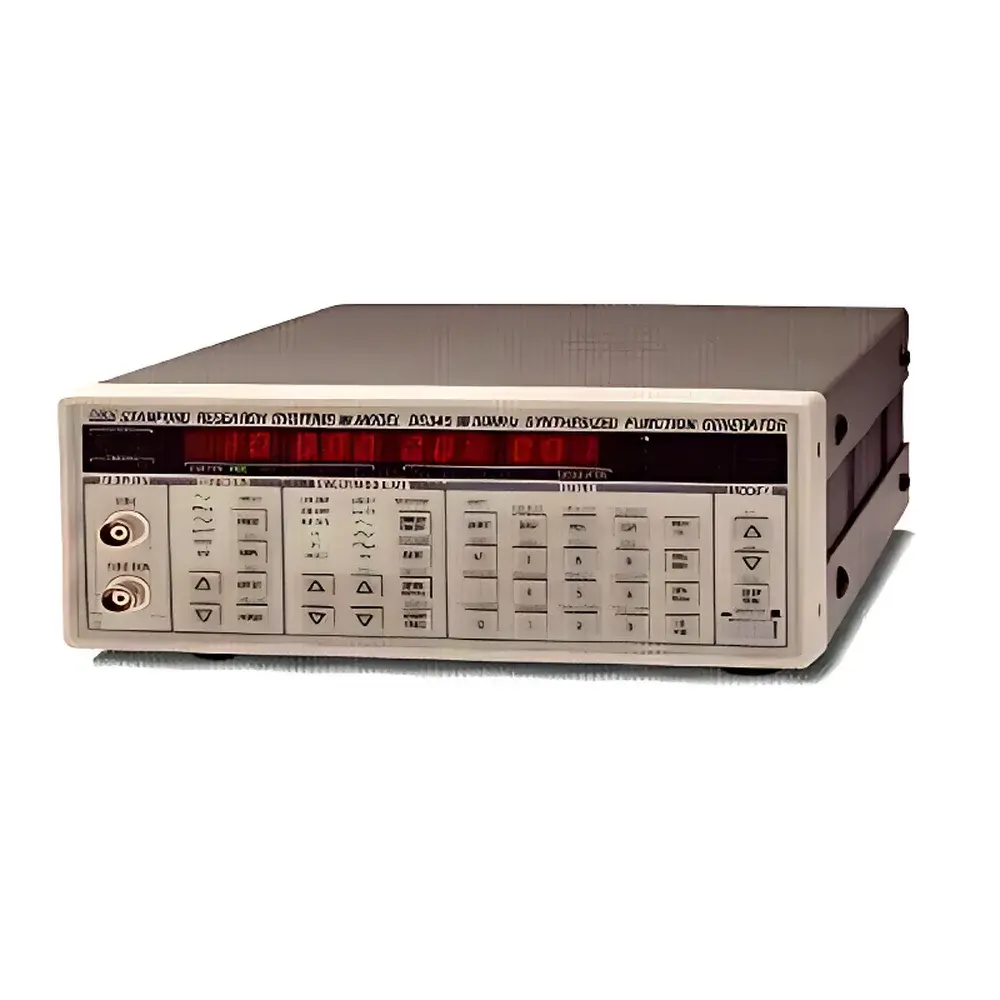
Stanford Research Systems DS345 Direct Digital Synthesis Arbitrary Function Generator
| Brand | SRS/Stanford Research Systems |
|---|---|
| Origin | USA |
| Model | DS345 |
| Frequency Range | 1 µHz to 30.2 MHz |
| Frequency Resolution | 1 µHz |
| Waveforms | Sine, Square, Ramp, Triangle, Noise |
| Modulation Types | AM, FM, Phase Modulation, Burst, Linear/Logarithmic Sweep |
| Arbitrary Waveform Memory | 16,300 points |
| Sample Rate | 40 MSa/s |
| Reference Input | 10 MHz |
| Optional Interfaces | RS-232, GPIB |
Overview
The Stanford Research Systems DS345 is a high-performance arbitrary function generator engineered for precision signal synthesis in advanced scientific laboratories and metrology environments. Built upon a direct digital synthesis (DDS) architecture, the DS345 delivers exceptional frequency stability, sub-microhertz resolution, and phase-continuous frequency sweeps—critical attributes for applications requiring coherent excitation, lock-in amplifier reference generation, laser modulation, or impedance spectroscopy stimulus. Unlike analog-based generators, its DDS core ensures minimal phase noise, low jitter (<100 ps RMS), and deterministic waveform timing—enabling reproducible experimental conditions across long-duration measurements. Designed specifically for integration into optical spectroscopy setups—including FTIR, Raman, and cavity ring-down systems—the DS345 serves as a stable, programmable stimulus source compatible with both benchtop and automated test configurations.
Key Features
- Direct Digital Synthesis (DDS) engine delivering 1 µHz frequency resolution and 30.2 MHz maximum output bandwidth
- Phase-continuous linear and logarithmic frequency sweeps for dynamic system characterization
- Five standard waveforms: sine, square, triangle, ramp, and broadband noise—with adjustable symmetry and DC offset
- Comprehensive modulation suite: amplitude modulation (AM), frequency modulation (FM), phase modulation (PM), burst mode with programmable gate timing, and triggered sweep
- Arbitrary waveform generation with 16,300-point memory depth and 40 MSa/s update rate—supporting user-defined transients, chirps, and complex periodic stimuli
- 10 MHz external reference input for synchronization with master clocks or other instruments in multi-channel spectroscopic systems
- Optional IEEE-488 (GPIB) and RS-232 interfaces for remote control under LabVIEW, MATLAB, or Python-based automation frameworks
Sample Compatibility & Compliance
The DS345 is not a sample-contacting instrument; it functions exclusively as a calibrated voltage source for electronic stimulation of detectors, modulators, actuators, or optical components within spectroscopic systems. Its 50 Ω output impedance and ±10 V amplitude range (into 50 Ω) ensure compatibility with standard RF amplifiers, electro-optic modulators (EOMs), piezoelectric transducers, and lock-in amplifier reference inputs. The unit complies with FCC Part 15 Class A and CE electromagnetic compatibility (EMC) directives. While not certified for medical or industrial safety standards (e.g., IEC 61010), its design adheres to general laboratory-grade electrical safety practices. For GLP/GMP-regulated environments, traceable calibration documentation (NIST-traceable certificate available upon request) supports audit readiness.
Software & Data Management
The DS345 supports full SCPI (Standard Commands for Programmable Instruments) command set over GPIB or RS-232, enabling seamless integration into automated data acquisition workflows. SRS provides native drivers for LabVIEW and MATLAB, along with command-line utilities for Linux and Windows. Arbitrary waveforms can be loaded via ASCII text files (comma- or space-delimited) or binary formats using the included WaveForm Editor software. All instrument settings—including frequency, amplitude, offset, modulation parameters, and waveform memory—are stored in non-volatile memory and persist through power cycles. Audit trails are maintained through external logging systems; while the DS345 itself does not implement FDA 21 CFR Part 11-compliant electronic signatures or user-level access controls, its deterministic behavior and SCPI logging capability support integration into validated environments when paired with compliant host software.
Applications
- Stimulus source for lock-in amplifiers in photothermal or photoacoustic spectroscopy
- Modulation driver for acousto-optic modulators (AOMs) and electro-optic modulators (EOMs) in tunable laser systems
- Frequency-swept excitation for dielectric spectroscopy and impedance analysis of optical coatings
- Trigger and gate signal generation for time-resolved fluorescence or pump-probe experiments
- Calibration reference for oscilloscope bandwidth verification and ADC linearity testing
- Arbitrary waveform synthesis for mimicking transient spectral artifacts or simulating detector response dynamics
FAQ
What is the output impedance of the DS345, and how should it be terminated?
The DS345 features a fixed 50 Ω output impedance. For optimal signal fidelity and minimal reflections, it must be terminated into a 50 Ω load—either directly at the instrument output or via a properly terminated coaxial cable.
Does the DS345 support synchronized multi-unit operation?
Yes—using the 10 MHz reference input and output ports, multiple DS345 units can be phase-locked to a common master clock for coherent multi-channel stimulus generation.
Can arbitrary waveforms be updated in real time during a sweep or modulation sequence?
No—arbitrary waveforms are loaded into static memory prior to execution. Real-time waveform streaming is not supported; however, burst mode allows precise triggering of preloaded waveforms with sub-microsecond latency.
Is NIST-traceable calibration included with the instrument?
A factory calibration certificate is supplied. NIST-traceable calibration with uncertainty budget is available as an optional service at time of purchase or during scheduled recalibration.
What operating systems are supported for remote control?
The DS345 is OS-agnostic when controlled via SCPI commands. Official drivers are provided for Windows (32/64-bit) and Linux; macOS users may interface via serial or GPIB using third-party libraries such as PyVISA.




