
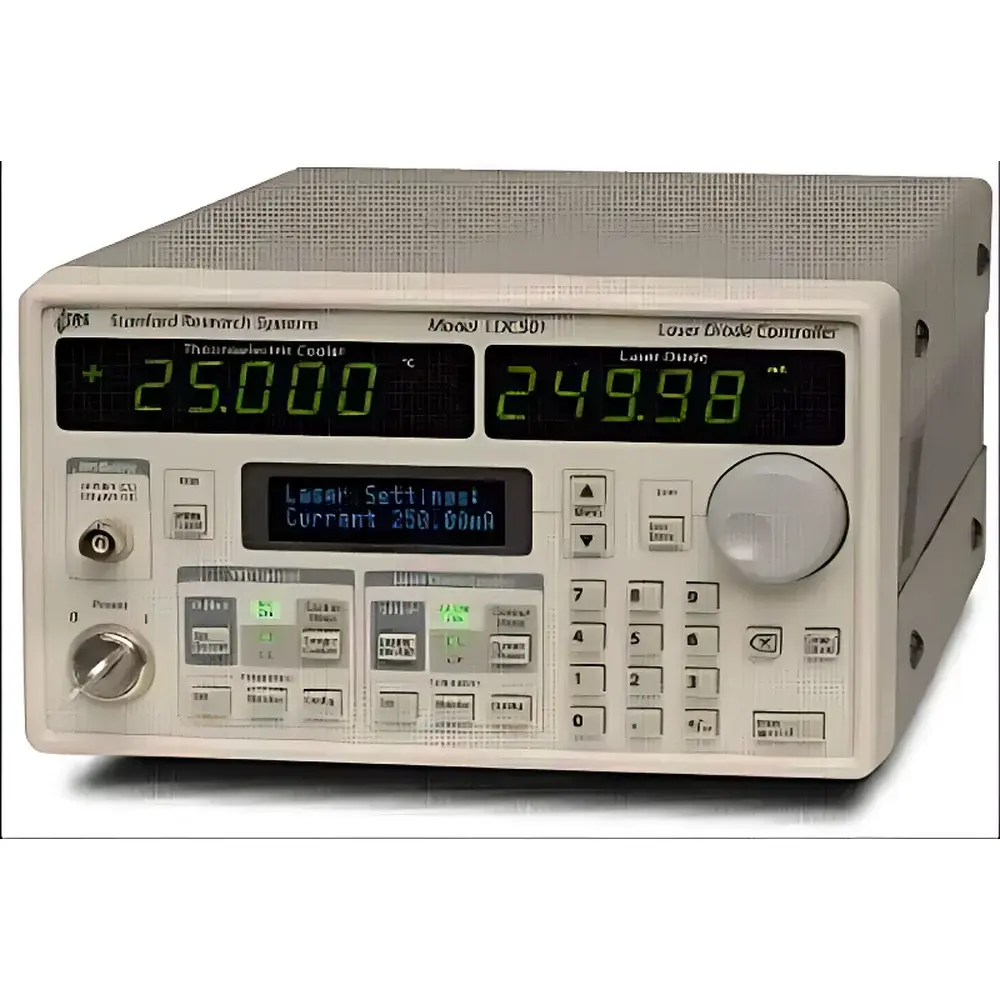
Stanford Research Systems LDC501 Laser Diode Controller
| Brand | SRS/Stanford Research Systems |
|---|---|
| Origin | USA |
| Manufacturer Type | Authorized Distributor |
| Product Origin | Imported |
| Model | LDC501 |
| Pricing | Available Upon Request |
Overview
The Stanford Research Systems LDC501 Laser Diode Controller is a dual-function, benchtop instrumentation platform engineered for precision control and characterization of laser diodes in research, development, and production environments. It integrates two independently optimized subsystems: a low-noise, high-stability current source for laser diode drive, and a high-power thermoelectric cooler (TEC) controller for active temperature regulation. The device operates on the fundamental principle of closed-loop electro-optical stabilization—where precise current injection governs optical output power and wavelength via carrier density modulation, while active thermal management suppresses mode hopping, threshold drift, and wavelength instability through sub-millikelvin thermal setpoint fidelity. Designed for integration into spectroscopic systems—including tunable diode laser absorption spectroscopy (TDLAS), cavity ring-down spectroscopy (CRDS), and external-cavity diode laser (ECDL) setups—the LDC501 meets the stringent stability and noise requirements demanded by high-resolution optical metrology and quantum optics applications.
Key Features
- 500 mA ultra-low-noise laser current source with <1.1 µA RMS current noise (10 Hz–1 MHz bandwidth) and ultra-low thermal drift (<10 ppm/°C)
- 36 W TEC controller supporting thermistor, RTD (Pt100/Pt1000), and IC-based temperature sensors with auto-tuning PID loop optimization
- Dynamic real-time switching between constant-current (CC) and constant-power (CP) operating modes for laser diode biasing
- High-precision temperature stability of ±0.0005 °C/°C (normalized to ambient temperature change), enabling long-term wavelength lock for spectroscopic applications
- Comprehensive laser protection suite: soft-start ramping, interlock-enabled shutdown, short-circuit current limiting, open-circuit detection, over-temperature cutoff, and user-configurable current limits
- Standard digital interfaces: GPIB (IEEE-488.2), RS-232, and 10/100 Mbps Ethernet with SCPI command compliance for automated test systems
Sample Compatibility & Compliance
The LDC501 is compatible with single-emitter and multi-mode laser diodes across visible to near-infrared wavelengths (e.g., 405 nm, 635 nm, 780 nm, 850 nm, 980 nm, and 1550 nm packages), including TO-can, butterfly, and C-mount configurations. Its analog and digital I/O terminals support external modulation (up to 100 kHz bandwidth), photodiode feedback integration, and interlock chaining for system-level safety. From a regulatory perspective, the instrument conforms to IEC 61010-1 (Safety Requirements for Electrical Equipment for Measurement, Control, and Laboratory Use) and meets FCC Class B and CE EMC emission standards. While not certified for medical or industrial process control use out-of-the-box, its architecture supports traceable calibration and audit-ready operation when deployed under GLP or ISO/IEC 17025 quality frameworks.
Software & Data Management
The LDC501 operates natively via SCPI commands over all supported interfaces, enabling seamless integration with LabVIEW, MATLAB, Python (PyVISA), and custom C/C++ applications. SRS provides a Windows-based GUI application (LDC501 Control Suite) for rapid setup, real-time monitoring, data logging (CSV/TXT export), and script-based sequence execution. All parameter changes—including current setpoints, temperature targets, PID coefficients, and protection thresholds—are timestamped and stored in non-volatile memory. Audit trail functionality is available via Ethernet logging to external servers; while the unit itself does not implement FDA 21 CFR Part 11 electronic signature controls, its deterministic behavior and deterministic command-response latency make it suitable for validated environments when paired with compliant host software and procedural documentation.
Applications
- Stabilized seed sources for fiber amplifiers and ECDL systems
- Wavelength-scanned absorption spectroscopy in environmental gas sensing (e.g., CH₄, CO₂, NH₃)
- Atomic physics experiments requiring Doppler-free saturation spectroscopy or magneto-optical trap (MOT) cooling lasers
- Calibration and qualification of photodetectors, optical power meters, and spectrometers
- Reliability testing of laser diodes under accelerated thermal and current stress conditions
- Integration into OEM spectroscopic analyzers where low SWaP-C (Size, Weight, Power, and Cost) and high channel density are critical
FAQ
Does the LDC501 support analog modulation of the laser diode current?
Yes—via a dedicated 0–5 V input with 100 kHz small-signal bandwidth and user-selectable gain scaling.
Can the TEC controller operate without a connected temperature sensor?
No—sensor feedback is mandatory for closed-loop operation; however, open-loop voltage control is accessible via SCPI for diagnostic or transient testing.
Is firmware upgradable in the field?
Yes—firmware updates are delivered as signed binary files via Ethernet or RS-232 and applied using the included update utility.
What is the maximum allowable load capacitance for stable current source operation?
The LDC501 is specified for stable operation with ≤100 pF total capacitive load at the laser output terminals; external filtering or cable capacitance must be accounted for in high-frequency modulation scenarios.
How is calibration traceability maintained?
Each unit ships with a NIST-traceable calibration certificate covering current output accuracy (±0.05% of reading + 100 µA) and temperature readback accuracy (±0.1 °C for thermistor inputs).




