
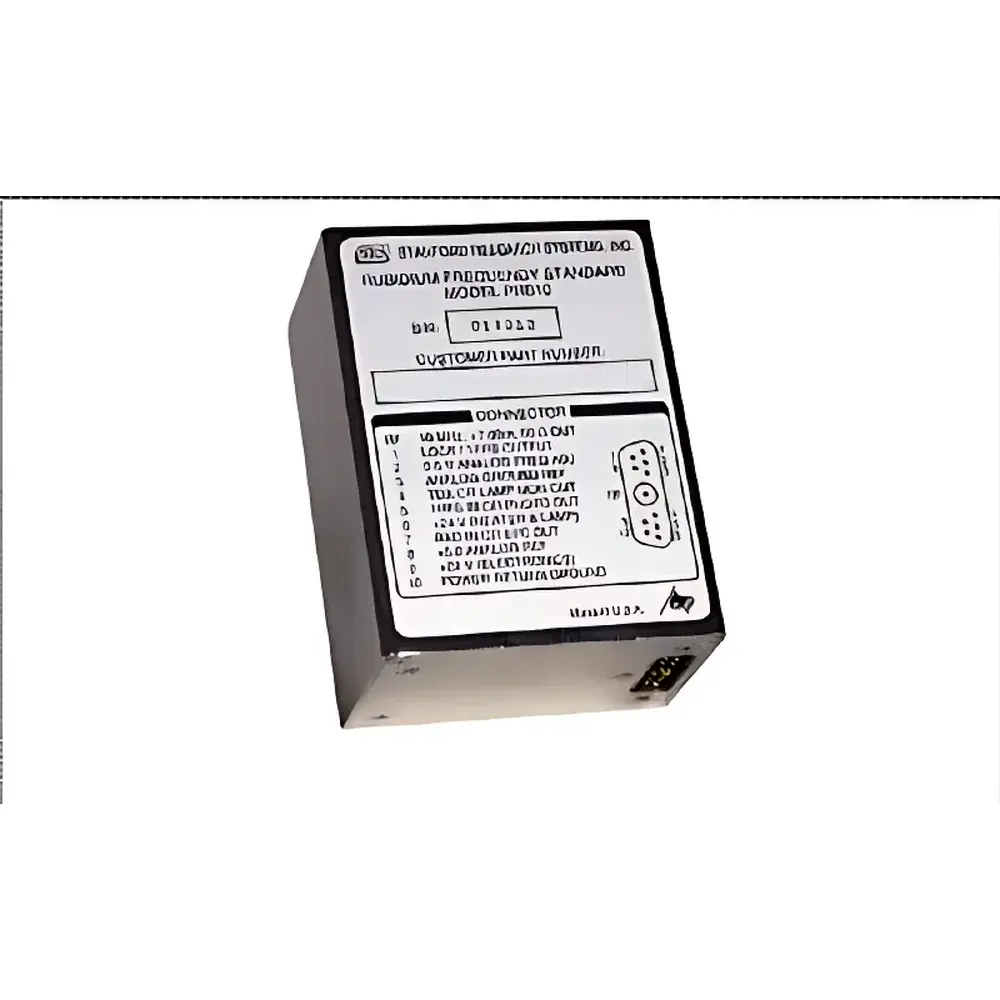
Stanford Research Systems PRS10 Rubidium Atomic Frequency Standard
| Brand | SRS / Stanford Research Systems |
|---|---|
| Origin | USA |
| Model | PRS10 |
| Output Frequency | 10 MHz |
| Phase Noise | –130 dBc/Hz @ 10 Hz |
| Aging Rate | < 5 × 10⁻¹¹ per month |
| Holdover Stability | Stratum 1 level for 72 hours |
| Interface | RS-232 |
| Expected Lifetime | 20 years |
| Input | 1 PPS external reference (e.g., GPS-disciplined) |
| Compliance | Designed for telecom synchronization, metrology, and defense-grade timing applications |
Overview
The Stanford Research Systems PRS10 Rubidium Atomic Frequency Standard is a precision oven-controlled atomic oscillator engineered for long-term frequency stability and ultra-low phase noise performance. Unlike quartz-based oscillators, the PRS10 leverages rubidium vapor cell physics—specifically the hyperfine transition of 87Rb atoms at 6.834682610904324 GHz—to generate a highly reproducible 10 MHz output signal via optical pumping and microwave interrogation. This atomic resonance serves as the primary frequency reference, delivering exceptional short- and medium-term stability without requiring continuous external discipline. Its architecture integrates a low-noise voltage-controlled crystal oscillator (VCXO), a rubidium lamp, photodetector, and servo loop to lock the VCXO to the atomic resonance line. The PRS10 is widely deployed in environments where traceable, autonomous timekeeping is critical—including telecommunications infrastructure synchronization (ITU-T G.811/G.812 Stratum 1 compliance), radar system timing, satellite ground station operations, and national metrology laboratories.
Key Features
- Ultra-low phase noise: –130 dBc/Hz at 10 Hz offset, enabling high-resolution spectral analysis and low-jitter digital signal processing.
- Exceptional aging performance: < 5 × 10⁻¹¹ per month, minimizing calibration frequency and supporting multi-year deployment without drift-induced measurement uncertainty.
- 72-hour Stratum 1 holdover capability: Maintains ≤ 1 × 10⁻¹¹ time error over three days following loss of external reference (e.g., GPS outage), meeting ITU-T G.812 Class I requirements.
- Integrated 1 PPS input port: Supports phase-locking to external timing references such as GPS receivers or cesium-beam standards for long-term accuracy traceability.
- RS-232 serial interface: Enables remote monitoring of internal status, temperature, lock state, and aging diagnostics; compatible with SCPI command set for integration into automated test systems.
- Robust thermal design: Ovenized rubidium cell and temperature-stabilized electronics ensure consistent performance across ambient temperatures from 0 °C to 50 °C.
Sample Compatibility & Compliance
The PRS10 is not a sample-dependent instrument; it functions as a self-contained frequency reference standard and requires no consumables or user-provided samples. Its operation complies with international timing and synchronization frameworks, including ITU-T Recommendations G.811 (Primary Reference Clock), G.812 (Transit Exchange Clock), and G.826 (error performance in synchronous networks). While not certified to ISO/IEC 17025 for calibration laboratory accreditation, its documented stability metrics align with NIST SP 1065 guidance for secondary frequency standards. The device meets MIL-STD-810G environmental testing criteria for shock, vibration, and thermal cycling—making it suitable for mobile or field-deployable timing applications. It is also designed for compatibility with GLP/GMP data integrity workflows when used in regulated instrumentation systems (e.g., as a clock source in FDA 21 CFR Part 11-compliant analyzers).
Software & Data Management
The PRS10 supports ASCII-based SCPI commands over RS-232 for full operational control and telemetry acquisition. Users can query real-time parameters—including lock status, internal temperature, aging rate estimate, and 10 MHz output amplitude—via terminal emulation or custom LabVIEW/Python scripts. SRS provides a Windows-compatible configuration utility for firmware updates and basic setup, though most integration occurs through third-party timing management software (e.g., Meinberg NTP servers, Symmetricom TimeProvider, or custom Python-based monitoring daemons). All communication logs and configuration changes are timestamped and exportable for audit trails, supporting traceability in quality-critical environments. No proprietary cloud service or subscription model is required—data remains on-premise and under full user control.
Applications
- Telecom network synchronization: Serving as Stratum 1 PRC backup or Stratum 2 SEC in mobile backhaul, 5G fronthaul, and core switching infrastructure.
- Radar and EW systems: Providing low-phase-noise local oscillators for coherent signal generation and pulse-to-pulse phase stability in airborne and naval platforms.
- Time-of-arrival (TOA) and TDOA measurement systems: Enabling sub-nanosecond timestamp resolution in distributed sensor networks and geolocation arrays.
- Calibration laboratories: Acting as a stable flywheel reference during intercomparison of primary standards or transfer calibration of high-end signal generators and spectrum analyzers.
- Space-ground link timing: Supporting precise orbit determination and two-way satellite time transfer (TWSTT) protocols where GPS-denied operation is required.
FAQ
What is the typical warm-up time to full specification?
The PRS10 achieves specified stability within 5 minutes of power-on and reaches optimal phase noise performance after approximately 30 minutes of thermal stabilization. Full aging-rate convergence may require 30–90 days of continuous operation.
Can the PRS10 be operated in a GPS-disciplined mode?
Yes—the integrated 1 PPS input enables closed-loop disciplining using external GNSS receivers. The internal servo adjusts the VCXO frequency to minimize phase error relative to the PPS edge, achieving long-term accuracy traceable to UTC.
Is the PRS10 compliant with FCC or CE electromagnetic emission standards?
The PRS10 meets FCC Part 15 Class A and EN 55032:2015 Class A radiated/conducted emission limits. Full EMC test reports are available upon request for system-level integration validation.
Does the unit support redundant reference inputs or hot-swap capability?
No—the PRS10 features a single 1 PPS input. Redundancy must be implemented externally via signal combiners or timing switch units (e.g., Microsemi SyncServer S650).
How is long-term reliability validated?
SRS specifies a 20-year operational lifetime based on accelerated life testing of the rubidium lamp and vapor cell assembly, consistent with MIL-HDBK-217F failure rate models for atomic frequency standards.





