
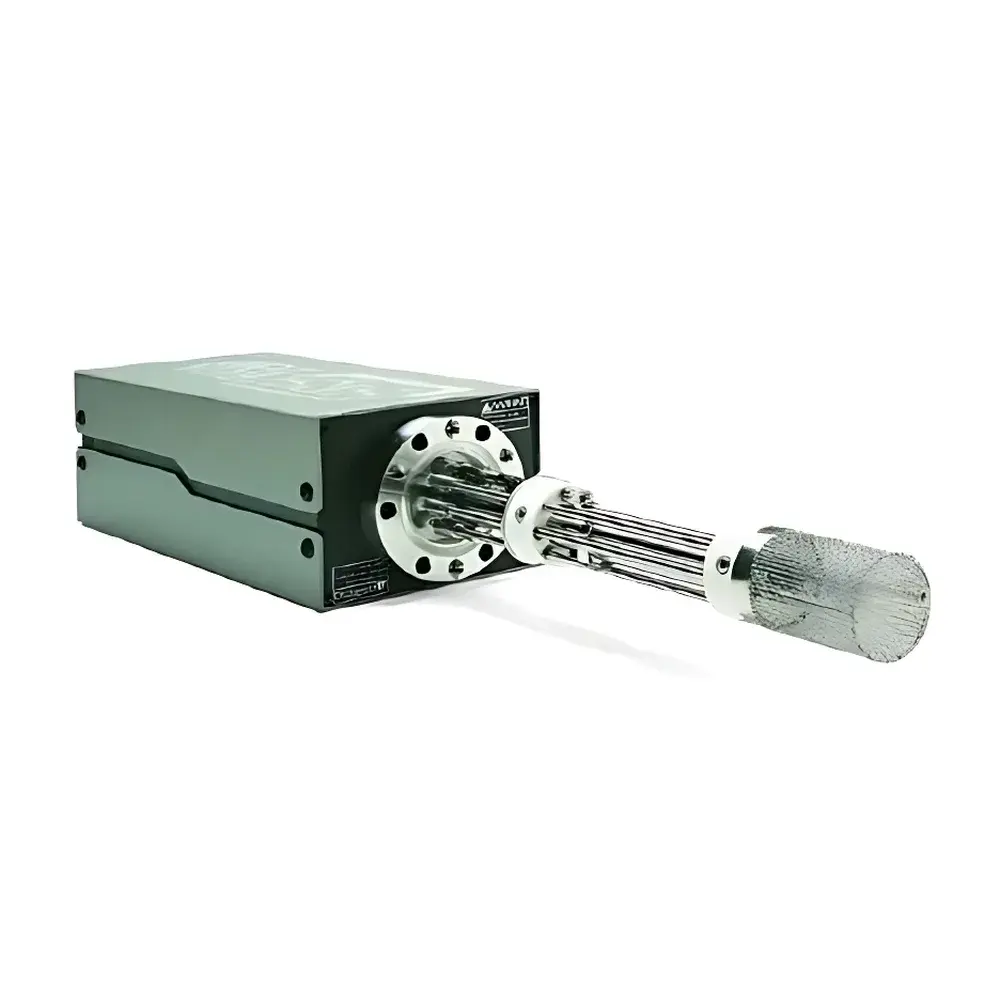
Stanford Research Systems RGA Series Residual Gas Analyzer
| Brand | SRS/Stanford Research Systems |
|---|---|
| Origin | USA |
| Model | RGA |
| Mass Range | 100 amu / 200 amu / 300 amu |
| Resolution | < 0.5 amu |
| Dynamic Range | 6 decades |
| Detection Limit | 5 × 10⁻¹⁴ Torr (with EM detector) |
| Sensitivity | 2 × 10⁴ A/Torr (FC), >200 A/Torr (EM) |
| Operating Pressure Range | 10⁻⁴ Torr to UHV (FC) |
| Max. Probe Temperature | 300 °C (without ECU) |
| Max. ECU Temperature | 70 °C |
| Detector Options | Faraday Cup (standard), Electron Multiplier (optional) |
| Interface | RS-232 |
| Software | Real-time RGA Windows & LabVIEW drivers |
| Replaceable Components | Filament and electron multiplier in situ |
Overview
The Stanford Research Systems RGA Series Residual Gas Analyzer is a quadrupole mass spectrometer engineered for precise, real-time identification and quantification of trace gaseous species within vacuum environments. Operating on the principle of mass-selective ion filtering via radio-frequency (RF) and direct-current (DC) voltages applied to hyperbolic rod electrodes, the RGA enables high-fidelity residual gas analysis across ultra-high vacuum (UHV) to medium vacuum regimes. Unlike broad-spectrum gas sensors, this instrument delivers true compositional speciation—distinguishing helium, hydrogen, water vapor, hydrocarbons, CO, CO₂, nitrogen, oxygen, and process contaminants by their mass-to-charge (m/z) ratios. Its design prioritizes stability under thermal and pressure transients, making it suitable for integration into semiconductor processing chambers, particle accelerator beamlines, thin-film deposition systems, and space simulation facilities where vacuum integrity and outgassing characterization are mission-critical.
Key Features
- Three configurable mass ranges: 100 amu, 200 amu, and 300 amu—optimized for applications ranging from leak detection to complex process gas monitoring
- Mass resolution better than 0.5 amu at 10% peak height, ensuring reliable separation of adjacent isotopes (e.g., ²⁸N⁺ vs. ²⁸CO⁺) and overlapping fragments
- 6-decade dynamic range supports simultaneous detection of major background species and sub-picoTorr-level contaminants
- Dual-detector architecture: Standard Faraday cup for high-current, low-noise measurement; optional electron multiplier for enhanced sensitivity down to 5 × 10⁻¹⁴ Torr partial pressure
- Hot cathode ion source with field-replaceable filament and EM assembly—enabling maintenance without venting the vacuum system
- RS-232 serial interface compliant with standard SCPI command syntax for seamless integration into automated vacuum control architectures
- Thermally robust probe capable of continuous operation up to 300 °C (probe-only mode), minimizing condensable adsorption artifacts during high-temperature bakeouts
Sample Compatibility & Compliance
The RGA Series is compatible with all common vacuum technologies—including turbomolecular, cryogenic, and ion pumps—and interfaces directly with ConFlat (CF), ISO-K, and NW flange configurations. It meets mechanical and electrical requirements per CE marking directives (2014/30/EU EMC Directive, 2014/35/EU LVD). While not certified as a safety-critical device per IEC 61508, its firmware and hardware architecture support GLP/GMP-aligned operational protocols when deployed in regulated environments such as semiconductor fab tool qualification or NASA-standard vacuum chamber certification. Data acquisition workflows comply with ALCOA+ principles when used with timestamped, audit-trail-enabled software configurations. The instrument does not require hazardous gas certifications, as it analyzes gases already present within evacuated systems rather than drawing ambient samples.
Software & Data Management
RGA systems ship with Real-Time RGA—a native Windows application supporting spectral acquisition, peak identification, time-resolved partial pressure trending, and customizable alarm thresholds. Full LabVIEW VIs (version 2015 and later) enable programmable control of scan parameters (step size, dwell time, mass range), detector gain switching, and synchronized logging with external DAQ devices. All acquired spectra include embedded metadata: timestamp (UTC), instrument ID, detector mode, emission current, and calibration file version. Export formats include CSV, ASCII, and binary .RGA files—compatible with third-party spectral libraries (NIST Chemistry WebBook, SRS-provided reference spectra). Audit trails record user-initiated actions (e.g., filament activation, EM bias adjustment), satisfying FDA 21 CFR Part 11 requirements when paired with validated Windows domain authentication and electronic signature modules.
Applications
- Leak detection and localization using helium tracer gas, with detection sensitivity enabling identification of leaks below 1 × 10⁻¹¹ atm·cm³/s
- Process chamber conditioning verification—monitoring H₂O, O₂, and hydrocarbon decay profiles during pump-down and bakeout cycles
- Thin-film deposition endpoint detection via reactive gas consumption kinetics (e.g., SiH₄ depletion in PECVD)
- Outgassing rate quantification per ASTM E595 for spacecraft material screening
- Residual gas fingerprinting in synchrotron beamline front-ends to diagnose photon-induced desorption events
- UHV system health diagnostics—including identifying oil backstreaming (m/z = 41, 55, 69), elastomer degradation (m/z = 73, 147), or metal oxide formation (m/z = 16, 32)
FAQ
What vacuum level is required before initiating RGA analysis?
Stable operation begins at 10⁻⁴ Torr for Faraday cup mode and 10⁻⁶ Torr for electron multiplier mode. Below these thresholds, signal-to-noise ratio degrades significantly due to ion-molecule collision effects and space charge limitations.
Can the RGA be used for quantitative analysis without calibration?
Yes—for relative comparisons and trend analysis—but absolute partial pressure values require species-specific sensitivity factors, typically derived from NIST-traceable calibration gases or empirical response curves generated under identical operating conditions.
Is remote operation supported over Ethernet or USB?
The standard interface is RS-232; however, RS-232-to-Ethernet converters (e.g., Digi One SP) are widely deployed in industrial settings. USB connectivity is not natively supported, but USB-to-serial adapters compliant with FTDI chipsets maintain full command compatibility.
How often should the filament be replaced?
Filament lifetime depends on total accumulated emission hours and exposure to oxidizing species. Under typical UHV conditions (<10⁻⁹ Torr), filaments last 6–12 months at 2 mA emission current; in reactive gas environments, replacement intervals may shorten to 2–4 weeks.
Related Products







