
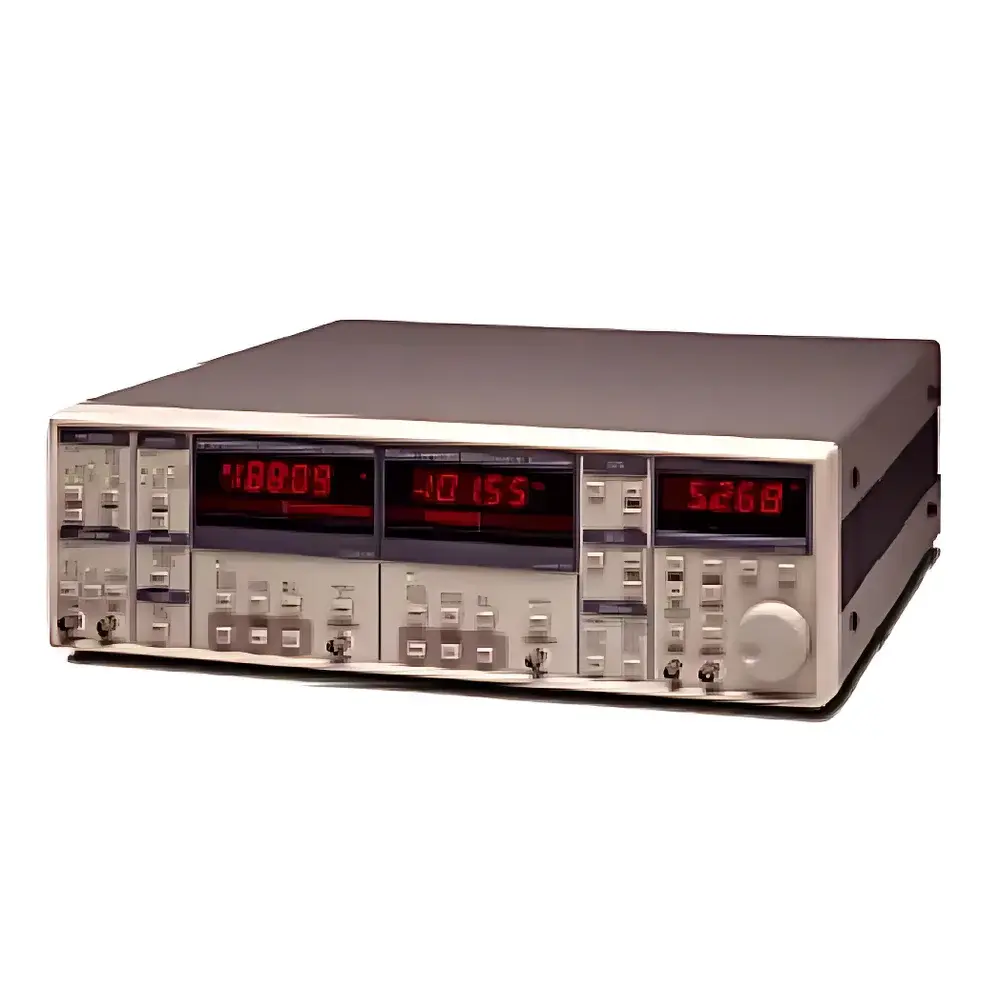
Stanford Research Systems SR830 Digital Dual-Phase Lock-in Amplifier
| Brand | SRS/Stanford Research Systems |
|---|---|
| Origin | USA |
| Manufacturer Type | Authorized Distributor |
| Product Category | Imported |
| Model | SR830 |
| Component Type | Signal Detection & Demodulation Module |
| Gain Range | 2 nV to 1 V (full-scale) |
| Frequency Range | 0.001 Hz to 102.4 kHz |
| Dynamic Reserve | >100 dB |
| Time Constant Range | 10 µs to 30 ks |
| Input Noise | 6 nV/√Hz @ 1 kHz (voltage), 0.13 pA/√Hz @ 1 kHz (10⁶ V/A current gain), 0.013 pA/√Hz @ 100 Hz (10⁸ V/A) |
| Phase Resolution | 0.008° (computer-controlled), 0.01° (front-panel) |
| Phase Drift | 0.01°/°C (<10 kHz), 0.1°/°C (>10 kHz) |
| Input Impedance (Voltage) | 10 MΩ + 25 pF, AC/DC coupled |
| Input Impedance (Current) | 1 kΩ to virtual ground |
| Reference Input | TTL or sine wave, 400 mV rms min (sine), logic-level compatible (TTL) |
| Interface | IEEE-488.2 (GPIB), RS-232 |
| Power | 40 W, 100–240 V AC, 50/60 Hz |
| Dimensions | 432 × 495 × 133 mm (L×W×H) |
Overview
The Stanford Research Systems SR830 Digital Dual-Phase Lock-in Amplifier is a precision instrument engineered for high-sensitivity detection and demodulation of weak periodic signals buried in noise—typically at signal-to-noise ratios below –100 dB. Operating on the principle of synchronous demodulation, the SR830 employs two orthogonal (0° and 90° phase-shifted) reference channels to extract both in-phase (X) and quadrature (Y) components of an input signal. These are mathematically combined to yield magnitude (R = √(X² + Y²)) and phase (θ = arctan(Y/X)), enabling quantitative analysis of amplitude and phase response in real time. Its digital architecture—featuring high-resolution ADCs, FPGA-based signal processing, and stable clock synthesis—ensures exceptional long-term stability and repeatability across decades of frequency (0.001 Hz to 102.4 kHz) and dynamic range (>100 dB dynamic reserve). Designed for integration into optical, electronic, and materials characterization setups, the SR830 serves as a foundational tool in ultra-low-light spectroscopy, impedance spectroscopy of superconductors, piezoelectric response mapping, and quantum transport measurements.
Key Features
- Dual-phase demodulation with independent X and Y outputs, plus derived R and θ outputs via front-panel BNC connectors
- Configurable input modes: voltage (high-impedance differential or single-ended) or current (10⁶ V/A or 10⁸ V/A transimpedance gain)
- Programmable sensitivity range from 2 nV to 1 V full scale, with gain accuracy ±1% (typical ±0.2%) and temperature drift <5 ppm/°C
- Low-noise analog front-end: 6 nV/√Hz input voltage noise at 1 kHz; sub-picoampere current noise performance optimized for photodiode and cryogenic detector interfaces
- Adjustable time constants from 10 µs to 30 ks, selectable filter slopes (6, 12, 18, or 24 dB/octave) for optimal noise rejection vs. response speed trade-offs
- Reference channel supports TTL-compatible pulses or sine waves; phase control resolution of 0.008° (GPIB/RS-232) and 0.01° (front panel), with low thermal drift (≤0.01°/°C below 10 kHz)
- Integrated auto-functions: Auto-gain, Auto-phase, Auto-dynamic-reserve, and Auto-offset compensation reduce setup time and operator dependency
Sample Compatibility & Compliance
The SR830 interfaces seamlessly with a broad spectrum of transducers and detectors—including photomultiplier tubes (PMTs), avalanche photodiodes (APDs), lock-in thermography sensors, and low-temperature Hall probes—without requiring external preamplification in most configurations. Its high-input-impedance voltage mode (10 MΩ || 25 pF) supports direct connection to piezoelectric elements and electro-optic modulators, while its low-impedance current mode (1 kΩ to virtual ground) ensures stable operation with fast-response photodiodes. The instrument complies with IEC 61000-4 electromagnetic compatibility standards and meets UL/CSA safety requirements for laboratory instrumentation. While not certified for medical or industrial process control, its traceable calibration path, stable gain/phase behavior, and audit-ready parameter logging support GLP-aligned experimental workflows—particularly when used with compliant data acquisition software under controlled environmental conditions.
Software & Data Management
The SR830 communicates via IEEE-488.2 (GPIB) and RS-232 serial interfaces, enabling full remote control and data streaming using industry-standard protocols. Native drivers are available for LabVIEW, MATLAB, Python (PyVISA), and C/C++. All instrument settings—including sensitivity, time constant, filter slope, reference phase, and display channel assignments—are programmable and recallable. Real-time X, Y, R, and θ values can be streamed at up to 512 samples per second (dependent on time constant and filter settings), with timestamping supported via external trigger synchronization. Data output is ASCII-formatted and compatible with CSV import for post-processing in Origin, Igor Pro, or Python-based analysis pipelines. While the SR830 itself does not implement FDA 21 CFR Part 11 electronic signature or audit-trail features, its deterministic command-response behavior and consistent register-mapped memory structure allow integration into validated systems when paired with compliant host software and procedural controls.
Applications
- Modulation-transfer-function (MTF) characterization of optical components using chopped laser sources
- Time-resolved fluorescence lifetime measurements via phase-modulated excitation and homodyne detection
- AC susceptibility and critical-current mapping of high-Tc superconducting thin films
- Electrochemical impedance spectroscopy (EIS) of battery electrodes and fuel-cell catalysts
- Scanning probe microscopy (SPM) signal recovery in atomic force acoustic microscopy (AFAM) and Kelvin probe force microscopy (KPFM)
- Nonlinear optical coefficient determination via second-harmonic generation (SHG) lock-in detection
- Low-frequency dielectric spectroscopy of polymer electrolytes and biological membranes
FAQ
What is the maximum usable bandwidth for real-time data streaming?
Maximum sustained data throughput is 512 points/second for all four outputs (X, Y, R, θ) when configured with short time constants (e.g., 100 µs) and minimal filtering. Throughput decreases with longer time constants due to inherent low-pass filtering latency.
Can the SR830 measure signals below 1 mHz?
Yes—the SR830 supports frequencies down to 0.001 Hz (1 mHz), though measurement stability at ultra-low frequencies requires careful attention to thermal drift, grounding, and reference signal jitter; use of external low-noise reference oscillators is recommended for sub-10 mHz applications.
Is internal calibration traceable to NIST standards?
SRS provides factory calibration documentation with uncertainty budgets traceable to NIST through accredited metrology laboratories; recalibration services follow ISO/IEC 17025 procedures and include full report-of-calibration with as-found/as-left data.
How does dynamic reserve affect measurement fidelity?
Dynamic reserve quantifies the amplifier’s ability to reject out-of-band interference while preserving in-band signal integrity; >100 dB reserve means the instrument can accurately resolve a 1 µV signal in the presence of a 100 mV noise component at unrelated frequencies—critical for heterodyne detection and multi-frequency excitation schemes.
Does the SR830 support harmonic detection (e.g., 2f, 3f)?
No—the SR830 is a fundamental-frequency (1f) lock-in amplifier. Harmonic detection requires external frequency multiplication or use of SRS’s SR850 or SR865 models, which offer multi-harmonic and dual-frequency capabilities.




