
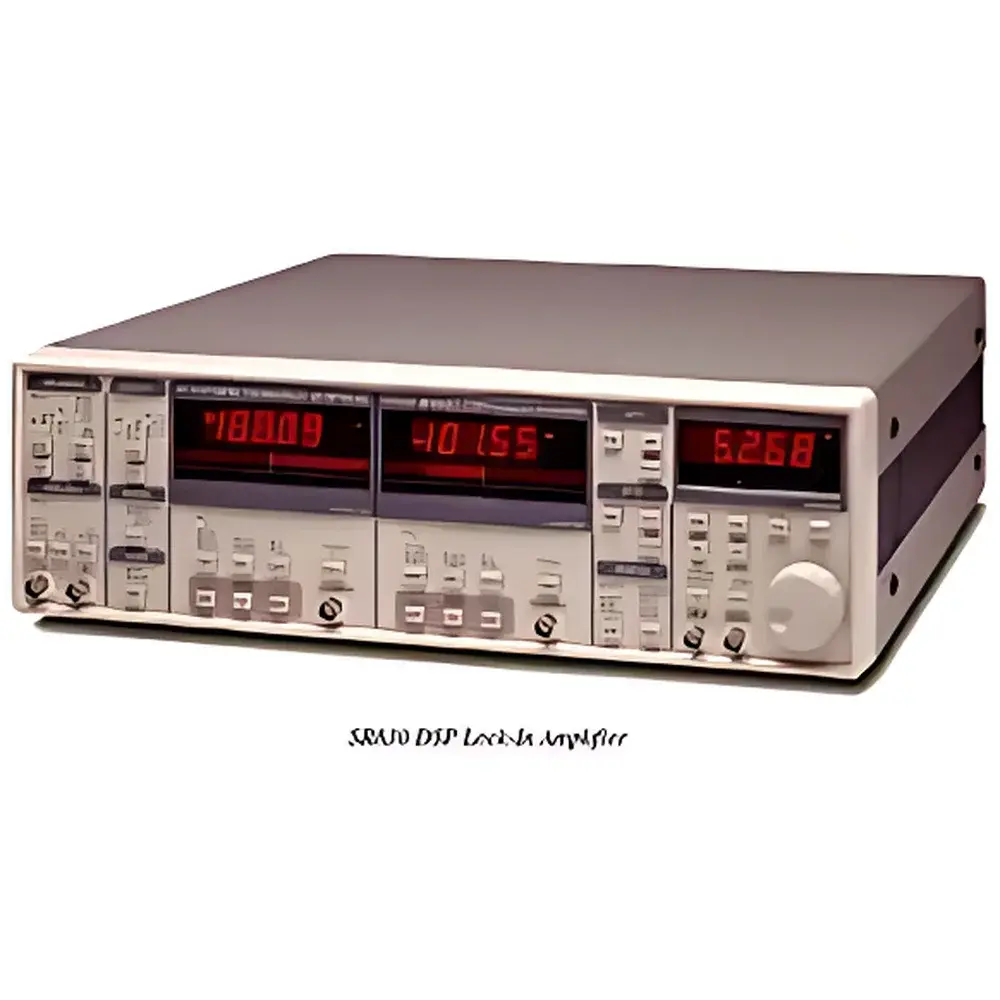
Stanford Research Systems SR830 Digital Lock-in Amplifier
| Brand | SRS/Stanford Research Systems |
|---|---|
| Origin | USA |
| Model | SR830 |
| Frequency Range | 1 mHz to 102.4 kHz |
| Dynamic Reserve | >100 dB |
| Phase Resolution | 0.01° |
| Time Constant Range | 10 µs to 30 ks (6–24 dB/octave roll-off) |
| Input Noise | 6 nV/√Hz |
| Input Impedance | 10 MΩ |
| Sensitivity | Down to 2 nV full scale |
| Current Gain Options | 10⁶ V/A and 10⁸ V/A |
| Stability | 5 ppm/°C |
| Reference Source | Direct Digital Synthesis (DDS), <−80 dBc distortion |
| Interfaces | GPIB (IEEE-488.2) and RS-232 |
| Auxiliary Inputs | 4 × 16-bit ADC |
| Analog Outputs | X, Y, R, θ, noise, and user-defined ratios (256 kHz update rate) |
| Built-in Auto Functions | Auto-gain, auto-phase, auto-offset, auto-dynamic reserve |
Overview
The Stanford Research Systems SR830 Digital Lock-in Amplifier is a precision instrument engineered for the detection and measurement of extremely weak AC signals buried in high-noise environments—particularly in optical, laser, and low-temperature physics applications. Operating on the principle of synchronous demodulation, the SR830 multiplies the input signal with a phase-coherent reference waveform and applies digital low-pass filtering to extract DC outputs proportional to the in-phase (X) and quadrature (Y) components of the signal. Unlike analog lock-in amplifiers that rely on analog multipliers and passive RC filters, the SR830 employs high-resolution analog-to-digital conversion followed by real-time digital signal processing (DSP), eliminating drift, harmonic distortion, and gain/phase errors associated with analog circuitry. Its 1 mHz–102.4 kHz operating bandwidth, >100 dB dynamic reserve without pre-filtering, and 0.01° phase resolution make it suitable for demanding applications such as photothermal spectroscopy, scanning probe microscopy, quantum transport measurements, and modulated optical reflectance.
Key Features
- Digital synchronous demodulation using 24-bit A/D conversion and DDS-based reference synthesis ensures long-term stability and repeatability.
- Dynamic reserve exceeding 100 dB enables accurate measurement of signals immersed in noise up to 100,000× larger than the signal amplitude—without analog tracking bandpass filters.
- Phase resolution of 0.01° and orthogonal X/Y output resolution of 0.001° support high-fidelity vector analysis in impedance or ellipsometry measurements.
- Programmable time constants from 10 µs to 30 ks with selectable filter slopes (6, 12, 18, or 24 dB/octave) accommodate both transient and ultra-low-frequency measurements.
- Integrated dual-channel analog output (X, Y, R, θ, noise, and user-defined ratios) updated at 256 kHz supports real-time monitoring and feedback control loops.
- Four 16-bit auxiliary inputs enable normalization (e.g., referencing photodiode current to laser power fluctuations); four 16-bit DAC outputs provide programmable bias or control voltages (±10.5 V).
- Front-panel and computer-controlled auto-functions—including auto-gain, auto-phase, auto-offset, and auto-dynamic reserve—streamline setup and improve measurement reproducibility across experimental conditions.
Sample Compatibility & Compliance
The SR830 accepts voltage or current inputs via differential BNC connectors with 10 MΩ input impedance and configurable gain (2 nV to 1 V full scale). Current mode operation supports transimpedance gains of 10⁶ V/A and 10⁸ V/A, making it compatible with photodiodes, bolometers, and other low-current detectors. Line-frequency rejection (50/60 Hz and 100/120 Hz notch filters) mitigates ambient electromagnetic interference without compromising signal fidelity. The instrument complies with CE marking requirements for EMC and safety, and its digital architecture supports audit-ready data acquisition workflows aligned with GLP and GMP principles. While not FDA 21 CFR Part 11 certified out-of-the-box, its deterministic DSP core, non-volatile configuration storage, and GPIB/RS-232 traceability enable integration into validated laboratory systems when paired with compliant software environments.
Software & Data Management
The SR830 communicates via standard GPIB (IEEE-488.2) and RS-232 interfaces, supporting SCPI command sets for seamless integration with LabVIEW, MATLAB, Python (via PyVISA), and custom C/C++ applications. All settings—including sensitivity, time constant, filter slope, reference source, and harmonic order—are fully scriptable and recallable. Nine instrument configurations can be stored in non-volatile RAM for rapid reconfiguration between experiments. Output data streams (X, Y, R, θ, and auxiliary channels) are timestamped and streamed at up to 512 samples per second over GPIB, enabling synchronized acquisition with oscilloscopes, DAQ systems, or motion controllers. Firmware updates are delivered via ASCII text files through serial interface, ensuring long-term maintainability without proprietary toolchains.
Applications
- Optical heterodyne detection in interferometric sensing and laser Doppler vibrometry.
- Modulated reflectance and photoluminescence spectroscopy for semiconductor defect characterization.
- AC susceptibility measurements in superconducting and magnetic materials research.
- Scanning tunneling and atomic force microscopy (STM/AFM) lock-in detection for topographic and spectroscopic mapping.
- Low-noise cryogenic measurements where thermal EMF and microphonic pickup must be rejected.
- Calibration of radiation thermometers and bolometric power meters using chopped blackbody sources.
- Synchronization with external timing devices such as the SRS DG535 digital delay generator for pump-probe experiments.
FAQ
What is the difference between the SR830 and SR810?
The SR830 provides simultaneous X, Y, R, and θ outputs with 0.01° phase resolution, while the SR810 outputs only X and R (magnitude-only detection). The SR830 also includes a second user-definable analog output channel and enhanced harmonic detection capabilities.
Can the SR830 measure higher harmonics of the reference frequency?
Yes—it supports harmonic detection up to any integer order N, provided the harmonic frequency (N × fref) remains within the 1 mHz–102.4 kHz bandwidth.
Is external reference synchronization supported?
Yes—the internal DDS reference generator can phase-lock to an external TTL or sine-wave reference input, preserving jitter performance and enabling multi-instrument coherence.
How does the SR830 achieve >100 dB dynamic reserve without analog bandpass filtering?
Through oversampling, high-bit-depth digitization, and numerically implemented narrow-band digital filters that reject out-of-band noise before demodulation—eliminating analog filter-induced distortion and drift.
Does the SR830 support automated calibration routines?
While it lacks self-calibrating hardware, its stable DSP architecture, factory-trimmed gain/phase coefficients, and SCPI-accessible offset/gain controls allow scripted calibration against traceable AC standards.






