
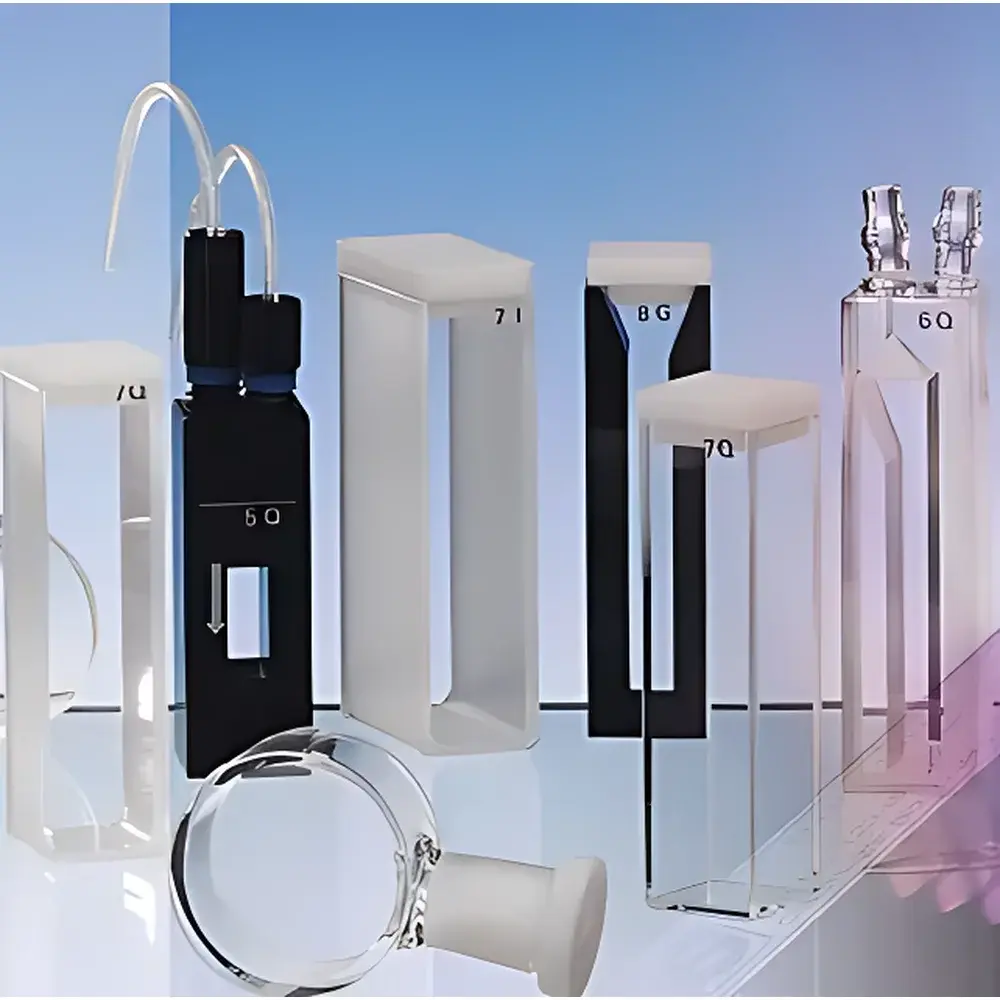
Starna Quartz Cuvettes for UV-Vis Spectrophotometers
| Brand | Starna |
|---|---|
| Origin | United Kingdom |
| Manufacturer Type | Authorized Distributor |
| Import Status | Imported |
| Model | Starna Standard & Specialized Quartz Cuvettes |
| Price Range | USD 0 – 999 |
Overview
Starna quartz cuvettes are precision-engineered optical cells designed for high-fidelity transmission measurements across the ultraviolet, visible, and near-infrared spectral ranges (190–2500 nm). Constructed from synthetic fused silica with exceptional UV transparency, low autofluorescence, and minimal batch-to-batch variation in refractive index and absorption coefficient, these cuvettes serve as critical metrological interfaces between light source, sample, and detector in spectrophotometric analysis. Their geometry adheres strictly to ISO 10810:2021 and ASTM E275-22 standards for cuvette dimensional tolerances, optical path length accuracy (±0.02 mm for 10 mm pathlength), and parallelism of optical faces (< 3 arcseconds). The fundamental measurement principle relies on Beer–Lambert law quantification—where absorbance A = ε·c·l—and demands that cuvette-induced optical artifacts (e.g., stray light, reflection loss, birefringence) remain below instrument detection thresholds. Starna’s manufacturing process includes laser interferometric face flatness verification, vacuum UV-grade cleaning, and individual spectral transmittance certification per lot.
Key Features
- Optical material: High-purity synthetic quartz (Suprasil® or equivalent), certified for ≥85% transmittance at 190 nm and ≥93% at 250 nm
- Standard pathlengths: 1 mm, 2 mm, 5 mm, 10 mm (most widely compatible), 20 mm, 50 mm, and 100 mm—each calibrated traceably to NPL (UK) reference standards
- Surface quality: λ/10 surface flatness, scratch-dig 10–5 per MIL-PRF-13830B, polished to < 0.5 nm RMS roughness
- Sealing options: PTFE-threaded caps (GL14 thread standard), silicone septa-compatible closures (Type 1, 9, 18/GL14), and inert O-ring seals for volatile or air-sensitive samples
- Specialized variants: Blackened-body cuvettes (Types 9B, 18B, 28B, 17B) reduce stray light by >99.9% via matte carbon coating; ultra-low-volume formats (Types 15, 15A, 16, 16R, 17) support 10–160 µL sample volumes with minimized meniscus error
- Traceability: Each batch supplied with Certificate of Conformance including spectral transmittance curves (200–1100 nm), pathlength verification data, and lot-specific UV cutoff wavelength
Sample Compatibility & Compliance
Starna quartz cuvettes are chemically inert toward aqueous solutions, organic solvents (including acetone, chloroform, and DMSO), strong acids (HCl, HNO₃ up to 6 M), and alkaline media (NaOH ≤ 1 M) when used within recommended temperature limits (−40 °C to +120 °C). They are not suitable for hydrofluoric acid or molten alkalis. All standard cuvettes comply with ISO/IEC 17025-accredited calibration protocols and are validated for use in GLP- and GMP-regulated environments. Documentation supports 21 CFR Part 11 compliance when integrated with validated spectrophotometer software platforms (e.g., Agilent Cary, Shimadzu UV-Vis, PerkinElmer Lambda series). Cuvette dimensions conform to IUPAC-recommended mechanical interface specifications, ensuring mechanical compatibility with autosamplers (e.g., Agilent 8000 Series, JASCO ASC-710) and temperature-controlled holders (Peltier or circulating water jackets).
Software & Data Management
While cuvettes themselves are passive optical components, Starna provides digital asset support for laboratory informatics integration: downloadable spectral transmittance datasets (CSV and ASCII format), 3D STEP files for mechanical CAD integration, and batch-specific QR-coded labels enabling LIMS traceability. For users operating under FDA-regulated workflows, Starna’s CoC templates include fields for analyst signature, calibration date, instrument ID linkage, and environmental condition logging (temperature/humidity)—facilitating audit-ready documentation per ALCOA+ principles. No proprietary firmware or drivers are required; compatibility is inherent to optical design and dimensional conformity.
Applications
- Quantitative UV-Vis spectroscopy per USP , EP 2.2.25, and JP 2.05 for pharmaceutical assay and impurity profiling
- Enzyme kinetics monitoring (e.g., NADH/NADPH oxidation at 340 nm) using sub-50 µL microvolume cuvettes (Types 15A, 16R)
- Nanoparticle characterization (DLS pre-screening, plasmonic absorbance) requiring low-scatter black-body cuvettes (Type 18B)
- High-concentration protein analysis where extended pathlengths (50–100 mm) eliminate serial dilution errors
- Reference-grade method validation in national metrology institutes (e.g., NIST SRM alignment studies)
- Field-deployable portable spectrometers requiring ruggedized 10 mm quartz cells with threaded sealing (Type 29)
FAQ
What is the shortest pathlength available for Starna quartz cuvettes, and what volume does it accommodate?
The shortest standard pathlength is 1 mm (Type 17/17B), optimized for highly absorbing samples; it holds ~15–25 µL depending on fill height and meniscus control.
Are Starna cuvettes suitable for fluorescence measurements?
Yes—low-fluorescence quartz grades are available upon request (certified < 0.1% relative fluorescence intensity at 280 nm excitation); standard cuvettes are intended for absorbance only.
Do black-body cuvettes affect photometric accuracy?
No—internal blackening eliminates internal reflections without altering the effective optical path or introducing absorption artifacts; certified transmittance data accounts for coating effects.
Can I use Starna cuvettes with a thermoelectrically controlled holder?
Yes—quartz’s low thermal expansion coefficient (5.5 × 10⁻⁷ /°C) ensures dimensional stability across −20 °C to +80 °C cycling; verify holder clamping force does not exceed 2.5 N to prevent microfracture.
How often should quartz cuvettes be recalibrated?
Cuvettes do not require periodic recalibration; however, users must perform baseline correction before each analytical run and inspect for scratches, etching, or residue using a 10× magnifier and white-light interference test.




