
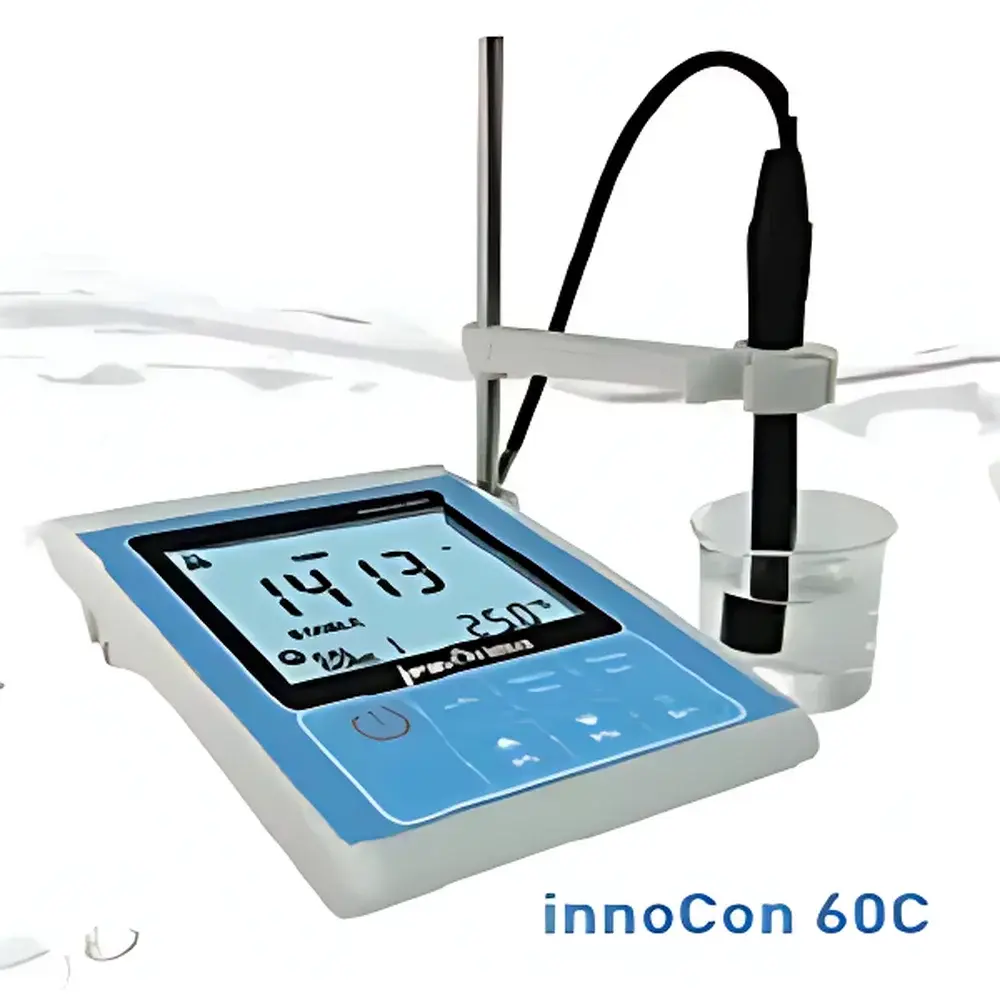
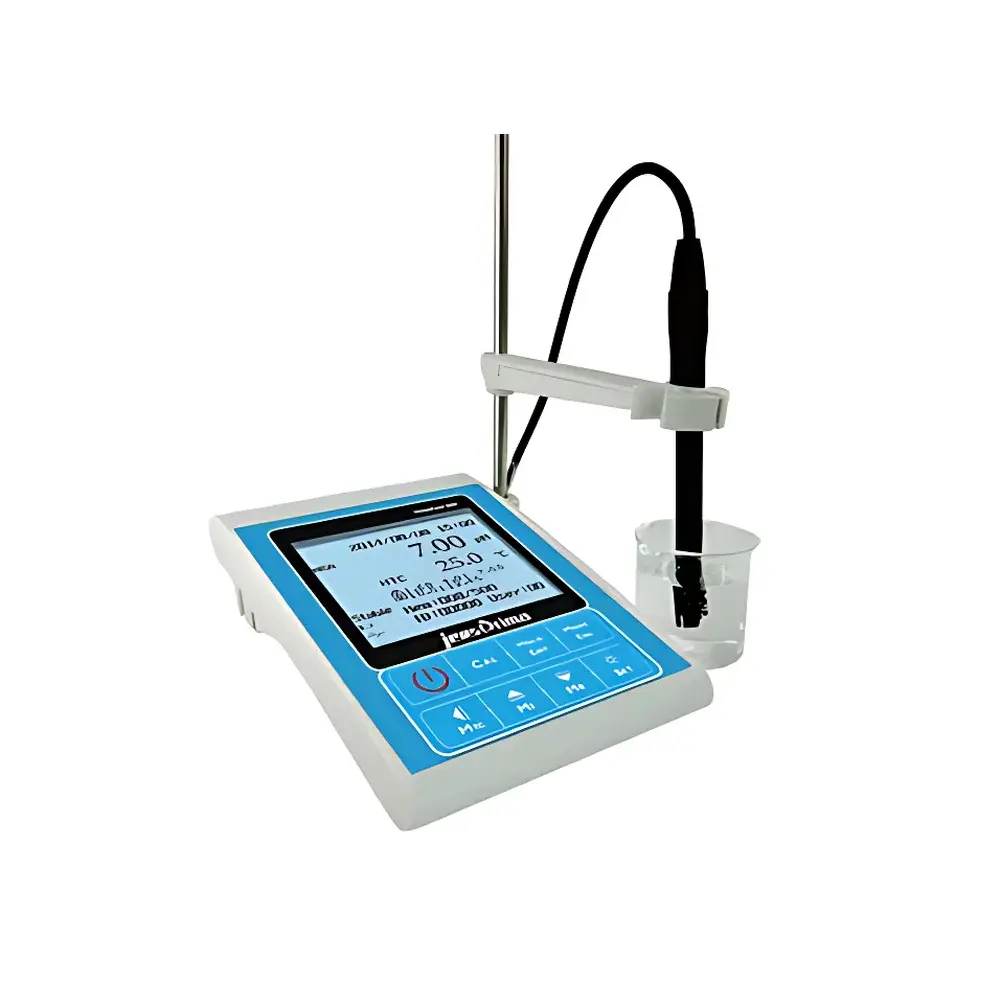
Starwood InnoCon 60C Benchtop Conductivity, Salinity & TDS Meter
| Brand | Starwood |
|---|---|
| Origin | Beijing, China |
| Manufacturer Type | OEM/ODM Manufacturer |
| Origin Category | Domestic (China) |
| Model | InnoCon 60C |
| Detection Parameters | Conductivity, Salinity, TDS, Resistivity, Temperature |
| Portability | Benchtop |
| Intended Use | Laboratory |
| Conductivity Range | 0–5.000 / 50.00 / 500.0 / 5000 µS/cm |
| TDS Range | 0–500 ppt |
| Resistivity Range | 0–100 MΩ·cm |
| Salinity Range | 0–325 ppt |
| Temperature Range | 5–55 °C |
| Accuracy | ±1% of Full Scale |
| Minimum Resolution | 0.001 / 0.01 / 0.1 / 1 µS/cm |
| Temperature Compensation | Automatic (adjustable TC coefficient: 0.00–9.99%, factory default 2.00%) |
| Data Storage | 100 measurement records |
| Power Supply | Rechargeable Li-ion battery with AC adapter |
| Interface | USB-B for PC connectivity |
| Display | Backlit LCD with adjustable brightness and keypress tone |
| Electrode Diagnostics | Real-time electrode status indication |
| Auto Power-Off | Configurable timeout (default: 10 min) |
| Calibration | Manual 1–3 point calibration with user-defined standards |
Overview
The Starwood InnoCon 60C is a precision-engineered benchtop conductivity meter designed for routine and quality-critical laboratory analysis of aqueous solutions. It operates on the principle of two-electrode conductometric measurement, where electrical conductance is determined by applying an alternating current (AC) voltage across a standardized cell and measuring the resulting current. The instrument simultaneously computes derived parameters—including total dissolved solids (TDS), salinity (in practical salinity units, PSU), and resistivity—using industry-standard conversion algorithms compliant with ASTM D1125 and ISO 7888. Its multi-range auto-scaling architecture enables seamless transition between low-conductivity ultrapure water monitoring (e.g., pharmaceutical rinse water) and high-conductivity industrial effluent or seawater simulation. Engineered for reproducibility in regulated environments, the InnoCon 60C supports traceable calibration workflows and integrates temperature compensation per the linearized CaCl₂ or NaCl reference curves, ensuring measurement integrity across dynamic thermal conditions typical in environmental and process control labs.
Key Features
- Five-parameter simultaneous readout: conductivity, TDS, salinity, resistivity, and temperature—with real-time unit switching (µS/cm, mS/cm, ppm, ppt, MΩ·cm, °C)
- Intelligent electrode diagnostics: continuous monitoring of cell constant deviation, polarization effects, and contact integrity—displayed via icon-based status indicators
- Configurable temperature compensation: user-adjustable temperature coefficient (0.00–9.99%/°C), with factory-default 2.00% setting aligned to IAPSO standard seawater behavior
- Dual power architecture: integrated rechargeable Li-ion battery (≥12 h runtime) + universal AC adapter—enabling uninterrupted operation during power fluctuations or temporary relocation within lab zones
- Regulatory-ready interface: USB-B port compliant with CDC/USB CDC ACM class drivers; supports direct data export to CSV or Excel-compatible formats without proprietary software
- GLP-compliant data management: timestamped 100-point internal memory with automatic record ID assignment; no overwrite protection enabled by default
- Ergonomic operator interface: backlit LCD with adjustable brightness levels and tactile keypress feedback—optimized for extended use under variable ambient lighting
Sample Compatibility & Compliance
The InnoCon 60C is validated for use with standard K = 0.1, 1.0, and 10.0 cm⁻¹ conductivity cells (not included), supporting both aqueous calibration standards (e.g., KCl 0.01 mol/kg, 0.1 mol/kg) and process-relevant matrices such as boiler feedwater, cooling tower blowdown, municipal wastewater influent/effluent, aquaculture pond water, and desalination brine streams. All measurement algorithms adhere to ISO/IEC 17025 technical requirements for uncertainty estimation and are compatible with laboratory quality systems operating under ISO 9001, ISO/IEC 17025, and USP <645>. While not FDA 21 CFR Part 11-certified out-of-the-box, its audit-trail-capable data logging and immutable record structure facilitate validation for GMP/GLP applications when deployed with documented SOPs and periodic verification protocols.
Software & Data Management
Data transfer occurs via native USB virtual COM port communication—requiring no third-party drivers on Windows 10/11, macOS 12+, or Linux kernel ≥5.4. Exported files follow ANSI X3.4-compliant UTF-8 encoding with tab-delimited fields: Record_ID, Date_Time, Conductivity_(µS_cm), TDS_(ppt), Salinity_(PSU), Resistivity_(MΩ·cm), Temp_(°C), Cell_Constant_(cm⁻¹), TC_Coefficient_(%/°C). The instrument does not embed firmware-level encryption or digital signature functions; however, exported datasets are fully compatible with LIMS integration via middleware scripts (e.g., Python pandas, LabVIEW DAQmx). Calibration history—including date, standard used, slope, offset, and R²—is stored separately and retrievable via USB dump.
Applications
- Environmental monitoring labs: compliance testing of surface water, groundwater, and wastewater per EPA Method 120.1 and APHA Standard Methods 2510B
- Pharmaceutical water systems: conductivity verification of Purified Water (PW) and Water for Injection (WFI) per USP <645> stages 1–3
- Power generation QA/QC: feedwater purity assessment in steam-cycle plants and condensate return loop surveillance
- Aquaculture and hydroponics: real-time salinity and nutrient concentration tracking in recirculating systems
- Academic teaching laboratories: foundational electrochemistry experiments involving Kohlrausch’s law, ion mobility, and solution conductivity modeling
- Food & beverage R&D: brine concentration control in pickling, fermentation, and dairy processing
FAQ
What calibration standards are recommended for routine verification?
KCl solutions traceable to NIST SRM 3601 (0.01 mol/kg, 0.1 mol/kg) are recommended for primary calibration; secondary verification may use certified conductivity standards from Merck, Hanna, or Thermo Fisher.
Does the InnoCon 60C support automatic cell constant recognition?
No—it requires manual entry of the cell constant prior to calibration; however, the electrode diagnostic function alerts users to significant deviations (>±5%) from the entered value.
Can measurement data be time-synchronized with external NTP servers?
No—the internal RTC lacks network connectivity; time stamps reflect local system clock at time of measurement and must be synchronized manually if traceability to UTC is required.
Is the instrument suitable for measuring high-ionic-strength brines above 300 ppt salinity?
Yes—within its specified 0–325 ppt range—but accuracy degrades near upper limits due to non-linear ion-pairing effects; use of a K = 10.0 cm⁻¹ cell and temperature-controlled sampling is strongly advised.
How often should the rechargeable battery be cycled to maintain longevity?
For optimal service life, perform full discharge/recharge cycles no more than once per quarter; continuous float charging via AC adapter is supported and does not harm battery health.





