
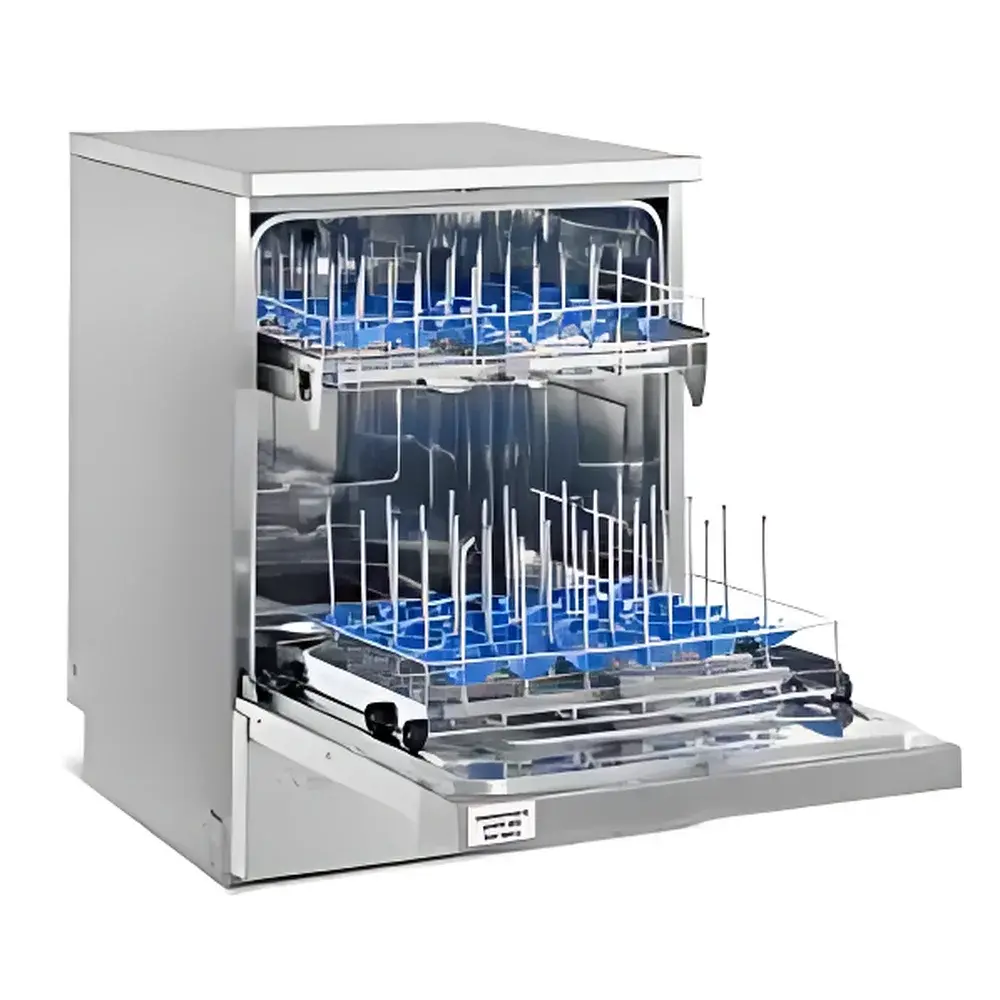
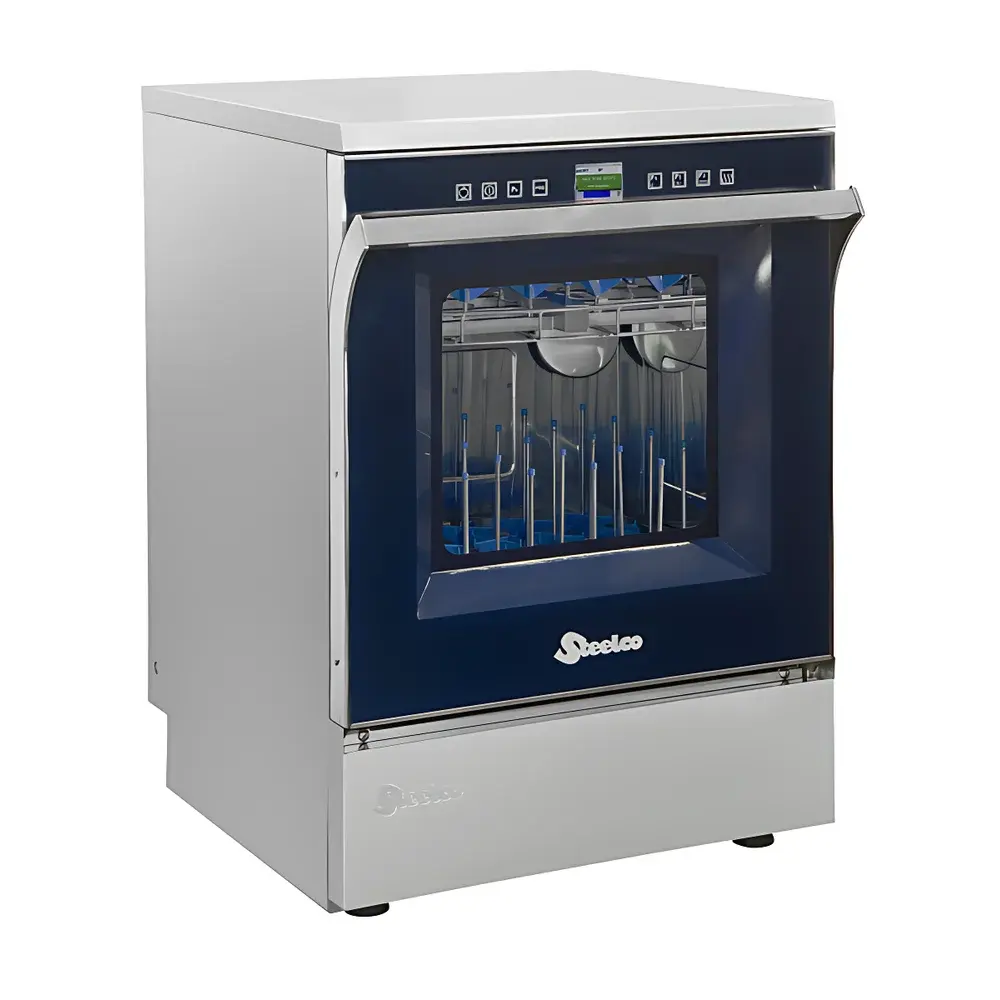
Steelco LAB 500 Series Laboratory Bottle Washer & Thermal Disinfector
| Brand | Steelco |
|---|---|
| Origin | Italy |
| Model | LAB 500 |
| Chamber Volume | 171 L |
| Heating Power | 5100 W |
| Wash Temperature | Adjustable (up to 93 °C) |
| Compatible Detergents | Alkaline and Acidic Solutions |
| External Dimensions (L×W×D) | 600 × 630 × 850 mm |
Overview
The Steelco LAB 500 Series is a CE-certified, EN ISO 15883-1/-2 compliant laboratory bottle washer and thermal disinfector engineered for reproducible, traceable, and validation-ready cleaning of glassware and labware in regulated environments. Designed using Couette-flow optimized spray arm dynamics and precision-controlled thermodynamic cycles, the system delivers consistent thermal disinfection at ≥93 °C for ≥5 minutes—meeting the microbiological log-reduction requirements defined in ISO 15883-1 for A0 ≥ 3000. Its stainless-steel AISI 316L chamber (mirror-polished, weld-free, radius-cornered) eliminates crevices where biofilm or residue may accumulate, ensuring compliance with GLP, GMP, and FDA 21 CFR Part 11 data integrity expectations when paired with optional audit-trail-enabled software.
Key Features
- Triple-source water inlet system (cold, hot, and deionized) enables programmable fill sequences—reducing cycle time by up to 22% and minimizing energy consumption during pre-rinse and final rinse phases.
- Dual PT1000 platinum resistance thermometers: one for real-time display feedback, the other for independent sterilization temperature control and validation-grade logging.
- Two integrated peristaltic detergent pumps (expandable to four), each calibrated for ±2% volumetric accuracy across pH 1–13; pump timing and dosage are programmable per phase and stored with full revision history.
- Three-tier stainless-steel filtration system (50 µm primary, 25 µm secondary, 10 µm tertiary) protects circulation pumps and extends service intervals beyond 12,000 operational hours under typical lab usage.
- HEPA-filtered drying system (optional on LAB 500, standard on LAB 500D/CDL/DRS variants) delivers particle-free air at temperatures adjustable from ambient to 140 °C, supporting low-humidity drying of moisture-sensitive vessels including volumetric flasks and HPLC vials.
- Double-insulated door with magnetic seal reduces surface temperature to <42 °C during operation and maintains acoustic emission at ≤52 dB(A), complying with EN 60601-1 noise limits for shared laboratory spaces.
- RS232 serial interface supports bidirectional protocol communication: upload/download of validated wash programs, remote diagnostics, and direct connection to thermal printers for ASME BPE-compliant cycle record generation.
Sample Compatibility & Compliance
The LAB 500 accommodates standard and custom labware configurations—including test tubes (up to 440 mm height in single-layer mode), conical flasks (≤2 L), Petri dishes, pipettes, burettes, and graduated cylinders—via configurable stainless-steel baskets with adjustable dividers. Chamber geometry (540 × 510 × 550 mm usable volume) permits simultaneous processing of two stacked racks, with vertical clearance of 170 mm (upper level) and 210 mm (lower level). All materials contacting process water conform to USP Class VI and EU 10/2011 plastic migration standards. The system is certified to EN ISO 15883-1/-2 (washer-disinfectors), EN 61010-1 (safety), EN 61010-2-040 (particular safety for lab equipment), EN 61326 (EMC), and complies with Machinery Directive 2006/42/EC and Low Voltage Directive 2014/35/EU.
Software & Data Management
The embedded microcontroller runs a deterministic real-time OS with non-volatile program storage (128 KB Flash) supporting up to 40 user-defined cycles (standard on LAB 500CL/CDL/DRS models). Each cycle stores timestamped metadata: inlet water conductivity, detergent dosing events, temperature profiles (with dual-sensor cross-verification), pressure curves, and fault logs. Optional Ethernet module enables integration with LIMS via Modbus TCP or OPC UA, while RS232 output meets FDA 21 CFR Part 11 requirements when used with qualified third-party electronic signature and audit trail software. Cycle reports include A0 calculation, thermal mapping flags, and pass/fail status per ISO 15883 Annex C criteria.
Applications
The LAB 500 serves as a critical unit operation in quality control laboratories (pharmaceutical, biotech, food safety), research facilities requiring traceable cleaning (e.g., elemental analysis, isotopic tracing), and clinical diagnostics labs adhering to CLIA and CAP standards. It replaces manual washing for volumetric glassware subject to USP analytical instrument qualification, ensures residue-free preparation of containers for ICH Q5C stability studies, and supports cleaning validation per PDA Technical Report No. 29 and EU Annex 15. Typical use cases include pre-cleaning of HPLC autosampler vials, depyrogenation of cell culture flasks prior to sterile filling, and detergent residue removal from GC-MS sample vials.
FAQ
Does the LAB 500 meet FDA requirements for cleaning validation in pharmaceutical manufacturing?
Yes—the system’s temperature uniformity, detergent delivery repeatability, and data logging architecture support IQ/OQ/PQ execution per ASTM E2500 and ISPE Baseline Guide Vol. 4.
Can the LAB 500 be integrated into a central utility monitoring system?
Yes—via optional analog 4–20 mA outputs for temperature and pressure, or digital Modbus RTU over RS485 (available as field upgrade kit).
What is the recommended maintenance interval for the three-stage filter system?
Visual inspection every 200 cycles; full replacement of all three filters every 1,000 cycles or semi-annually—whichever occurs first—under standard alkaline wash conditions.
Is validation documentation available for the LAB 500 series?
Steelco provides a Validation Support Package including Design Qualification (DQ) templates, FAT/SAT protocols, and blank IQ/OQ forms aligned with GAMP 5 principles.
How does the LAB 500 handle hard water conditions?
Models LAB 500D and LAB 500CDL integrate an inline water softener (Na⁺/H⁺ exchange resin); hardness reduction to <1°dH is verified at point-of-use and logged per cycle.
Related Products



