
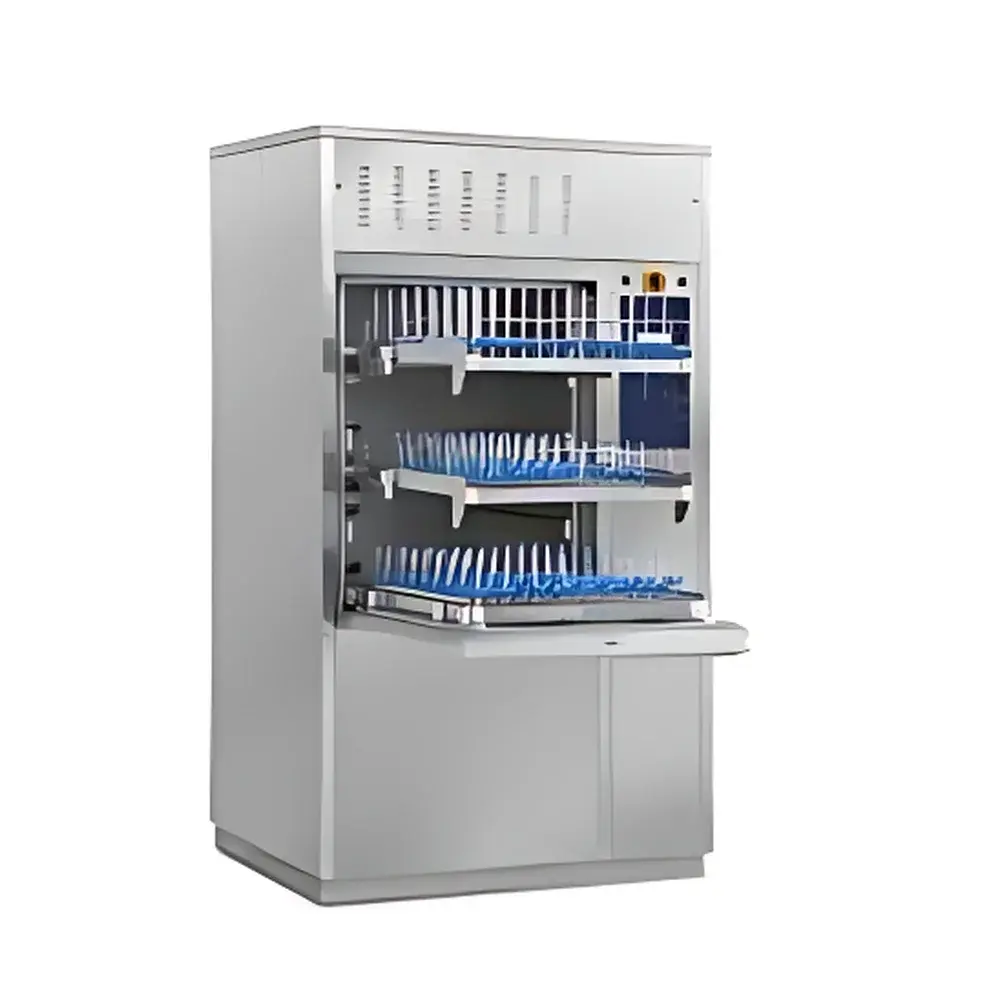
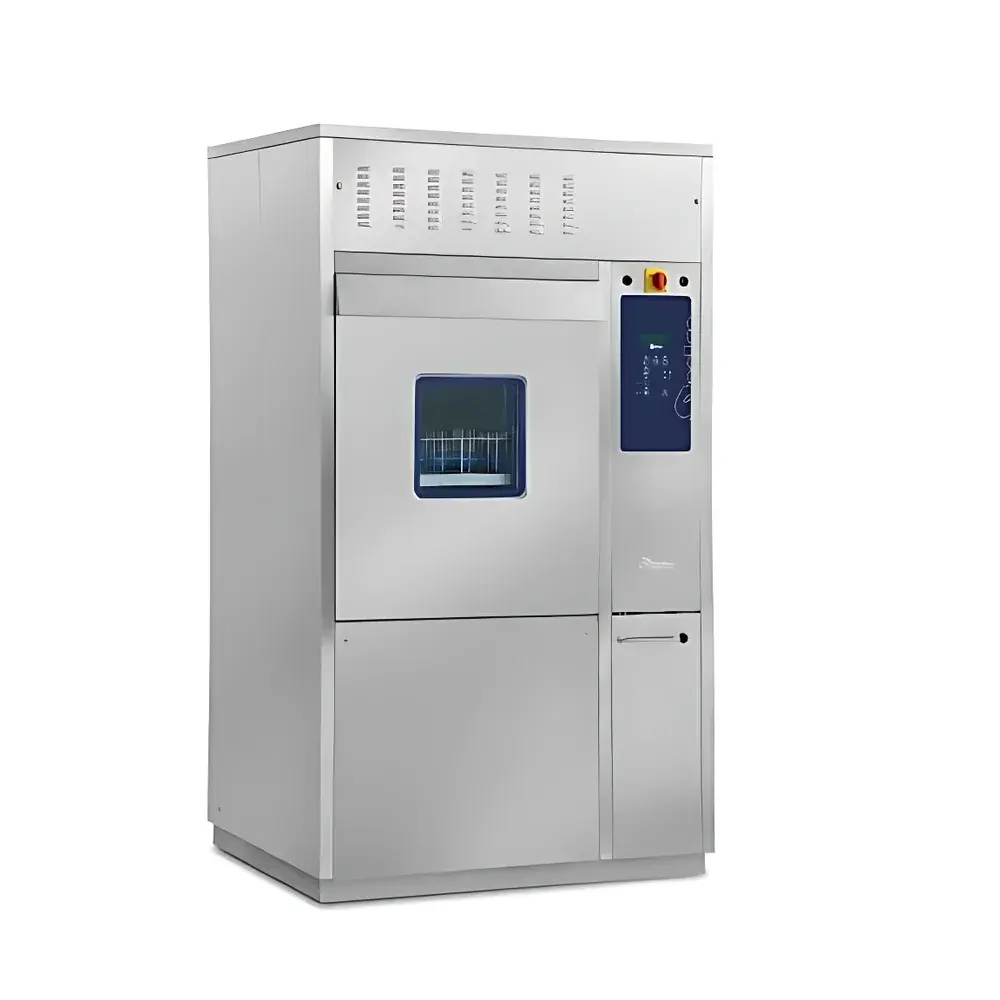
Steelco LAB 680 Laboratory Bottle Washer & Thermal Disinfector
| Brand | Steelco |
|---|---|
| Origin | Italy |
| Model | LAB 680 |
| Chamber Volume | 600 L |
| Heating Power | 18 kW |
| Wash Temperature | Adjustable (up to 93 °C for thermal disinfection) |
| Compatible Detergents | Alkaline and acidic solutions |
| External Dimensions (L×W×H) | 1140 × 930 × 1975 mm |
| Compliance | EN ISO 15883-1/-2, EN 61010-1, EN 61010-2-040, EN 61326, EU Directives 98/37/EC, 2006/95/EC, 89/336/EEC, 92/31/EEC, 93/68/EEC |
| Drying System | HEPA-filtered hot air (ambient–140 °C adjustable) |
| Noise Level | ≤58 dB(A) |
| Power Supply | 400 V, 3-phase, 50 Hz |
| Max. Total Power | 20 kW |
| Filtration | Triple-layer stainless steel mesh filter |
| Chamber Material | AISI 316L mirror-polished stainless steel with seamless, welded-free sloped bottom and radius corners |
| Standard Features | Dual PT1000 temperature sensors, dual peristaltic detergent pumps (expandable to four), automatic level sensing, RS232 interface with real-time data logging and remote diagnostics, LED display with program status and fault codes, steam condenser, double-insulated door, viewing window |
Overview
The Steelco LAB 680 is a CE-certified, fully automated laboratory bottle washer and thermal disinfector engineered for high-reliability cleaning, rinsing, thermal disinfection (≥93 °C per EN ISO 15883-1/-2), and HEPA-filtered hot-air drying of reusable labware. Designed specifically for regulated environments—including pharmaceutical QC/QA labs, biotechnology R&D facilities, clinical diagnostics centers, and GLP-compliant research institutions—the LAB 680 operates on the principle of controlled, multi-stage thermodynamic cleaning: precisely metered alkaline or acidic detergents are delivered via peristaltic pumps into a heated, recirculated wash chamber; mechanical action is enhanced by optimized spray arm dynamics and uniform water distribution across five adjustable basket levels; final thermal disinfection is validated using redundant PT1000 sensors and time-temperature integration (TTI) logic; and residual moisture is removed via programmable HEPA-filtered airflow (ambient to 140 °C). Its AISI 316L stainless-steel chamber—mirror-polished, fully drainable, and constructed without internal welds—minimizes biofilm retention and ensures long-term corrosion resistance in aggressive chemical environments.
Key Features
- Compliance-ready architecture meeting EN ISO 15883-1/-2 (for thermal disinfection validation), EN 61010-1 (electrical safety), EN 61010-2-040 (liquid handling equipment), and multiple EU EMC and Low Voltage Directives.
- Dual independent PT1000 temperature sensors—one for process monitoring, one for closed-loop disinfection control—ensuring traceable, repeatable thermal validation.
- RS232 serial interface supporting real-time cycle parameter logging, remote firmware updates, diagnostic code retrieval, and optional printer integration for full audit trail generation (aligned with FDA 21 CFR Part 11 data integrity expectations when paired with compliant software).
- Four programmable detergent dosing channels (standard configuration: two peristaltic pumps; expandable to four), enabling precise, recipe-driven delivery of alkaline, acidic, or neutral rinse agents per phase.
- Triple-layer stainless steel filtration system capturing particulates ≥50 µm, reducing pump wear and extending maintenance intervals.
- Steam condenser integrated into the drying circuit eliminates external venting requirements and shortens total cycle duration by up to 22% versus non-condensing systems.
- Double-insulated, gas-spring-assisted door with silicone gasket maintains thermal integrity and reduces operational noise to ≤58 dB(A) at 1 m distance.
- 40 preconfigured and user-definable wash programs—including dedicated cycles for volumetric glassware, cell culture flasks, HPLC vials, and narrow-necked bottles—with adjustable temperature ramps, dwell times, spray pressure, and airflow profiles.
Sample Compatibility & Compliance
The LAB 680 accommodates standard and custom labware up to 430 L total basket volume across five vertically adjustable rack positions. Maximum load dimensions per level: 130 mm (Level 1), 140/250 mm (Level 2, height-adjustable), 75/180 mm (Level 3, height-adjustable), and 110 mm (Level 4). Compatible items include borosilicate glassware (volumetric flasks, graduated cylinders, NMR tubes), polypropylene centrifuge bottles, stainless-steel forceps trays, silicone tubing assemblies, and reusable pipette tips. All cycles are designed to meet ISO 15883-1 Annex B verification criteria for microbiological log reduction (≥10⁴ CFU for vegetative bacteria, ≥10³ for spores under defined challenge conditions). The system supports IQ/OQ documentation packages and integrates with LIMS via ASCII-based RS232 output for electronic record retention in GMP/GLP workflows.
Software & Data Management
The embedded microcontroller runs deterministic real-time firmware with non-volatile memory for storing all 40 programs, sensor calibration offsets, and historical cycle logs (timestamp, start/stop time, peak temperature, detergent volume dispensed, fault events). RS232 output provides ASCII-formatted data streams compatible with LabArchives, Benchling, or custom SQL-based ELN systems. Optional Ethernet gateway modules (sold separately) enable SNMP monitoring and OPC UA integration for centralized facility management. Audit trails include operator ID (via optional RFID badge reader), cycle initiation method (manual/local vs. remote trigger), and full parameter deviation flags—supporting ALCOA+ principles (Attributable, Legible, Contemporaneous, Original, Accurate, Complete, Consistent, Enduring, Available).
Applications
- Pharmaceutical manufacturing: Cleaning and thermal disinfection of sampling vessels, media preparation flasks, and stability study containers prior to sterility testing.
- Biologics development: Decontamination of single-use bag connectors, rocker bioreactor components, and chromatography column housings between batches.
- Clinical microbiology labs: Reprocessing of sputum collection cups, urine specimen containers, and PCR plate carriers under CLSI GP35 guidelines.
- Academic core facilities: High-throughput washing of NMR sample tubes, cryovials, and electrophoresis combs with documented reproducibility (RSD < 2.3% for residual protein assay across 50 consecutive runs).
- Food safety testing labs: Removal of matrix residues (e.g., dairy proteins, starches, fats) from Petri dishes and blender jars prior to AOAC 990.12 validation.
FAQ
Does the LAB 680 comply with FDA 21 CFR Part 11 requirements for electronic records?
The base unit provides raw RS232 data export and full audit trail logging. Full Part 11 compliance requires implementation of supplementary controls—including electronic signatures, role-based access, and secure archive protocols—typically managed via third-party LIMS or ELN platforms interfacing with the washer.
Can the LAB 680 be connected to plant utilities beyond cold water?
Yes. It supports simultaneous connection to cold water, hot water (≤80 °C), and deionized water circuits. Inlet selection is programmable per phase to optimize energy use and reduce heating demand during fill stages.
What validation support documentation is available?
Steelco supplies IQ/OQ templates, temperature mapping protocols (per EN ISO 15883-2 Annex C), detergent residue test methods (based on ASTM E3071), and thermal penetration studies for common load configurations.
Is HEPA filter replacement required after every cycle?
No. The HEPA filter is rated for ≥12 months of continuous operation under typical lab usage. Replacement intervals are tracked automatically and displayed on the LED interface when service is due.
How is cycle reproducibility verified across installations?
Each unit undergoes factory performance qualification using calibrated thermocouples, flow meters, and conductivity probes. Final commissioning includes on-site temperature uniformity mapping (±0.5 °C tolerance across chamber volume) and detergent dosing accuracy verification (±2% of setpoint).



