
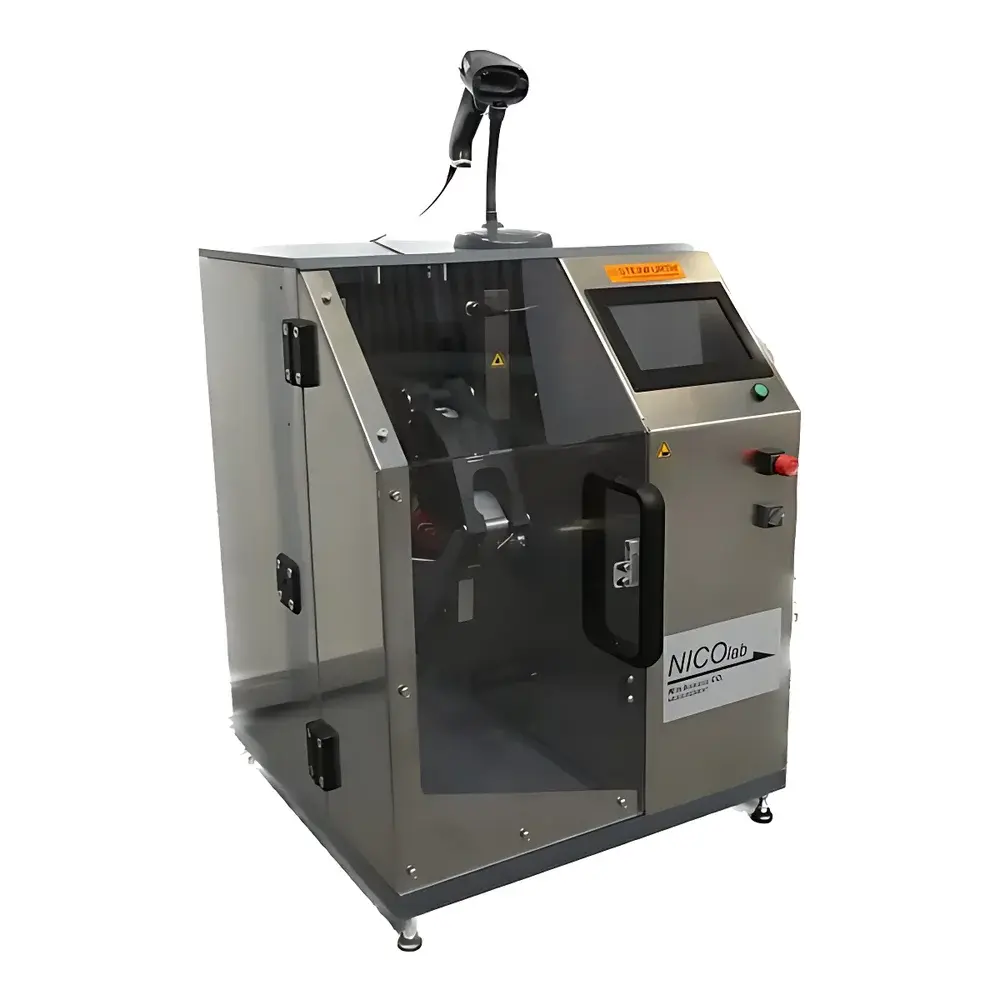
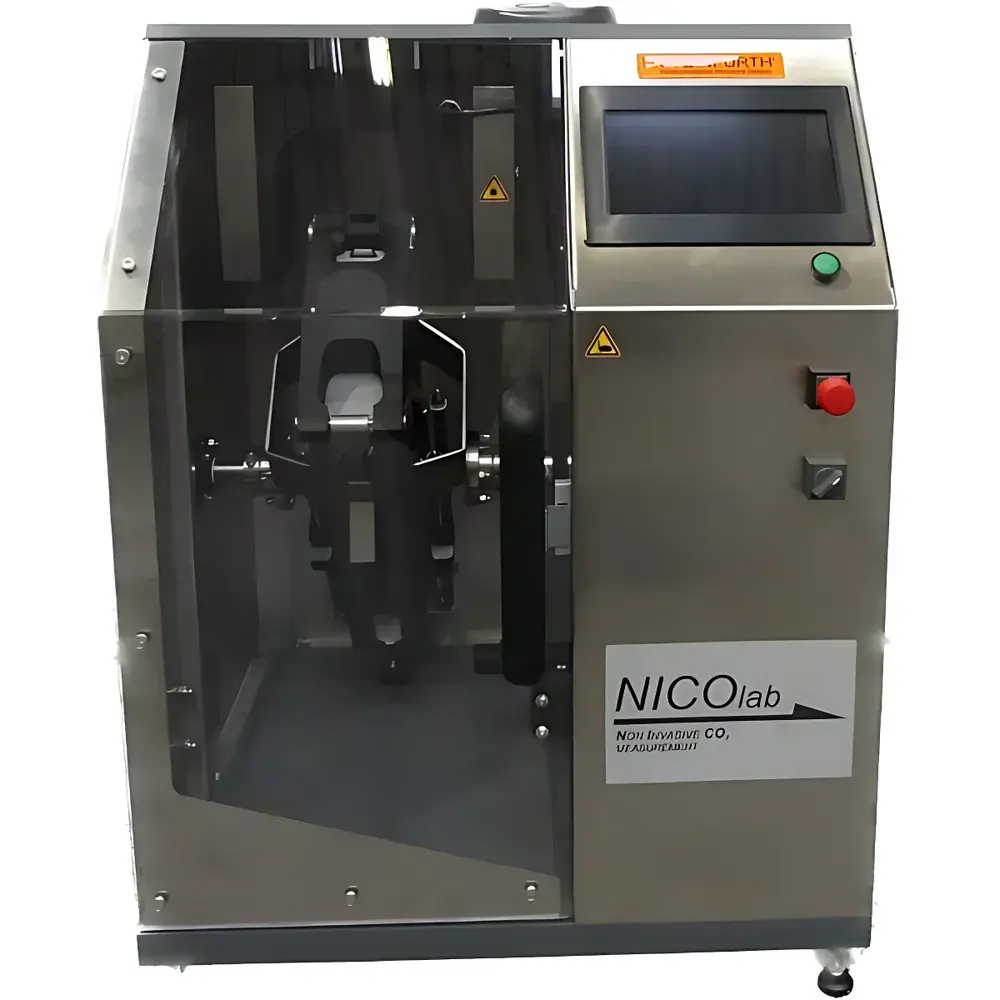
Steinfurth NICOLab Desktop Non-Destructive CO₂ Analyzer for Beverages
| Brand | Steinfurth |
|---|---|
| Origin | Germany |
| Model | NICOLab |
| Instrument Type | Beverage CO₂ Analyzer (Lab & Online-Capable) |
| Dimensions (L × W × H) | 590 × 670 × 520 mm |
| Weight | 40 kg |
| Pressure Range | 1–6 bar |
| Pressure Accuracy | <1.5% FS |
| Pressure Repeatability | <0.5% FS |
| Temperature Range | 5–35 °C |
| Temperature Accuracy | <0.25 °C |
| IP Rating | IP32 |
| Sample Compatibility | PET and glass bottles (transparent & semi-transparent) |
| Interface | Ethernet, touchscreen GUI, optional barcode scanner |
Overview
The Steinfurth NICOLab Desktop Non-Destructive CO₂ Analyzer is an engineered solution for precise, repeatable quantification of dissolved carbon dioxide in carbonated beverages—without compromising package integrity or sample validity. Unlike conventional destructive methods requiring opening, degassing, or headspace sampling, the NICOLab employs a non-invasive, physics-based measurement principle rooted in thermodynamic equilibrium analysis. It simultaneously monitors real-time pressure and temperature within sealed containers under controlled thermal conditions, then applies the fundamental relationship described by Henry’s Law to calculate CO₂ concentration with traceable metrological rigor. This approach eliminates operator-induced variability associated with manual venting, syringe extraction, or sensor insertion—making it especially suited for quality control labs, R&D facilities, and production environments where regulatory compliance, data integrity, and packaging consistency are critical.
Key Features
- Non-destructive, non-invasive CO₂ analysis for intact PET and glass bottles—preserving sample authenticity and enabling retest capability;
- Integrated high-stability pressure transducer and calibrated Pt100 temperature sensor, both traceably certified to ISO/IEC 17025-accredited standards;
- Automated thermal equilibration protocol that establishes reproducible thermodynamic states across diverse bottle geometries and fill levels;
- Touchscreen-driven human-machine interface (HMI) with intuitive workflow navigation, multilingual support, and context-sensitive guidance;
- Self-contained database architecture for secure storage of measurement records, sample metadata (e.g., batch ID, product code, operator), and environmental logs;
- Ethernet-based remote access supporting machine control, real-time data streaming, SQL-compatible database queries, and integration into LIMS or MES platforms;
- Optional barcode/QR code scanner for automated sample identification and audit-trail enrichment—fully compatible with GS1 standards;
- Robust mechanical design compliant with IP32 ingress protection, suitable for controlled laboratory and near-line industrial environments.
Sample Compatibility & Compliance
The NICOLab is validated for use with standard beverage containers—including PET bottles (0.2–2.0 L) and glass bottles (0.33–1.0 L)—regardless of wall thickness, curvature, or label coverage, provided optical transparency or semi-transparency allows stable thermal coupling. Its measurement independence from top-space volume, neck diameter, or gas-phase composition ensures consistent performance across heterogeneous packaging lines. From a regulatory standpoint, the system supports GLP and GMP-aligned workflows: all measurements include timestamped audit trails, user authentication, electronic signatures (via optional PKI module), and full 21 CFR Part 11 readiness when deployed with validated software configuration. Method documentation aligns with ASTM D6795-22 (“Standard Test Method for Determination of Carbon Dioxide in Carbonated Beverages”) and ISO 21502:2020 (“Sensory analysis — Methodology — General guidance for measuring carbonation”)
Software & Data Management
The embedded NICOLab Control Suite provides deterministic measurement sequencing, configurable pass/fail thresholds, statistical process control (SPC) charting, and export in CSV, PDF, or XML formats. All raw sensor data—including pressure decay curves, thermal stabilization profiles, and calculated CO₂ values—are retained with millisecond-level timestamps. The database engine enforces referential integrity, supports role-based access control (RBAC), and generates automated reports compliant with internal SOPs or external audit requirements. Remote diagnostics, firmware updates, and configuration backup/restore are managed via secure HTTPS or SSH protocols. Integration with enterprise systems is facilitated through RESTful API endpoints and ODBC-compliant drivers—enabling seamless synchronization with SAP QM, LabWare LIMS, or custom QA dashboards.
Applications
- Final product release testing for beer, sparkling water, soft drinks, and wine coolers;
- In-process monitoring during carbonation, bottling, and pasteurization stages;
- Stability studies assessing CO₂ loss under accelerated shelf-life conditions;
- Package integrity validation—including crown cap seal efficacy and PET barrier performance;
- Supplier qualification and incoming raw material verification (e.g., pre-filled kegs or bulk tanks);
- Method transfer and cross-site harmonization in multinational beverage operations.
FAQ
Does the NICOLab require calibration with reference gases or certified standards?
No—calibration is performed using NIST-traceable pressure and temperature references during factory certification. Field verification is conducted via built-in self-diagnostics and optional annual recalibration services aligned with ISO/IEC 17025.
Can the NICOLab measure CO₂ in aluminum cans or opaque packaging?
Not directly—the method requires thermal coupling through the container wall; aluminum cans and fully opaque materials prevent uniform heat transfer and invalidate the thermodynamic model. Alternative solutions (e.g., headspace GC) are recommended for such cases.
Is method validation support available for regulatory submissions?
Yes—Steinfurth provides IQ/OQ documentation packages, validation protocols (including repeatability, intermediate precision, and robustness testing), and technical assistance for FDA, EFSA, or Health Canada dossier preparation.
What maintenance is required for long-term operational reliability?
Annual sensor verification and mechanical inspection are recommended. No consumables or routine part replacements are needed—the system features solid-state sensing architecture with no moving parts or wetted components.
How does the NICOLab handle variations in ambient lab temperature?
The instrument includes active thermal stabilization and adaptive equilibration algorithms that compensate for ambient drift between 15–30 °C; operation outside this range requires climate-controlled lab infrastructure per ICH Q5C guidelines.
Related Products





