
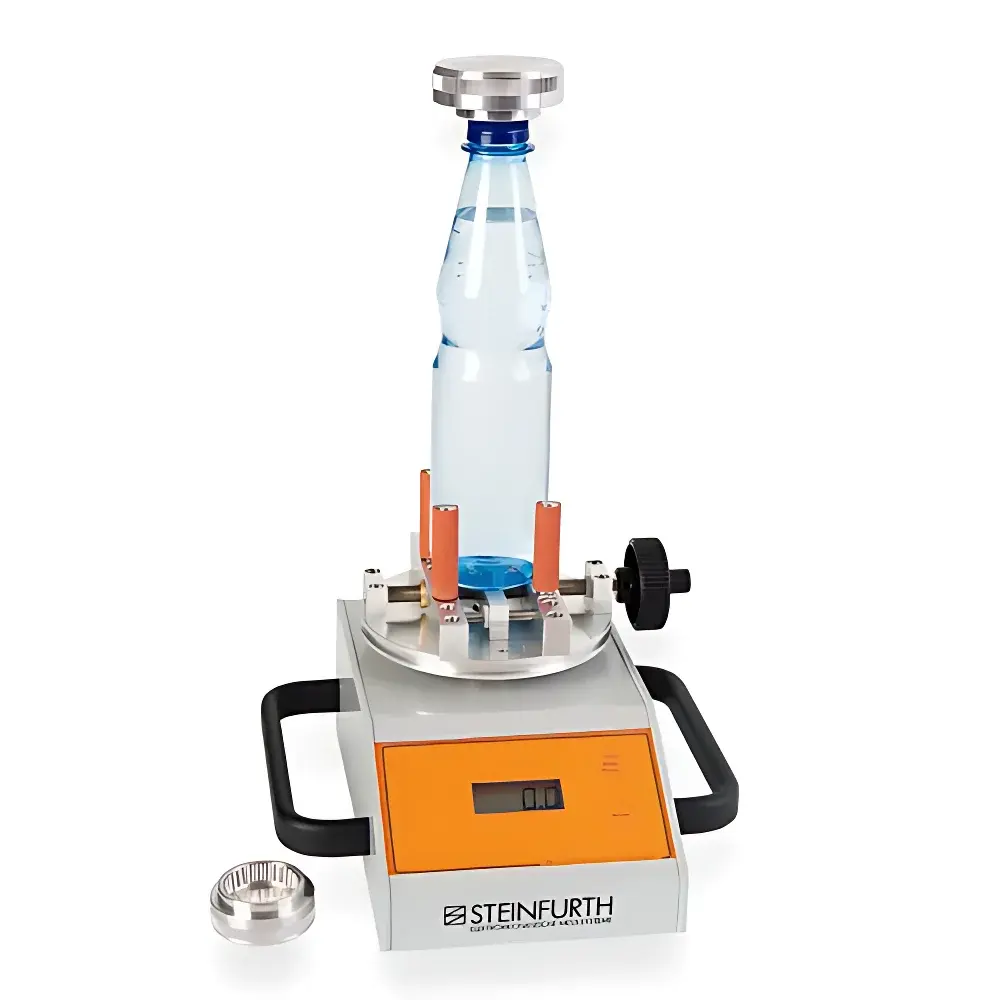
Steinfurth TMS 2000 Manual Torque Measurement System
| Brand | Steinfurth |
|---|---|
| Origin | Germany |
| Model | TMS 2000 |
| Application Types | Laboratory & On-line |
| Dimensions (L × W × H) | 300 mm × 250 mm × 60 mm |
| Weight | 5 kg |
| Measurement Range | 0–50 in-lb (bidirectional) |
| Accuracy | ±0.5 % F.S. |
| Resolution | 0.1 in-lb |
| Interface | RS-232 (USB optional) |
| Power Supply | 240 V, 50 Hz (115 V optional) |
| Ingress Protection | IP54 |
Overview
The Steinfurth TMS 2000 Manual Torque Measurement System is a precision-engineered, portable instrument designed specifically for torque evaluation of closure systems in the food and beverage industry. Developed by Steinfurth—a specialized brand under Industrial Physics focused exclusively on packaging performance testing—the TMS 2000 applies fundamental mechanical principles of rotational force measurement to quantify opening and closing torque values of screw-capped containers, including PET bottles, glass jars, and aluminum closures used in beer, soft drinks, wine, and dairy applications. Unlike automated systems requiring complex integration, the TMS 2000 operates on a manual actuation principle: the operator rotates the container against a calibrated load cell while the system captures real-time torsional resistance. The peak torque value—representing either the initial breakaway force (opening torque) or the final seating force (closing torque)—is digitally displayed and retained in memory. This approach satisfies ISO 8507, ASTM D3474, and USP <1207> guidance on container closure integrity, particularly where deterministic, operator-controlled assessment is sufficient for routine quality verification.
Key Features
- Compact, benchtop-ready design (300 × 250 × 60 mm) with lightweight aluminum housing and IP54-rated enclosure for dust and splash resistance—suitable for both controlled lab environments and humid production floor conditions.
- Bidirectional torque sensing (0–50 in-lb) with ±0.5 % full-scale accuracy and 0.1 in-lb resolution, traceable to NIST-certified standards via optional calibration kit (part no. CAL-TMS2000).
- Integrated digital display with hold function and internal memory for up to 99 test results—enabling immediate review without external software dependency.
- RS-232 serial interface (USB adapter available) supports data export to LIMS or Excel-based QA documentation; compatible with industrial PCs running Windows 10/11 and legacy DOS-based reporting tools.
- Ergonomic clamping mechanism accommodates standard bottle diameters (20–120 mm), adjustable for neck geometry variations without tooling changes.
- Optional auxiliary opening tool (AOT-TMS2000) minimizes operator-induced variability by standardizing grip position and rotation axis alignment—critical for GLP-compliant batch release testing.
Sample Compatibility & Compliance
The TMS 2000 is validated for use with common beverage packaging formats: PET carbonated soft drink bottles (e.g., 500 mL, 1.5 L), glass beer bottles (e.g., 330 mL, 500 mL), and HDPE juice containers. It meets functional requirements outlined in ISO 11607-1 (packaging for terminally sterilized medical devices), though its primary regulatory alignment lies within food-grade quality assurance frameworks—including FDA 21 CFR Part 11 (when paired with compliant data logging software), EU Regulation (EC) No 1935/2004 on materials in contact with food, and GMP-aligned internal SOPs for closure validation. All measurements adhere to repeatability thresholds defined in ASTM D3474 Annex A1 (manual torque testers) and are routinely audited during BRCGS Packaging and SQF Level 3 certifications.
Software & Data Management
While the TMS 2000 functions autonomously, its RS-232 output enables seamless integration with Industrial Physics’ proprietary TorqueLink™ Lite software (v3.2+), which provides timestamped test logs, statistical process control (SPC) charting (X̄-R charts), and PDF report generation compliant with ISO/IEC 17025 documentation requirements. Data exports include raw torque vs. time profiles, pass/fail flags based on user-defined upper/lower limits, and operator ID tagging—supporting audit readiness for FDA pre-approval inspections and third-party certification bodies. Optional USB-to-RS232 converters ensure compatibility with modern laptops lacking legacy serial ports.
Applications
- Verification of cap torque consistency across filling line shifts (e.g., post-capper validation at 30-minute intervals).
- Root cause analysis of consumer complaints related to difficult-open or leak-prone closures.
- Supplier qualification testing for new closure batches prior to production ramp-up.
- Stability studies assessing torque retention over shelf life (e.g., accelerated aging at 40 °C/75 % RH).
- Correlation studies between TMS 2000 manual readings and automated systems (e.g., TMS 5010) to establish equivalence protocols per ISO 10012.
- Training personnel on torque fundamentals without requiring full automation infrastructure.
FAQ
Is the TMS 2000 suitable for regulatory submissions?
Yes—when used with documented calibration records, operator training logs, and SPC-reviewed data outputs, it supports evidence packages for FDA, EFSA, and Health Canada reviews related to package integrity.
Can it measure reverse (counterclockwise) torque only, or both directions?
The system measures bidirectional torque: clockwise for closing torque and counterclockwise for opening torque—essential for evaluating tamper-evident band integrity.
Does it require annual recalibration?
Per ISO/IEC 17025 recommendations, calibration interval is determined by usage frequency and risk assessment; most clients schedule biannual verification using the certified CAL-TMS2000 kit.
Is battery operation supported?
No—the unit operates exclusively from AC mains (240 V / 50 Hz standard); an external 12 V DC power bank adapter is available upon request for temporary field deployment.
How does it compare to the automated TMS 5010?
The TMS 2000 prioritizes portability and cost-efficiency for spot-checking; the TMS 5010 adds motorized actuation, programmable dwell times, and full compliance with ASTM D3474 Section 7 (automated testers), making it appropriate for high-volume QC labs requiring 21 CFR Part 11 audit trails.
Related Products





