
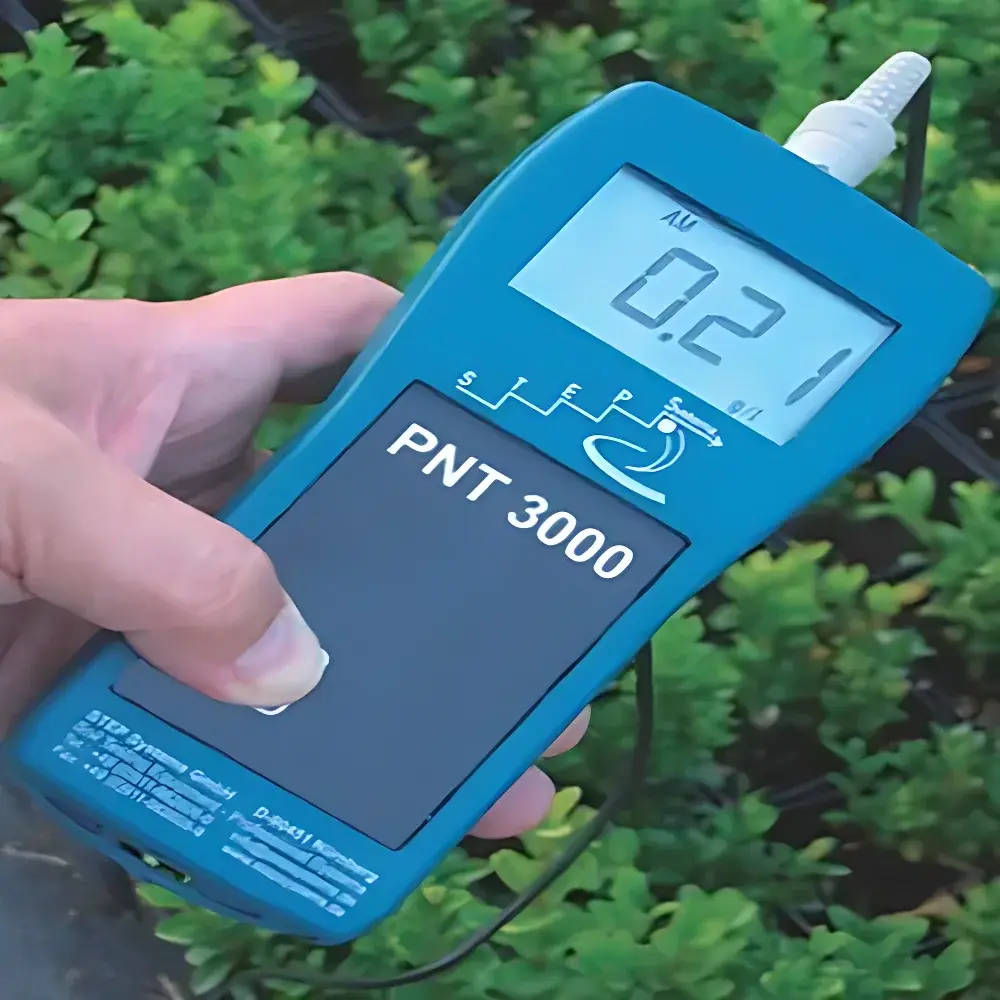
STEPS PNT3000 Portable Soil Salinity and Activity Meter
| Origin | Germany |
|---|---|
| Manufacturer Type | Authorized Distributor |
| Origin Category | Imported |
| Model | PNT3000 |
| Instrument Type | Fertilizer/Nutrient Analyzer |
| Housing | IP67-rated rugged waterproof enclosure |
| Dimensions | 180 × 85 × 50 mm |
| Weight | 280 g |
| Power Supply | 9-V alkaline battery (≥4,000 measurements per charge) |
| Connector | 5-pin proprietary probe interface |
| Activity Measurement Range | 0–10 g/L (as NaCl-equivalent activity) |
| Resolution | 0.01 g/L |
| Calibration | Factory-calibrated per ISO/IEC 17025-accredited procedure |
| Probe Material | Austenitic stainless steel (1.4404 / SS316L) |
| Probe Lengths | 250 mm, 500 mm, and 750 mm (interchangeable, dual-electrode configuration) |
Overview
The STEPS PNT3000 Portable Soil Salinity and Activity Meter is an engineered field instrument developed in alignment with the electrochemical activity measurement methodology pioneered by Dr. Günter Tepe, former Director of the Geisenheim Institute for Soil Science and Plant Nutrition. Unlike conventional EC-based soil conductivity meters, the PNT3000 quantifies *ionic activity*—a thermodynamically rigorous parameter reflecting the effective concentration of soluble salts (primarily Na⁺, Cl⁻, K⁺, NO₃⁻) under actual soil moisture and matrix conditions. This approach eliminates systematic errors introduced by soil texture, clay content, or cation exchange capacity—factors that significantly bias standard electrical conductivity (EC) readings. The device operates on a two-electrode potentiometric principle optimized for direct in-situ insertion into undisturbed soil profiles, enabling real-time assessment without sample extraction, drying, or extraction protocols. Its design adheres to the principles of process analytical technology (PAT), supporting decision-making in precision horticulture, controlled-environment agriculture, and environmental compliance monitoring.
Key Features
- Rugged IP67-rated housing constructed from impact-resistant polycarbonate with integrated rubber overmolding for shock and moisture protection—certified for continuous outdoor operation in rain, dust, and temperature fluctuations from −10 °C to +50 °C.
- Surface-mount device (SMD)-based electronics architecture ensures long-term stability, low thermal drift (<0.02 g/L/°C), and immunity to electromagnetic interference common in greenhouse or nursery environments.
- Single-button operational logic: power-on, auto-zero, measurement acquisition, and data hold—all executed within <3 seconds; no menu navigation or firmware updates required during field use.
- Interchangeable stainless-steel probes (250 mm, 500 mm, 750 mm) featuring dual platinum-coated electrodes with geometrically fixed spacing—designed to minimize polarization effects and ensure reproducible contact resistance across variable soil densities.
- Factory calibration traceable to NIST-certified NaCl reference solutions (0.1–10.0 g/L); full calibration certificate included with each unit per ISO/IEC 17025 requirements.
Sample Compatibility & Compliance
The PNT3000 is validated for direct measurement in mineral soils, peat-based substrates, coir, composted bark, and aeroponic root zones—provided moisture content exceeds 15 vol% to ensure continuous electrolyte bridging. It is not intended for use in dry, frozen, or highly calcareous soils (>25% CaCO₃) where ion-pairing effects dominate. The instrument complies with EN 13651-1:2021 (soil analysis—determination of soluble salt content), supports GLP-aligned documentation workflows, and meets the functional requirements for field verification under EU Fertilising Products Regulation (EU) 2019/1009 Annex I criteria for salt index reporting. Probe materials conform to FDA 21 CFR §178.3570 for incidental food-contact surfaces.
Software & Data Management
The PNT3000 operates as a standalone analog-digital hybrid meter with no onboard memory or Bluetooth/Wi-Fi connectivity—intentionally designed to eliminate firmware vulnerabilities, battery drain, and data synchronization complexity. All measurements are recorded manually or via optional third-party logging using the standardized 5-pin analog output (0–2 V DC proportional to activity value). For auditability, each unit ships with a GLP-compliant calibration logbook pre-stamped by the German distributor’s QA department, including serial-numbered calibration certificates, probe verification records, and temperature-compensation coefficients. Raw activity values may be directly cross-referenced against the included *Plant-Specific Salinity Interpretation Guide*, which maps g/L activity ranges to physiological stress thresholds for >120 horticultural species per DIN 19682-2 guidelines.
Applications
- Real-time salinity screening in container nurseries using slow-release fertilizers—detecting early-stage salt accumulation before visible phytotoxicity occurs.
- Post-winter chloride leaching assessment in municipal green spaces and golf course fairways—supporting irrigation scheduling per ASTM D4448 standards.
- In-process monitoring of humus maturation in commercial compost facilities—ensuring final product EC activity remains below 2.0 g/L to meet EU Organic Regulation (EC) No 834/2007 Annex I limits.
- Educational deployment in university agronomy labs for teaching ion activity vs. concentration concepts, aligned with ISO 11265:2022 pedological testing frameworks.
- Technical advisory services for greenhouse growers requiring rapid root-zone diagnostics during crop transition cycles—reducing reliance on lab-based extract analysis (e.g., saturated paste extract per USDA Handbook 40).
FAQ
Does the PNT3000 require recalibration in the field?
No. Each unit undergoes multi-point calibration at the German distribution center using certified reference standards traceable to PTB (Physikalisch-Technische Bundesanstalt); recalibration is neither necessary nor supported per manufacturer specifications.
Can the probe be used in flooded or waterlogged soils?
Yes—the stainless-steel probe and sealed housing are rated IP67 and validated for immersion up to 1 m for 30 minutes; however, measurements in standing water reflect pore-water activity, not bulk soil activity, and should be interpreted accordingly.
Is the activity reading temperature-compensated?
Yes. The internal thermistor automatically applies a soil-specific compensation algorithm based on the empirical relationship between NaCl activity and temperature (0–45 °C), referenced to ISO 11265 Annex B.
What maintenance is required between measurements?
Rinse the probe briefly with deionized water after each use; no storage solution, lubricants, or cleaning agents are needed. Stainless-steel electrodes resist passivation in typical horticultural matrices.
How does PNT3000 activity differ from EC measurements reported in dS/m?
Activity (g/L) reflects thermodynamically active ion concentration under in-situ water potential, whereas EC (dS/m) measures total ionic mobility in extracted solution—making activity more predictive of plant uptake and osmotic stress.







