
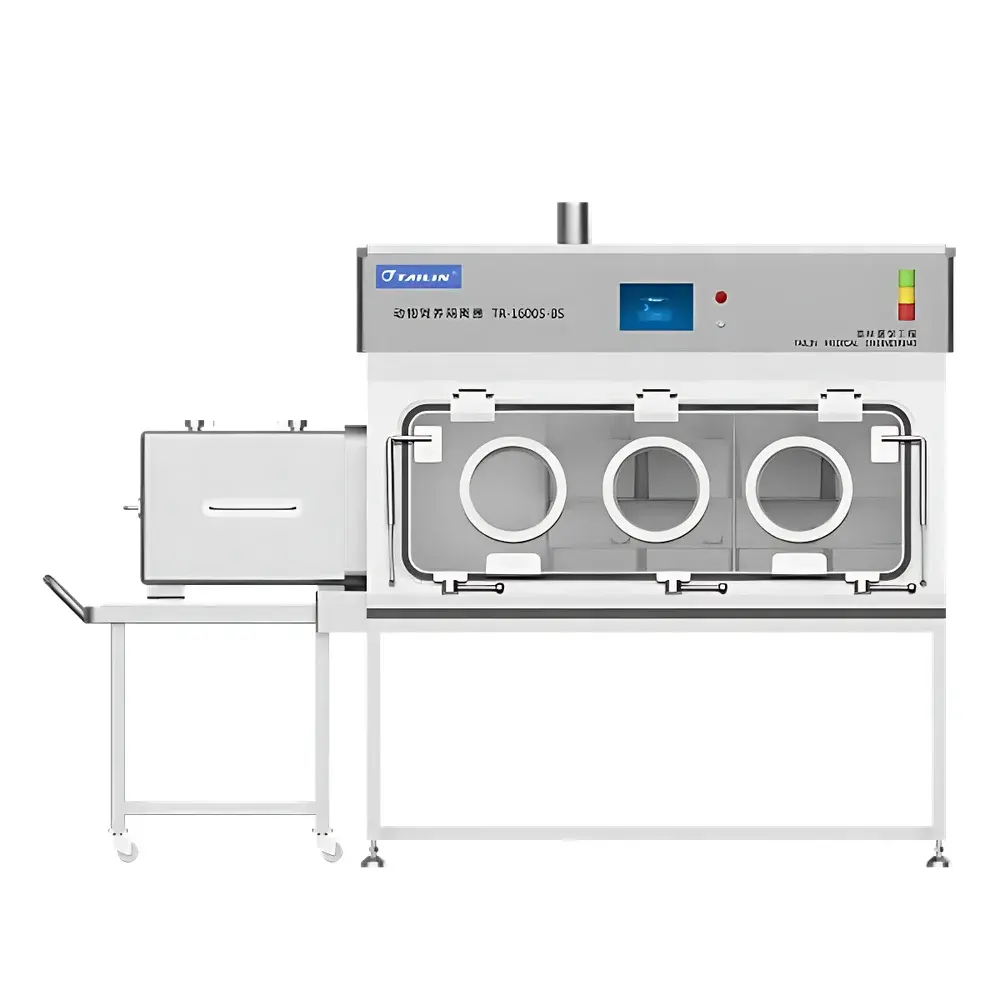
Sterile Animal Isolator by Tailin Biotech
| Brand | Tailin Biotech |
|---|---|
| Origin | Zhejiang, China |
| Manufacturer Type | OEM/ODM Manufacturer |
| Country of Origin | China |
| Model | Sterile Animal Isolator |
| Pricing | Available Upon Request |
Overview
The Tailin Biotech Sterile Animal Isolator is an engineered physical containment system designed for the housing, breeding, and experimental manipulation of germ-free (GF) and gnotobiotic rodents—primarily mice—under rigorously controlled aseptic conditions. It operates on the principle of positive-pressure, HEPA-filtered laminar airflow combined with full-barrier isolation, eliminating microbiological ingress from external environments. Unlike conventional ventilated cages or biosafety cabinets, this isolator integrates a sealed, stainless-steel 316L chamber with integrated environmental monitoring and validated decontamination protocols to maintain ISO Class 5 (Class 100) air quality within the animal workspace. Its architecture supports long-term maintenance of sterility without reliance on antibiotics or chemical prophylaxis, making it essential for immunology, microbiome, oncology, and translational research requiring defined microbial status.
Key Features
- 10-inch industrial-grade touchscreen HMI interface with intuitive navigation, real-time parameter display (pressure differential, temperature, humidity, airflow velocity), and configurable alarm thresholds.
- Modular portable transfer isolator (PTI) equipped with dual-door rapid对接 mechanism, enabling secure, gloveless transfer of cages, feed, water bottles, bedding, and instrumentation without breaching primary chamber integrity.
- On-demand hydrogen peroxide (H₂O₂) vapor bio-decontamination cycle (≤120 min, validated to ≥6-log reduction of Geobacillus stearothermophilus spores), fully automated and integrated with chamber pressure and humidity control.
- Dual-stage air handling system: pre-filter + ULPA (U15, 99.99995% @ 0.12 µm) filtration with adjustable laminar flow (0.3–0.5 m/s) and redundant pressure monitoring (±1 Pa resolution) across all operational zones.
- Full 316L stainless-steel construction with electropolished interior surfaces, welded seams, and zero dead-leg design to prevent biofilm accumulation and facilitate cleaning validation (CIP compatibility).
- Integrated environmental sensors (temperature: ±0.3°C; RH: ±2% RH; differential pressure: ±0.5 Pa) with continuous data logging and optional Ethernet/RS485 connectivity.
Sample Compatibility & Compliance
The isolator accommodates standard IVC-compatible mouse cages (up to 12 cages per chamber, depending on configuration), including static and individually ventilated systems. It supports sterile transfer of biological samples (e.g., fecal pellets, tissue biopsies, serum) via pass-through ports with interlocked doors. Designed in accordance with ISO 14644-1 (cleanroom classification), ISO 14698-1 (biocontamination control), and EU Annex 1 (manufacturing of sterile medicinal products), the system meets GLP-compliant infrastructure requirements for preclinical studies. Decontamination cycles are qualified per ISO 14937 and VHP manufacturer specifications, with full traceability of cycle parameters (exposure time, concentration, dwell, aeration). Documentation packages support FDA 21 CFR Part 11 compliance when paired with validated software modules.
Software & Data Management
The embedded control system logs all operational events—including door openings, pressure excursions, filter saturation alerts, and decon cycle metadata—with timestamped, tamper-evident records. Optional Tailin DataLink™ software enables remote monitoring, CSV export, audit trail generation, and integration with LIMS or ELN platforms. All data are stored locally on encrypted SD card (min. 16 GB) with automatic backup and user-access controls aligned with ALCOA+ principles (Attributable, Legible, Contemporaneous, Original, Accurate, Complete, Consistent, Enduring, Available).
Applications
- Germ-free mouse colony maintenance and expansion under barrier-sustained sterility.
- Microbiota transplantation (FMT) experiments requiring strict donor–recipient isolation.
- Immunocompromised model studies where opportunistic pathogen exclusion is critical.
- Preclinical evaluation of probiotics, prebiotics, and antimicrobial agents in defined flora settings.
- Host–microbe interaction research, including metabolomics and transcriptomics sample collection workflows.
- Regulatory toxicology studies requiring OECD 416 or ICH S5(R3)-compliant housing conditions.
FAQ
What sterilization method is used for the transfer isolator?
Hydrogen peroxide vapor (H₂O₂) at concentrations between 300–1200 ppm, delivered via integrated generator with real-time vapor concentration monitoring and catalytic decomposition.
Can the isolator be integrated into existing vivarium HVAC infrastructure?
Yes—equipped with dedicated exhaust ducting and pressure cascade interfaces compatible with building-wide negative-pressure zoning and central AHU coordination.
Is glove port replacement supported in situ?
Glove ports use standardized ISO-KF25 flanges and are field-replaceable without chamber depressurization or disassembly.
Does the system support IQ/OQ/PQ documentation?
Tailin provides comprehensive qualification templates (including test protocols, acceptance criteria, and raw data worksheets) aligned with ASTM E2500 and GAMP5 guidelines.
What is the maximum operating duration between ULPA filter replacements?
Under typical rodent housing conditions (12 cages, 20–24°C, 40–60% RH), ULPA filters maintain rated efficiency for ≥18 months; scheduled replacement is based on real-time ΔP monitoring and particle challenge testing.




