
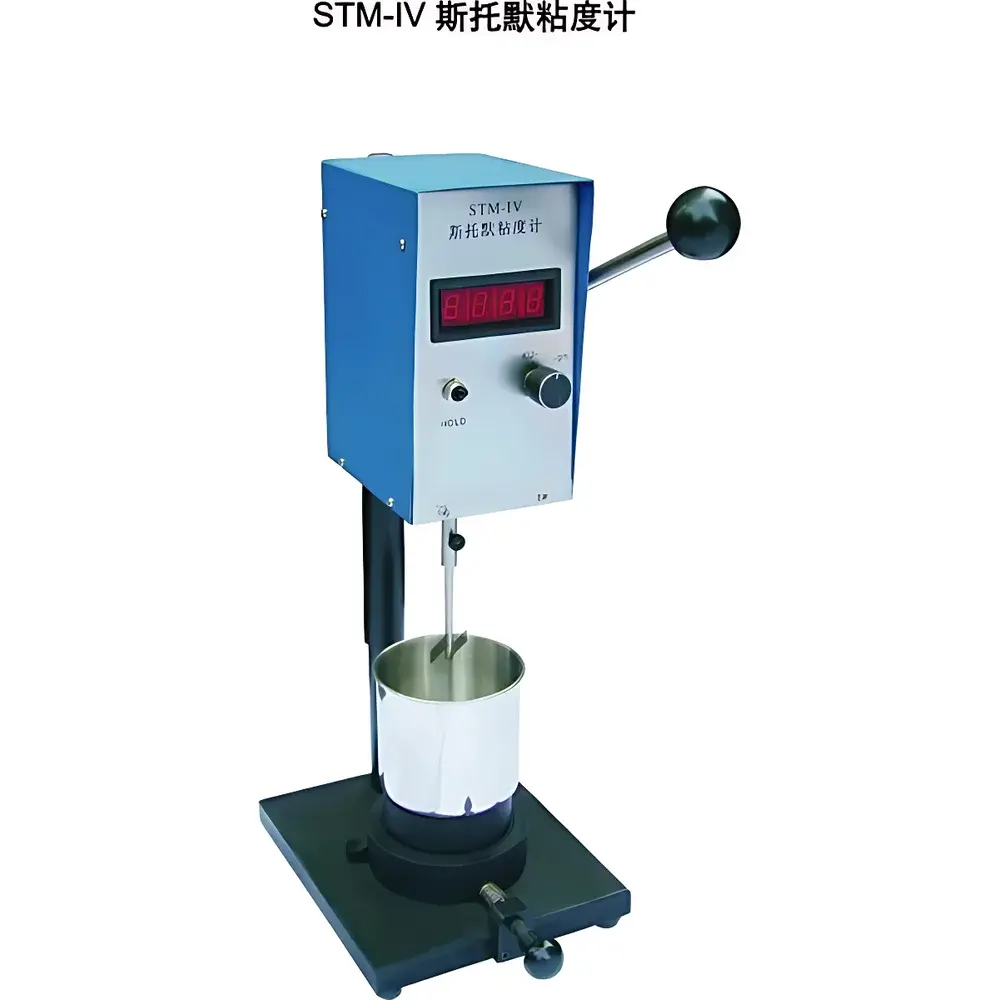
Stormer Viscometer STM-IV
| Origin | Shanghai, China |
|---|---|
| Manufacturer Type | Authorized Distributor |
| Origin Category | Domestic (China) |
| Model | STM-IV Stormer Viscometer |
| Pricing | Available Upon Request |
| Power Supply | 220 V AC, 50 Hz |
| Impeller Dimensions | 54 mm × 7.9 mm × 0.8 mm |
| Sample Cup Dimensions | Ø85 mm × 85 mm |
| Measurement Range | 40.2–141.0 KU and 32–1099 g |
| Accuracy | ±2% of full scale |
| Repeatability | ±1% of full scale |
| Rotational Speed | 200 rpm ±0.5 rpm |
| Compliance Standards | ASTM D562, GB/T 9269–1988 |
Overview
The Stormer Viscometer STM-IV is a precision-engineered rotational viscometer designed specifically for the determination of KU (Krebs Units) viscosity—a standardized metric widely adopted in the architectural coatings, industrial paints, and printing ink industries. Based on the classical Stormer principle, the instrument measures the torque required to rotate a standardized paddle impeller (Krebs-type) at a fixed speed of 200 rpm in a cylindrical sample cup under controlled conditions. This method directly correlates resistance to rotation with the apparent viscosity of non-Newtonian, shear-thickening or moderately shear-thinning dispersions—typical of pigment-loaded liquid coatings. Unlike capillary or rotational cone-and-plate systems, the STM-IV employs a robust, gravity-compensated mechanical design that ensures high reproducibility across routine QC environments without requiring complex calibration routines or temperature-controlled baths.
Key Features
- Integrated microcontroller-based electronics eliminate manual lookup tables—KU values and equivalent weight-in-grams are displayed simultaneously and digitally in real time.
- Precision-machined Krebs impeller (54 mm × 7.9 mm × 0.8 mm) and standardized sample cup (Ø85 mm × 85 mm) conform strictly to dimensional tolerances specified in ASTM D562 and GB/T 9269–1988.
- Stable 200 rpm drive system with ±0.5 rpm speed regulation ensures consistent shear rate application, minimizing inter-laboratory variability.
- High-resolution torque sensing enables measurement across a broad dynamic range: 40.2–141.0 KU (equivalent to 32–1099 g load), covering low-solids primers through high-viscosity texture coatings.
- Robust cast-aluminum housing and sealed bearing assembly support long-term reliability in production lab settings with minimal maintenance requirements.
Sample Compatibility & Compliance
The STM-IV is optimized for homogeneous, air-free liquid coatings—including waterborne acrylics, solvent-based alkyds, epoxy primers, and UV-curable formulations—provided they exhibit sufficient structural integrity to prevent excessive sagging during rotation. It is not intended for highly thixotropic gels, filled pastes, or heterogeneous suspensions with particle sizes exceeding 100 µm. All hardware and measurement protocols comply with ASTM D562 “Standard Test Method for Viscosity of Paints, Varnishes, Lacquers, and Related Products by Krebs-Unit (KU) Viscometer” and its Chinese national counterpart GB/T 9269–1988. The instrument supports traceable calibration via certified reference oils and meets baseline requirements for GLP-compliant QC documentation when paired with external audit-ready data logging.
Software & Data Management
While the STM-IV operates as a standalone benchtop unit with embedded digital display, optional RS-232 or USB interface modules enable direct data export to LIMS or Excel-compatible spreadsheets. Firmware supports timestamped result storage (up to 100 records), user-defined ID tagging, and configurable averaging (1–5 readings per test). When integrated into regulated environments, the system can be validated for FDA 21 CFR Part 11 compliance using third-party electronic signature and audit trail software—though native firmware does not include built-in e-signature capability. Raw KU and gram-equivalent outputs are unprocessed and fully transparent, supporting independent verification against standard conversion curves.
Applications
- Routine quality control of incoming raw materials (e.g., resins, thickeners) and finished paint batches prior to canning.
- Formulation development support—tracking KU drift during aging studies, freeze-thaw cycling, or pH adjustment trials.
- Supplier qualification testing where KU serves as an acceptance criterion per OEM technical specifications (e.g., automotive refinish, coil coating).
- Internal correlation studies linking KU values to sprayability, leveling behavior, and sag resistance—often used in conjunction with rheological profiling on advanced rotational rheometers.
- Educational laboratories demonstrating empirical viscosity metrics aligned with industry-standard test methods.
FAQ
What is the physical meaning of a KU value?
A Krebs Unit (KU) represents the load (in grams) required to maintain the standard impeller at 200 rpm in the sample; it is empirically derived—not a fundamental rheological parameter—but strongly correlated with application performance in roller and brush application.
Can the STM-IV measure viscosity in centipoise (cP)?
No. The STM-IV reports only KU and its gram-equivalent output. Conversion to cP requires empirical correlation with a rotational rheometer using the same material under defined shear conditions—and is not recommended for regulatory reporting.
Is temperature control available on this model?
The STM-IV does not incorporate active temperature regulation. For comparative testing, samples must be equilibrated to 23 ±0.5 °C per ASTM D562 before measurement.
How often should the impeller and cup be calibrated?
Mechanical geometry does not drift, but annual verification using NIST-traceable reference oils (e.g., Cannon SRM series) is recommended for ISO/IEC 17025-accredited labs.
Does the instrument support multiple user profiles?
No—user identification is managed externally via lab notebook or LIMS integration; the device itself stores no user-specific configuration data.



