
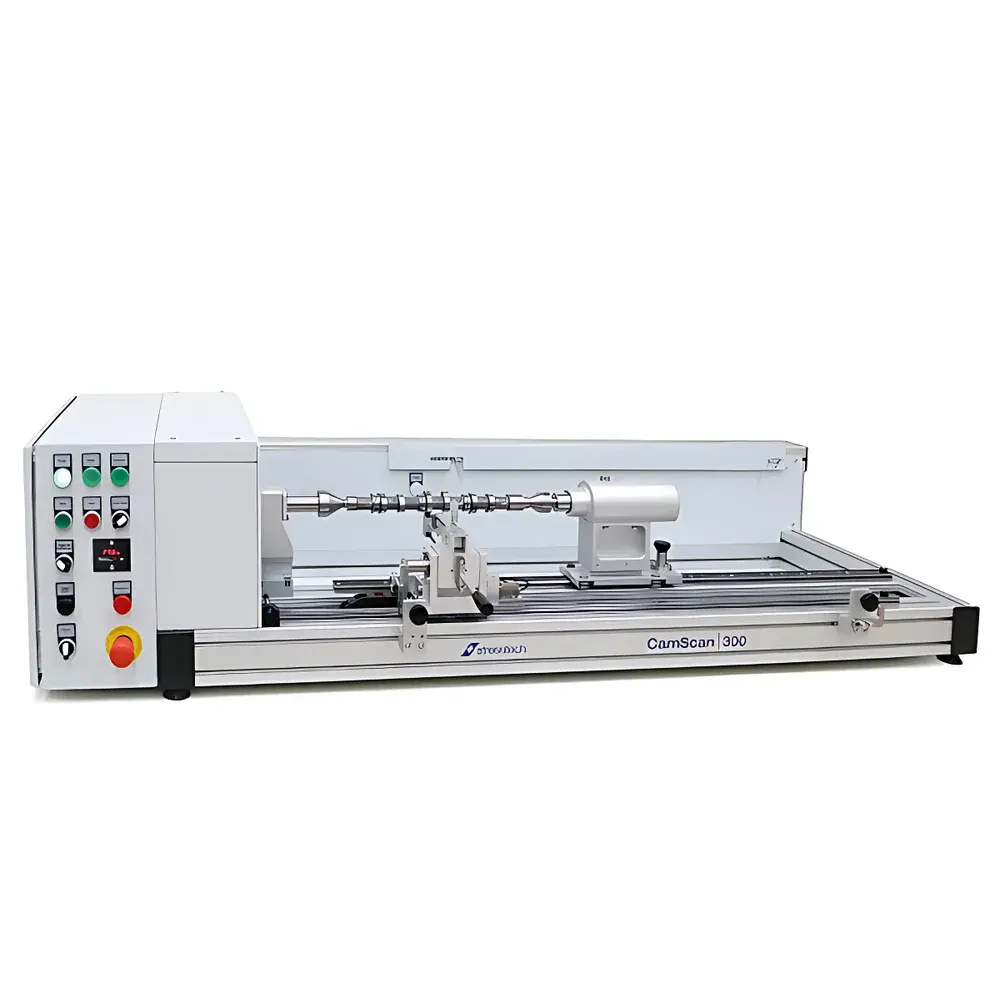
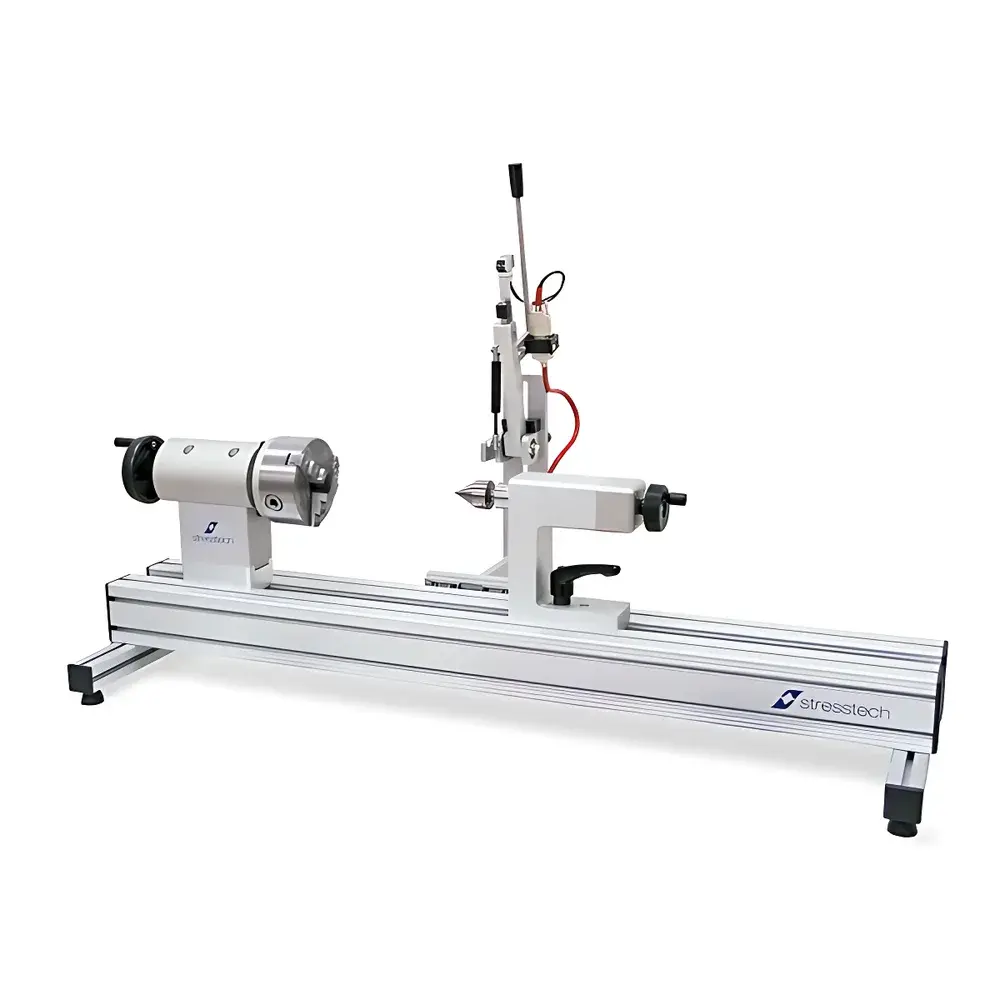
Stresstech Camscan Portable Camshaft Surface Grinding Burn & Defect Detection System
| Brand | Stresstech Oy |
|---|---|
| Country of Origin | Finland |
| Model | Camscan |
| Magnetization Frequency | Sine Wave 1–1000 Hz / Triangle Wave 1–150 Hz |
| Peak-to-Peak Magnetization Voltage | 0–16 V |
| Demagnetization Analysis Filter Bands | 10–70 kHz, 70–200 kHz, 200–450 kHz |
| Dimensions | 364 W × 156 H × 316 D mm |
| Interface | Ethernet, USB |
| Software | ViewScan Data Acquisition & Visualization Suite |
| Operating Modes | Single-Channel and Multi-Channel Probe Configurations |
| Measurement Time per Location | ~3–5 seconds |
| User Interface | Multilingual (English, German, French, Chinese, Russian) with Password-Protected Access |
| Compliance | Designed for GLP/GMP-aligned NDT workflows |
Overview
The Stresstech Camscan Portable Camshaft Surface Grinding Burn & Defect Detection System is an advanced electromagnetic non-destructive testing (NDT) instrument engineered for rapid, quantitative assessment of surface and near-surface integrity in case-hardened steel components—particularly camshafts, crankshafts, bearing journals, gear teeth, and aerospace landing gear. Unlike conventional destructive methods such as acid etching or metallographic sectioning, the Camscan leverages the magnetoelastic effect: localized microstructural changes induced by grinding burn, overheating, or improper heat treatment alter magnetic permeability and eddy current response. By applying controlled low-frequency AC magnetization and analyzing high-frequency harmonic content in the induced signal, the system detects subsurface microcracks, soft spots, tempering anomalies, and residual stress gradients with sub-millimeter spatial resolution. Its portable architecture enables on-site inspection directly at machining cells, heat-treatment lines, or final assembly stations—eliminating part removal, process interruption, or laboratory turnaround delays.
Key Features
- Multi-channel probe compatibility supporting axial, radial, and contour-following configurations for complex geometries including cam lobes, journal shoulders, fillets, and undercuts.
- Real-time signal processing engine enabling full spectral analysis across three user-selectable frequency bands (10–70 kHz, 70–200 kHz, 200–450 kHz) to discriminate between thermal damage, phase transformation zones, and mechanical wear signatures.
- ViewScan software platform providing intuitive color-mapped defect visualization, automated pass/fail thresholding, statistical process control (SPC) charting, and ISO 9001-compliant report generation with embedded metadata (operator ID, timestamp, probe calibration ID, ambient temperature).
- Robust industrial enclosure rated IP54, battery-operated operation (>4 h continuous use), and hot-swappable probe modules for field maintenance without system downtime.
- FDA 21 CFR Part 11–ready audit trail functionality, including electronic signature support, user-level access control, and tamper-evident data archiving via encrypted USB or network export.
Sample Compatibility & Compliance
The Camscan is validated for ferromagnetic alloy systems including AISI 4140, 4340, 52100, 8620, and 100Cr6 steels commonly used in high-stress rotating components. It complies with key international NDT standards including ASTM E1444 (Standard Practice for Magnetic Particle Testing), ASTM E2267 (Standard Test Method for Residual Stress Measurement Using Electromagnetic Acoustic Transducers), and ISO 10893-13 (Non-destructive testing of steel tubes — Part 13: Automated eddy current testing of seamless and welded steel tubes for detection of surface imperfections). All measurement protocols are traceable to NIST-certified reference standards for magnetic permeability and coercivity. The system meets CE marking requirements under the EU Machinery Directive 2006/42/EC and EMC Directive 2014/30/EU.
Software & Data Management
ViewScan v5.x serves as the central data acquisition, analysis, and documentation interface. It supports synchronized multi-probe acquisition, real-time FFT-based spectral decomposition, and adaptive baseline correction for varying part geometry and surface finish. Raw time-domain signals and processed harmonic spectra are stored in vendor-neutral HDF5 format, enabling third-party integration with MES (Manufacturing Execution Systems) and QMS (Quality Management Systems) platforms via OPC UA or RESTful API. Calibration records—including probe sensitivity drift compensation, frequency-response characterization, and temperature compensation coefficients—are digitally signed and version-controlled. Export options include PDF reports compliant with ASME BPVC Section V, Excel-compatible CSV datasets, and XML-formatted structured logs suitable for regulatory submissions.
Applications
The Camscan delivers mission-critical quality assurance in industries where surface integrity directly governs fatigue life and functional reliability. Primary use cases include: in-process verification of grinding parameters on CNC cam grinders; post-heat-treatment validation of case depth uniformity and absence of untempered martensite; root cause analysis of premature bearing failure in wind turbine gearboxes; incoming inspection of aircraft engine camshafts per SAE ARP999; compliance screening for nuclear reactor control rod drive mechanisms per ASME III NB-2300; and R&D-level correlation studies between grinding wheel dressing cycles and subsurface microstructure evolution. Universities and national labs employ it for fundamental research into thermomechanical coupling in hard turning and cryogenic grinding processes.
FAQ
How does the Camscan differentiate between grinding burn and mechanical wear?
It analyzes the amplitude ratio and phase shift between fundamental magnetization frequency and its higher-order harmonics—burned regions exhibit distinct nonlinear magnetic responses due to altered domain wall mobility and coercivity, whereas wear-induced topography changes produce broadband noise without harmonic distortion.
Can the system be integrated into automated production lines?
Yes—via Ethernet/IP or PROFINET gateways, the Camscan supports trigger-based measurement sequences synchronized with robotic handling, part fixturing, and PLC-controlled coolant flow.
What calibration standards are required for routine operation?
Annual verification using Stresstech-certified reference blocks with certified burn severity levels (Class A–D per DIN 50140) and magnetic property reference samples traceable to PTB (Physikalisch-Technische Bundesanstalt).
Is operator training provided with system delivery?
Stresstech offers certified Level II NDT training aligned with EN ISO 9712, including hands-on methodology qualification, probe selection logic, and interpretation of spectral defect signatures.
Does the system support remote diagnostics and firmware updates?
Yes—through secure TLS-encrypted cloud portal access, enabling predictive maintenance alerts, over-the-air firmware patches, and collaborative troubleshooting with Stresstech application engineers.




