
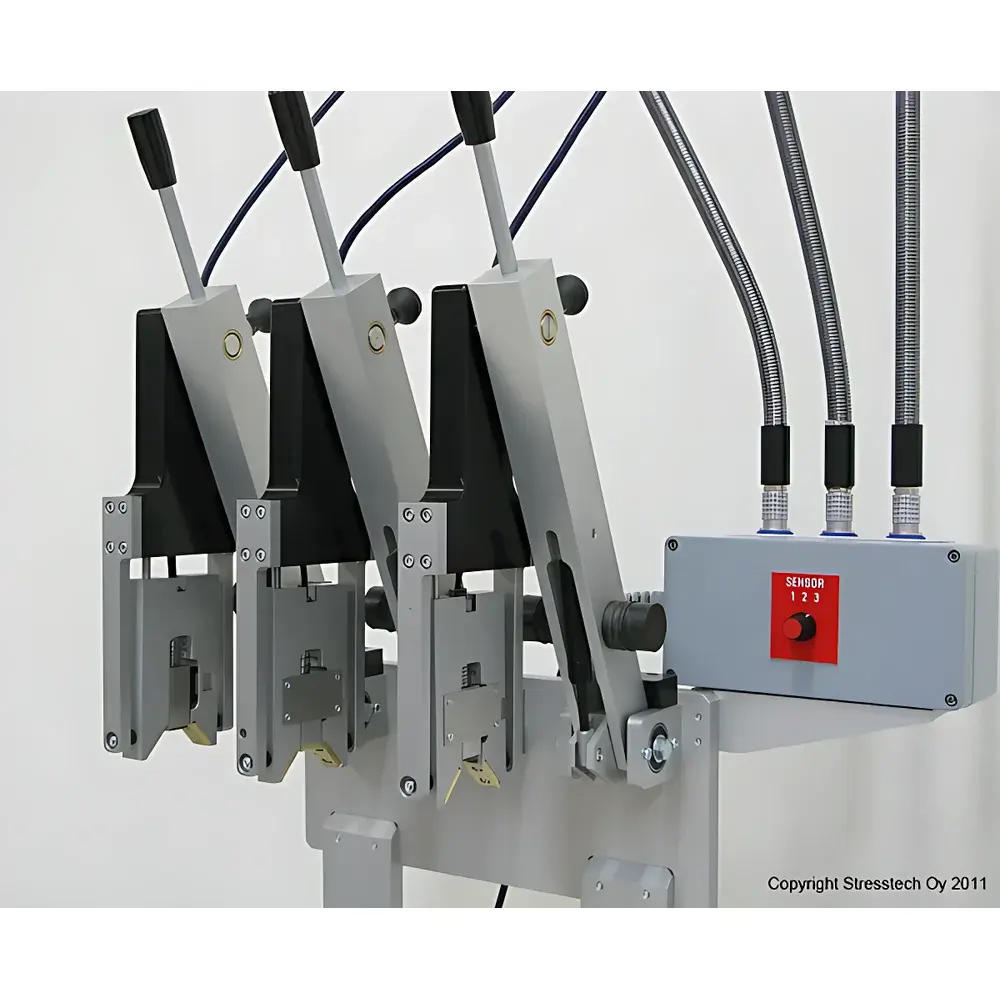
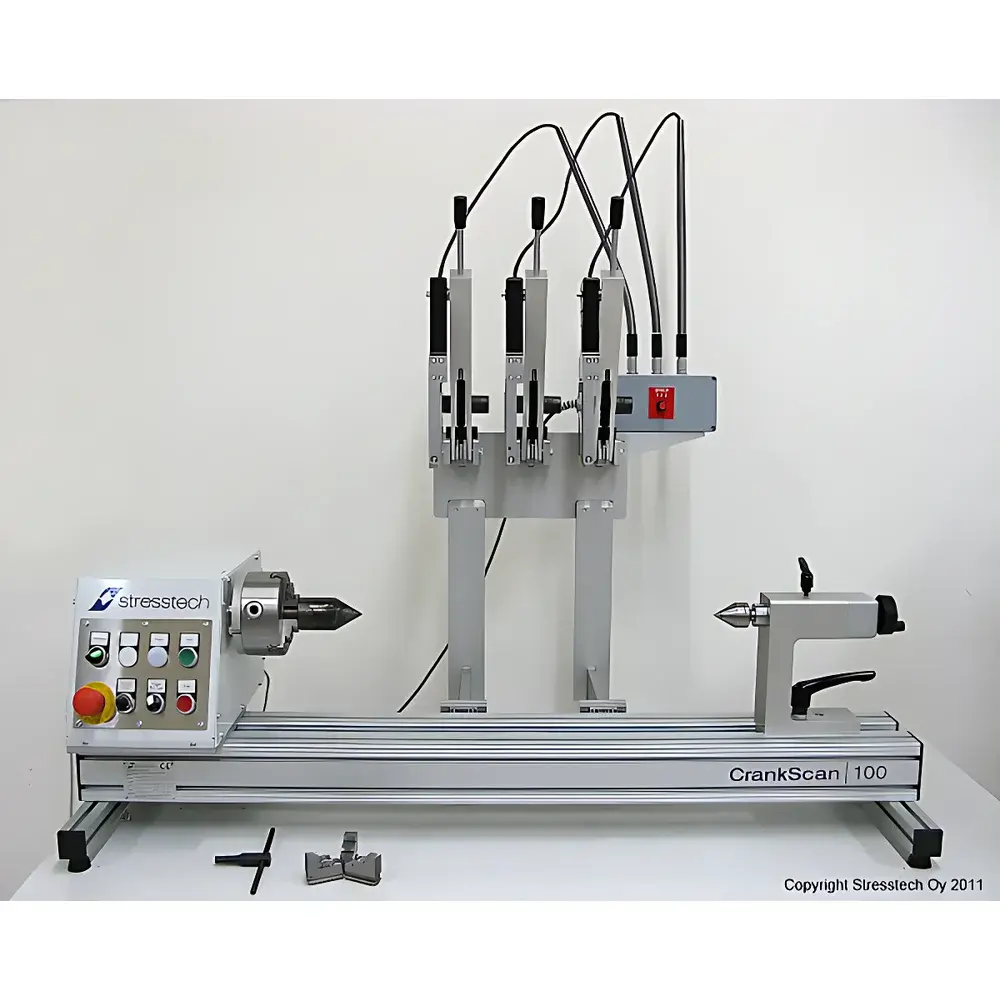
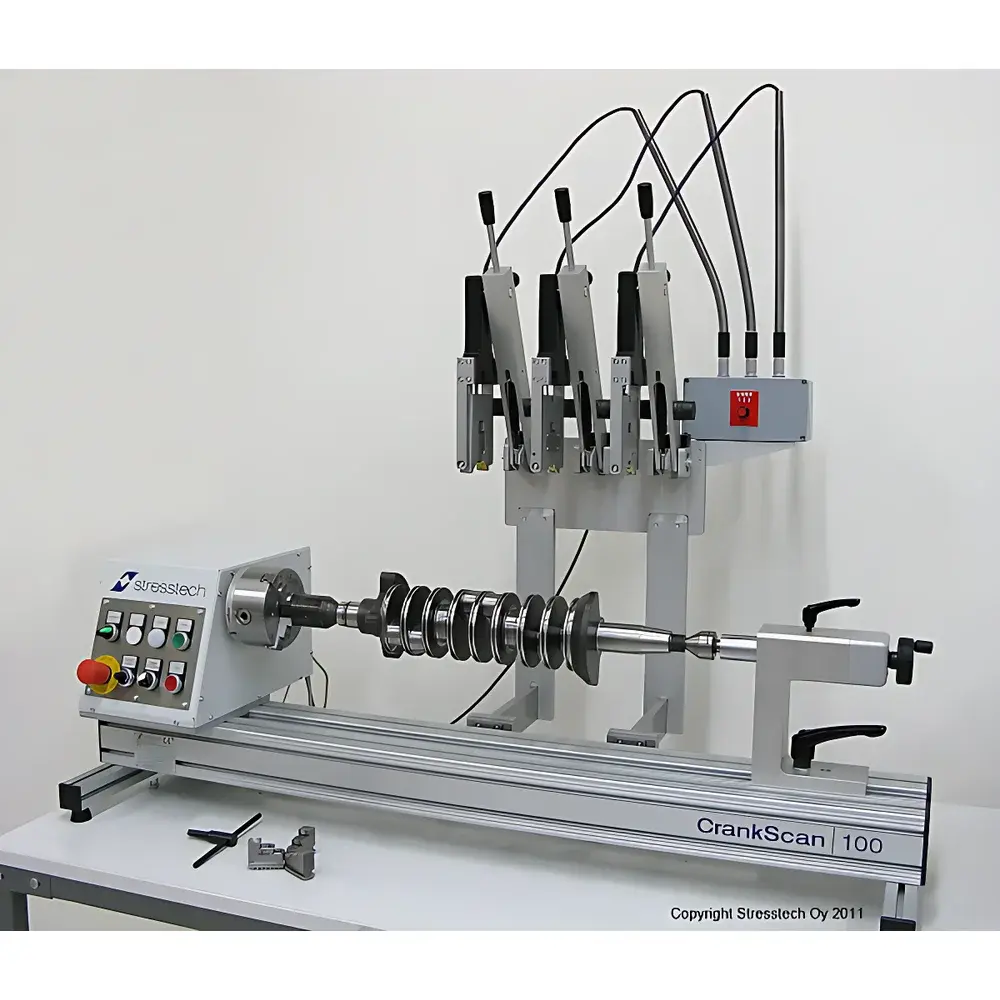
Stresstech CrankScan Barkhausen Noise-Based Crankshaft Grinding Burn Detection System
| Brand | Stresstech Oy |
|---|---|
| Origin | Finland |
| Manufacturer Type | Authorized Distributor |
| Origin Category | Imported |
| Model | CrankScan |
| Pricing | Upon Request |
Overview
The Stresstech CrankScan is a precision-engineered, non-destructive testing (NDT) system designed specifically for the detection and quantification of grinding-induced thermal damage—commonly referred to as “grinding burn”—on crankshafts and other rotationally symmetric ferromagnetic components. It operates on the physical principle of the Barkhausen Noise (BN) effect: when a time-varying magnetic field is applied to a ferromagnetic material, irreversible domain wall movements generate transient voltage pulses in a pickup coil. These pulses are statistically sensitive to microstructural changes—including residual stress gradients, martensitic phase transformations, and dislocation density increases—induced by excessive heat during grinding. Unlike destructive methods such as acid etching (per ASTM E1316), CrankScan delivers repeatable, quantitative BN signal metrics—including RMS amplitude, peak count rate, and pulse energy distribution—correlating directly with subsurface metallurgical degradation. Its architecture supports both manual scanning for R&D or low-volume verification and fully automated integration into production lines via programmable motion control interfaces.
Key Features
- Barkhausen Noise measurement technology compliant with ISO 20957 (non-destructive testing — electromagnetic testing — guidelines for Barkhausen noise analysis)
- Multi-channel acquisition capability: simultaneous evaluation of up to 8 measurement zones (e.g., journal surfaces, fillet radii, side faces, and crankpin bends) with independent probe positioning
- Measurement cycle time: 6–8 seconds per journal face under standard settings; sub-second per-point resolution achievable in high-speed mode
- Probe interchangeability: configurable sensor heads optimized for curvature radius (R ≥ 3 mm), surface roughness (Ra ≤ 3.2 µm), and accessibility constraints (e.g., narrow fillets, deep grooves)
- Real-time statistical analysis engine: computes and displays BN-derived parameters including RMS voltage (mV), pulse count/s, and cumulative energy distribution histograms
- Ruggedized industrial enclosure rated IP54; operational ambient range: −10 °C to +50 °C; resistant to coolant mist, oil vapor, and mechanical vibration typical in grinding cells
- User-configurable alarm thresholds with pass/fail color coding and automatic logging of out-of-spec measurements
Sample Compatibility & Compliance
CrankScan is validated for use on hardened steel crankshafts (e.g., 42CrMo4, 16MnCr5, EN10084 grades) and bearing components including inner/outer rings, needle roller bearings, and camshafts. It requires no surface preparation beyond standard cleaning (ISO 8502-3); no coupling agents, coatings, or electrical contact are needed. The system complies with CE marking requirements (2014/30/EU EMC Directive, 2014/35/EU LVD Directive) and meets essential safety and electromagnetic compatibility criteria for factory-floor deployment. Data traceability supports GLP/GMP-aligned workflows: audit trails record operator ID, timestamp, probe calibration status, and environmental metadata per measurement event.
Software & Data Management
Powered by Stresstech’s proprietary RollScan Studio software (v5.2+), CrankScan provides full data lifecycle management—from real-time visualization and comparative trending to export-ready reporting. Software features include multi-curve overlay for longitudinal process monitoring, statistical process control (SPC) charting (X-bar/R, Cpk), and batch-level summary dashboards. All raw BN waveforms and derived metrics are stored in encrypted SQLite databases with optional integration into enterprise MES/QMS platforms via OPC UA or CSV/JSON APIs. For regulated environments, the software supports 21 CFR Part 11-compliant electronic signatures, role-based access control, and immutable audit logs with SHA-256 hash verification.
Applications
- Detection of white-layer formation and untempered martensite in ground crankshaft journals and fillets
- Verification of grinding process stability across shift changes or wheel dressing cycles
- Root-cause analysis of premature bearing failure linked to subsurface thermal damage
- Qualification of new grinding parameters (wheel type, coolant flow, feed rate) prior to mass production
- Acceptance testing of incoming crankshafts from Tier-1 suppliers per OEM-specific BN acceptance criteria (e.g., Ford WSS-M2P177-A2, GM 6090M)
- Supporting ISO 9001:2015 clause 8.5.1 (control of production and service provision) through objective, physics-based evidence of process conformance
FAQ
How does Barkhausen Noise differ from conventional eddy current or ultrasonic NDT for burn detection?
Barkhausen Noise is uniquely sensitive to near-surface microstructural alterations (depth range: 0.02–0.2 mm), whereas eddy current responds primarily to conductivity changes and ultrasound lacks resolution for thin, thermally altered layers. BN provides direct correlation with grinding-induced phase transformation—making it the industry benchmark for burn assessment per VDI/VDE 2619-2.2.
Can CrankScan be integrated into an automated grinding cell?
Yes—CrankScan supports hardware-triggered measurement sequences via digital I/O (24 V DC), Modbus TCP, and EtherNet/IP protocols. Optional robotic path programming modules enable synchronized probe positioning with CNC grinders or gantry systems.
Is calibration required before each use?
A daily verification using a certified reference standard (e.g., Stresstech CR-STD-01) is recommended per ISO/IEC 17025. Full recalibration is performed annually by accredited service centers or Stresstech-certified engineers.
Does the system require special operator training?
Stresstech provides certified Level II BN testing training aligned with ISO 9712, including hands-on interpretation of BN spectra, threshold setting methodology, and report generation per customer-specific quality plans.
Related Products





