
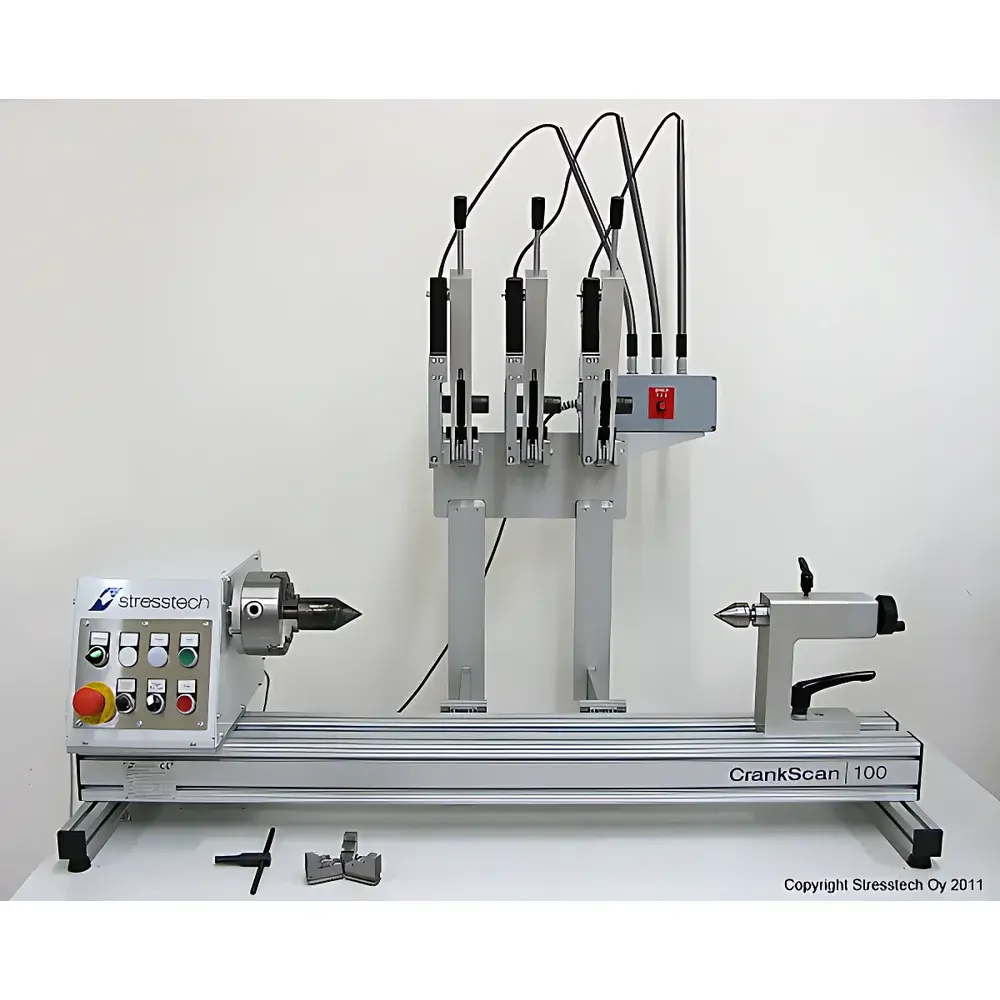
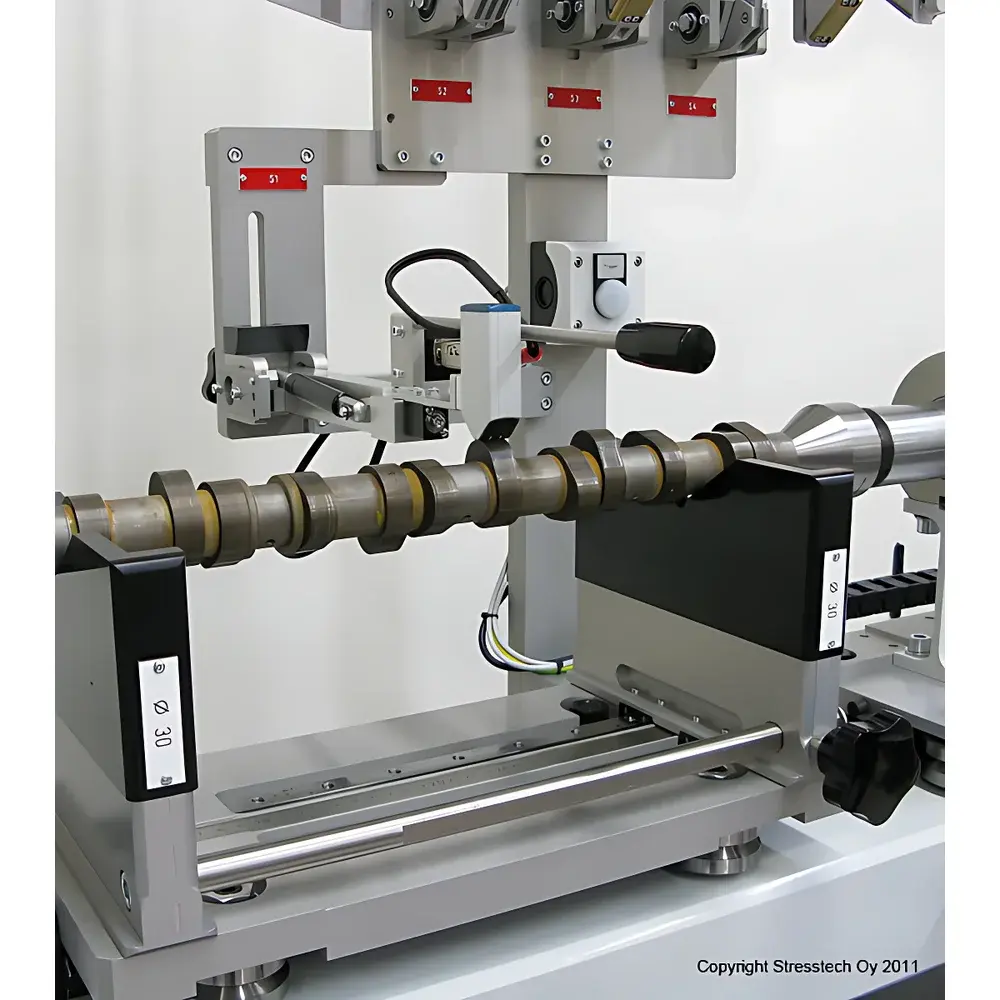
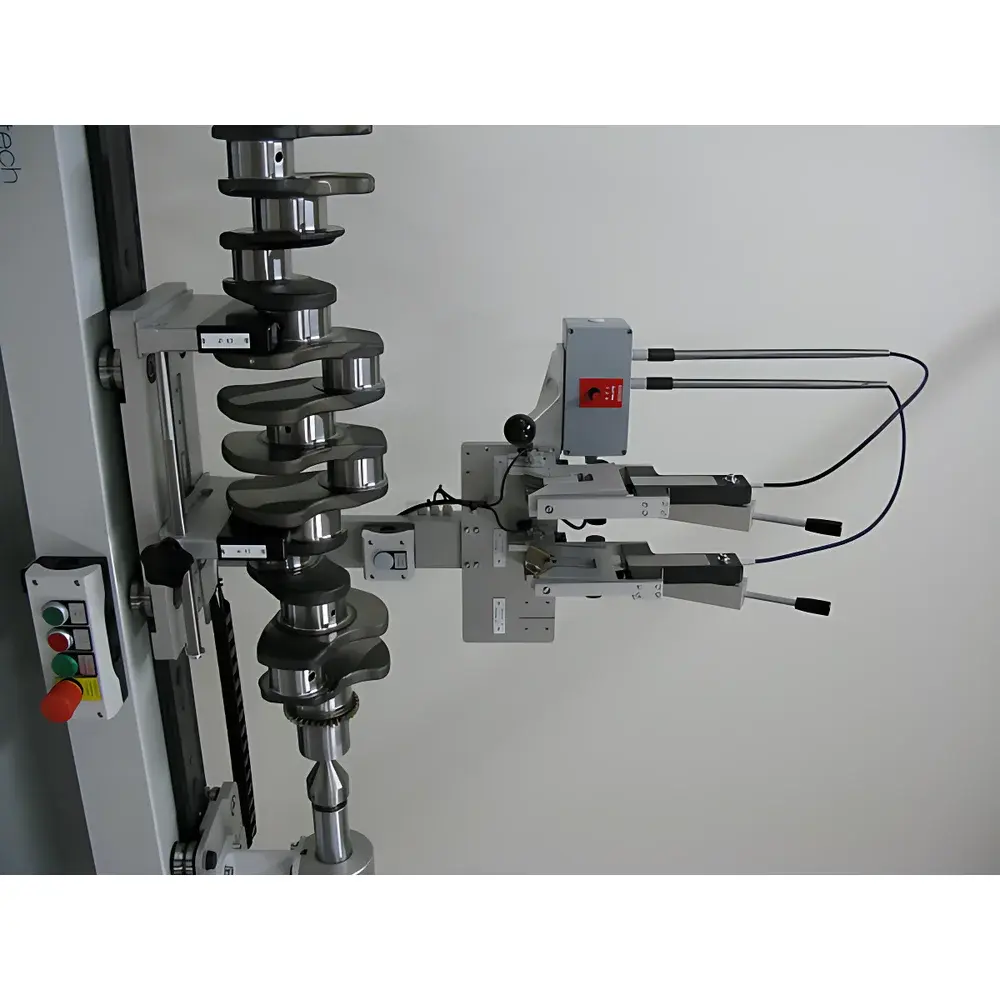
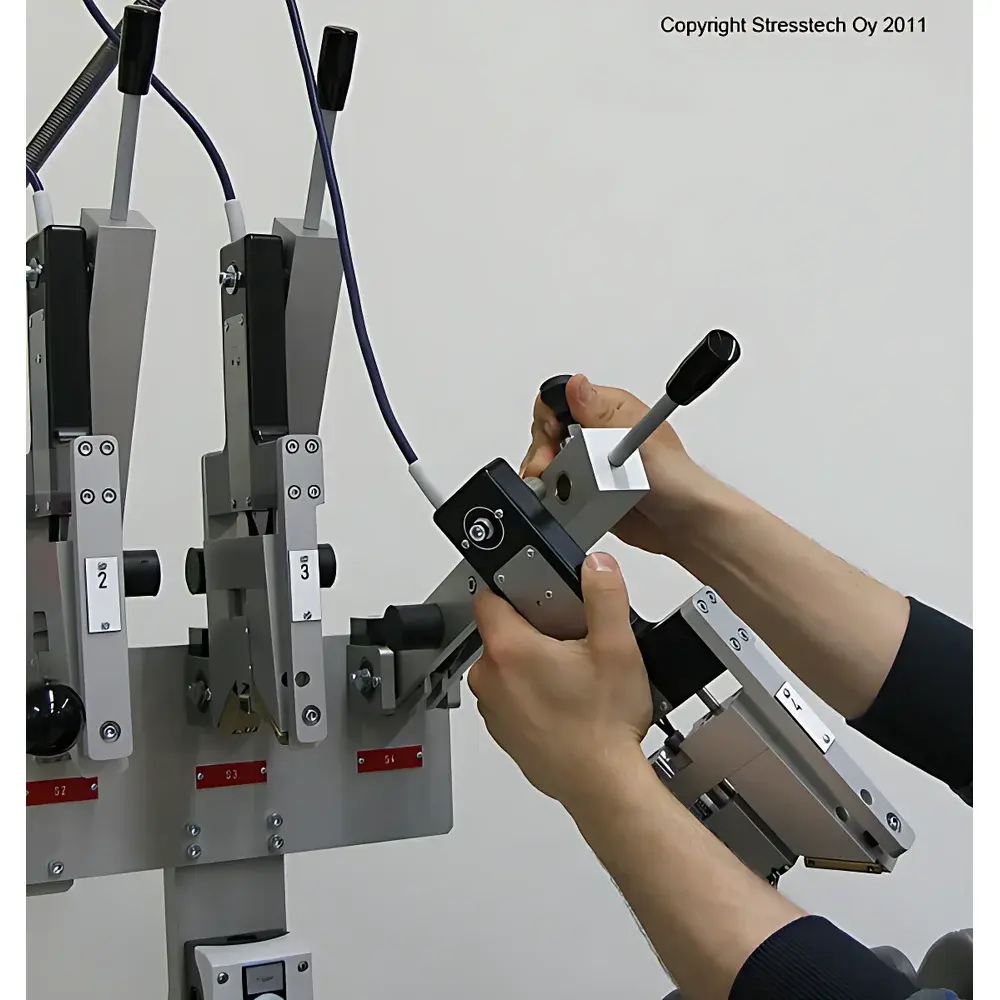
Stresstech CrankScan Surface Burn Detection System for Crankshaft Grinding
| Brand | Stresstech Oy |
|---|---|
| Origin | Finland |
| Model | CrankScan |
| Power Supply | 90–260 VAC, 49–61 Hz, single-phase |
| Inrush Current | 40 A @ 115 VAC / 80 A @ 230 VAC (cold start) |
| Nominal Power Consumption | 100 VA (150 VA during battery charging) |
| Magnetization Frequency Range | 1.0–1000 Hz |
| Magnetization Voltage | 0–16 V |
| Signal Analysis Bandwidths | 10–70 kHz, 70–200 kHz, 200–450 kHz |
| Channel Configuration | Single-channel or multi-channel (configurable) |
| Probe Compatibility | Interchangeable probes for journals, fillets, flanks, shoulders, and crank webs |
| Measurement Time per Surface | 6–8 seconds |
| IP Rating | IP20 |
| Operating Temperature | 0–40 °C |
| Relative Humidity | 10–90 % RH (non-condensing) |
| Storage Humidity | 10–90 % RH (non-condensing) |
Overview
The Stresstech CrankScan Surface Burn Detection System is a dedicated non-destructive testing (NDT) instrument engineered for the rapid, quantitative assessment of grinding-induced thermal damage—commonly referred to as “grinding burn”—on crankshaft surfaces. It operates on the principle of the Barkhausen Noise Analysis (BNA) method: a time-varying magnetic field induces domain wall motion in ferromagnetic materials, and the resulting stochastic voltage pulses (Barkhausen noise) are highly sensitive to microstructural changes—including residual stress gradients, martensitic phase transformations, and dislocation density increases—caused by localized overheating during grinding. Unlike destructive acid etching or time-intensive metallography, CrankScan delivers repeatable, traceable, and calibration-verified results without surface preparation or material removal. Its design specifically addresses the geometric complexity of crankshafts—including journals, transition fillets, flanks, shoulders, and web regions—making it a production-integrated solution for engine component manufacturers adhering to stringent automotive quality standards (e.g., ISO/TS 16949, VDA 6.3).
Key Features
- True non-destructive evaluation: No surface alteration, acid etching, or sample sectioning required.
- Multi-band spectral analysis: Simultaneous acquisition across three configurable frequency bands (10–70 kHz, 70–200 kHz, 200–450 kHz) enables discrimination between subsurface plastic deformation, tempering effects, and severe white-layer formation.
- Configurable channel architecture: Supports both single-probe manual inspection and synchronized multi-probe setups for high-throughput inline or offline verification of multiple crankshaft surfaces in one cycle.
- Real-time threshold-based alarm logic: User-definable pass/fail limits per measurement zone, with audible and visual alerts integrated into the HMI interface.
- Rugged industrial design: IP20-rated enclosure suitable for shop-floor deployment; optimized for ambient temperatures from 0 °C to 40 °C and humidity up to 90 % RH (non-condensing).
- Low-inertia probe options: Dedicated probes engineered for curvature matching—journal probes (cylindrical), fillet probes (conformal radius), and flank probes (flat-to-curved transition)—ensure consistent coupling and signal reproducibility across part geometries.
Sample Compatibility & Compliance
CrankScan is validated for use on hardened and tempered steel crankshafts used in passenger car, light-duty, and heavy-duty diesel/gasoline engines—including forged, cast, and billet variants with hardness ranges from 45 to 65 HRC. It complies with the technical foundations of ASTM E1444/E1444M (Standard Practice for Magnetic Particle Testing) and supports audit-ready documentation aligned with ISO 17025 requirements for NDT laboratories. While BNA itself is not codified as a standalone ASTM standard, its application in grinding burn detection follows established industry protocols referenced in OEM specifications (e.g., Ford WSS-M2P175-B, GM 6090M, VW TL 226). The system’s measurement traceability, calibration certificate management, and operator authentication features support GLP/GMP-aligned quality systems and FDA 21 CFR Part 11 readiness when deployed with optional audit trail software modules.
Software & Data Management
The CrankScan Control Suite provides full instrument orchestration via a Windows-based interface with intuitive workflow navigation. Each measurement captures raw time-domain signals, RMS amplitude, peak count rate, and spectral centroid values per band—exportable in CSV or XML format for statistical process control (SPC) integration. Calibration data—including probe serial number, magnetization settings, and reference sample IDs—is embedded in every result file. Optional reporting modules generate PDF inspection certificates compliant with IATF 16949 clause 8.5.1.2 (Control of production processes), including measurement location mapping, trend charts over time, and deviation heatmaps relative to master reference parts. All user actions—including parameter changes, calibration events, and report generation—are logged with timestamps and operator IDs to satisfy internal audit and regulatory review requirements.
Applications
- Final verification of crankshaft grinding processes prior to hardening or after finish grinding.
- Root cause analysis of premature bearing failures linked to subsurface microcracking or untempered martensite layers.
- Process validation and capability studies (Cpk/Ppk) for new grinding wheel types, coolant formulations, or feed rate adjustments.
- Supplier qualification audits where grinding burn resistance is contractually mandated.
- Tool wear monitoring: Progressive degradation of wheel sharpness manifests as measurable shifts in Barkhausen signal amplitude and spectral distribution.
- Integration into automated handling cells using digital I/O or EtherNet/IP for go/no-go feedback to CNC grinders or robotic loaders.
FAQ
What physical principle does CrankScan rely on?
It utilizes the magnetoelastic Barkhausen noise effect, where abrupt magnetic domain wall movements in ferromagnetic steels generate measurable voltage transients directly correlated to near-surface microstructural integrity.
Can CrankScan detect subsurface burn beyond the visible white layer?
Yes—Barkhausen noise responds to stress-induced lattice distortions and phase instability at depths up to ~200 µm, often identifying thermally affected zones before they evolve into macroscopically observable white etching layers.
Is probe calibration required before each measurement?
No—probes are factory-calibrated with unique identification and stored compensation curves; however, daily verification using certified reference samples is recommended per ISO/IEC 17025 Clause 7.7.
Does the system support integration with MES or QMS platforms?
Yes—via OPC UA or RESTful API interfaces, enabling real-time transfer of inspection outcomes, SPC data, and alarm status to enterprise-level quality databases.
What training is provided for operators and maintenance personnel?
Stresstech offers certified operator training (8 hours), advanced application engineering workshops (16 hours), and on-site preventive maintenance certification for in-house service engineers.





