
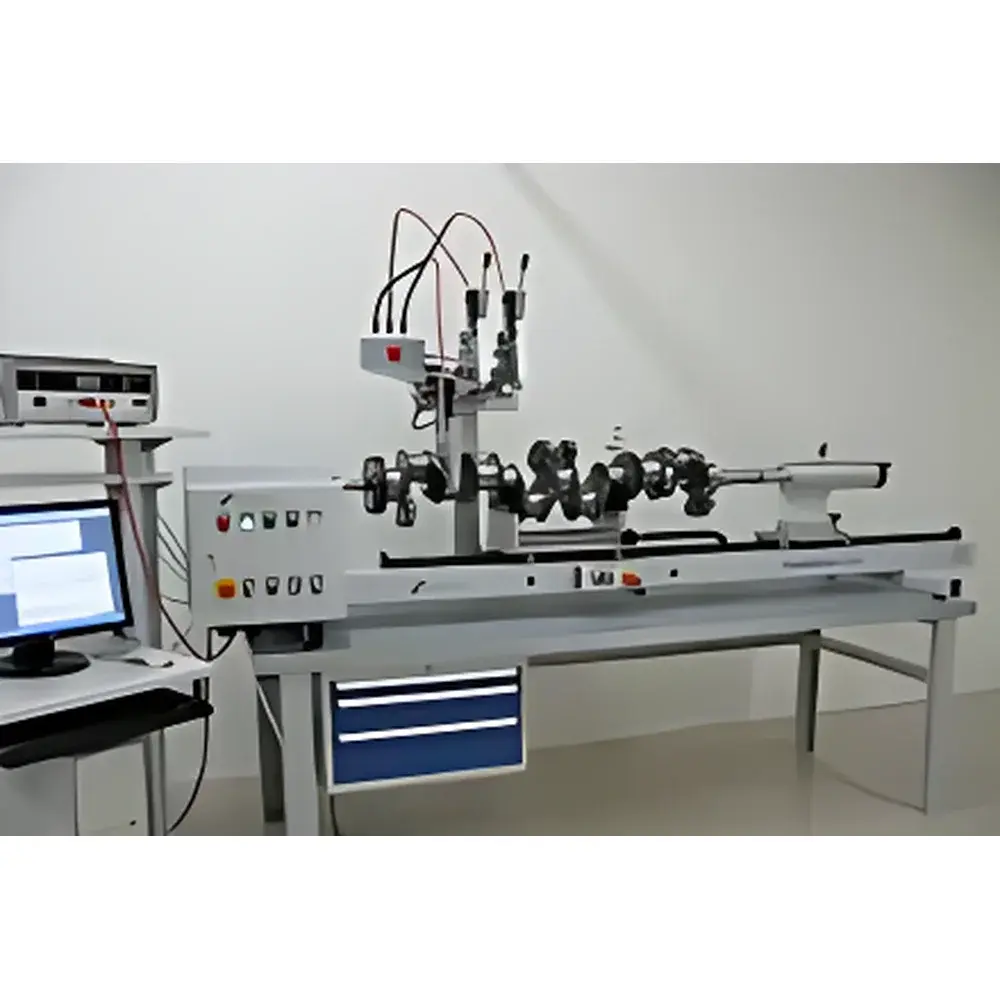
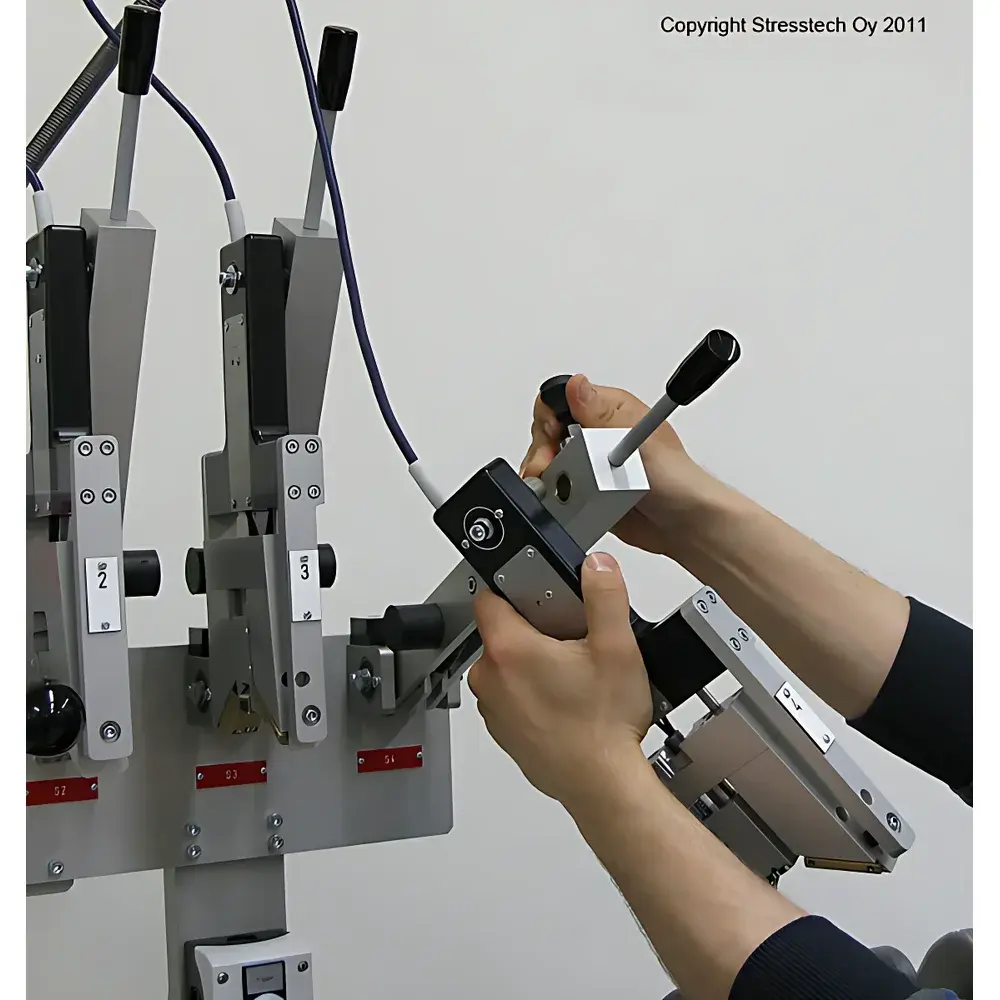
Stresstech CrankScan200 Magnetic Barkhausen Noise (MBN) Crankshaft Grinding Burn Detection System
| Brand | Stresstech Oy |
|---|---|
| Origin | Finland |
| Model | CrankScan200 |
| Detection Principle | Magnetic Barkhausen Noise (MBN) |
| Measurement Type | Non-Destructive, Surface & Near-Surface Integrity Assessment |
| Channel Configuration | Single- or Multi-Channel Probe Support |
| Probe Compatibility | Curved-Surface Optimized Sensors for Journal, Fillet, Flank, and Crankweb Geometry |
| Alarm Thresholding | User-Configurable Signal Amplitude & Statistical Deviation Limits |
| Compliance Framework | Supports ISO 28671 (Non-destructive testing — Magnetic Barkhausen noise testing — General principles), ASTM E3094 (Standard Guide for MBN Testing of Ferromagnetic Materials), and GLP/GMP-aligned data traceability |
Overview
The Stresstech CrankScan200 is a dedicated magnetic Barkhausen noise (MBN)–based inspection system engineered for the non-destructive evaluation of grinding-induced surface damage in ferromagnetic crankshafts. Unlike destructive acid etching or subjective visual assessment, the CrankScan200 quantifies microstructural alterations—including tensile residual stress gradients, martensitic phase instability, and localized plastic deformation—within the top 50–200 µm of the component surface. These changes are direct indicators of thermal overload during grinding or inadequate coolant application, which can initiate premature fatigue failure under cyclic loading. Designed specifically for high-volume engine manufacturing environments, the system delivers repeatable, operator-independent results across diverse crank geometries—from compact inline-4 automotive crankshafts to heavy-duty V12 diesel crankshafts—with measurement repeatability better than ±3% relative standard deviation under controlled calibration conditions.
Key Features
- Proprietary MBN sensor architecture with curvature-adapted probe heads for conformal contact on journals (cylindrical), fillets (radius ≤ 2 mm), flanks, and crankwebs—enabling full circumferential coverage without repositioning.
- Real-time signal acquisition at up to 1 MHz sampling rate, coupled with digital lock-in amplification to suppress electromagnetic interference common in production-floor settings.
- Multi-channel expansion capability: Supports up to four synchronized probes for parallel scanning of opposing journals or simultaneous fillet/journal assessment—reducing cycle time by up to 60% versus sequential single-point inspection.
- Embedded threshold logic engine allowing configurable pass/fail criteria based on amplitude, peak frequency shift, and RMS noise energy—each calibrated against reference samples with known burn severity per ASTM E3094 Annex A2.
- Ruggedized industrial enclosure (IP54 rated) with integrated thermal management, enabling continuous operation in ambient temperatures from 5 °C to 45 °C and relative humidity up to 85% non-condensing.
Sample Compatibility & Compliance
The CrankScan200 is validated for use on AISI 4340, 5140, 1045, and EN 10083-3 C70S6, C67S6, and 42CrMo4 crankshaft steels after hardening and grinding. It complies with ISO 28671:2022 requirements for MBN system verification, including linearity assessment, sensitivity calibration using standardized notched reference blocks, and long-term stability monitoring. Data output meets FDA 21 CFR Part 11 requirements for electronic records and signatures when deployed with optional audit-trail-enabled software modules. All measurement procedures align with OEM-specific internal standards (e.g., Ford WSS-M2P157-A, GM 6094M, VW TL 226) governing grinding burn acceptance limits in powertrain components.
Software & Data Management
CrankScan200 operates with Stresstech’s ScanView v5.3 analysis suite, featuring intuitive scan-path programming, automatic geometry registration via encoder-synchronized motion control, and spatial mapping of MBN parameters onto 2D crank contour diagrams. Raw time-domain signals and derived spectral features (e.g., Barkhausen pulse count, coercivity index, harmonic distortion ratio) are stored in vendor-neutral HDF5 format. Integrated reporting tools generate PDF-certified inspection reports compliant with ASME B31.8 and API RP 1104 documentation protocols. Optional cloud synchronization enables centralized fleet-wide trend analysis across multiple production lines, supporting predictive maintenance of grinding wheel dressing intervals and coolant concentration optimization.
Applications
- Final quality gate inspection of crankshafts post-grinding prior to balancing and assembly.
- In-process validation of grinding wheel condition, feed rate, and coolant flow rate in closed-loop process control systems.
- Root cause analysis of field failures linked to subsurface white-layer formation or untempered martensite.
- Qualification of alternative grinding media (e.g., cubic boron nitride wheels) or cryogenic cooling strategies.
- Residual stress profiling correlation studies with X-ray diffraction (XRD) or neutron diffraction reference measurements.
FAQ
How does MBN detect grinding burn without surface preparation?
MBN relies on irreversible domain wall motion in ferromagnetic materials under controlled AC magnetization; thermal damage alters local coercivity and domain pinning density, producing measurable changes in noise amplitude and spectral distribution—requiring no coupling medium or surface finishing.
Can CrankScan200 distinguish between regrind burn and original heat-treat defects?
Yes—through multi-parameter analysis (e.g., amplitude vs. frequency centroid shift), combined with depth-profiling via variable excitation frequency sweep, enabling differentiation between near-surface grinding artifacts and bulk microstructural anomalies.
Is operator certification required to operate the system?
While basic scanning functions require minimal training, interpretation of MBN signatures for process troubleshooting demands Level II certification per ISO 9712 or SNT-TC-1A, as specified in customer quality manuals.
Does the system support integration with factory MES/SCADA platforms?
Yes—via OPC UA and Modbus TCP interfaces, enabling real-time transfer of pass/fail status, quantitative MBN indices, and timestamped measurement logs into enterprise manufacturing execution systems.




