
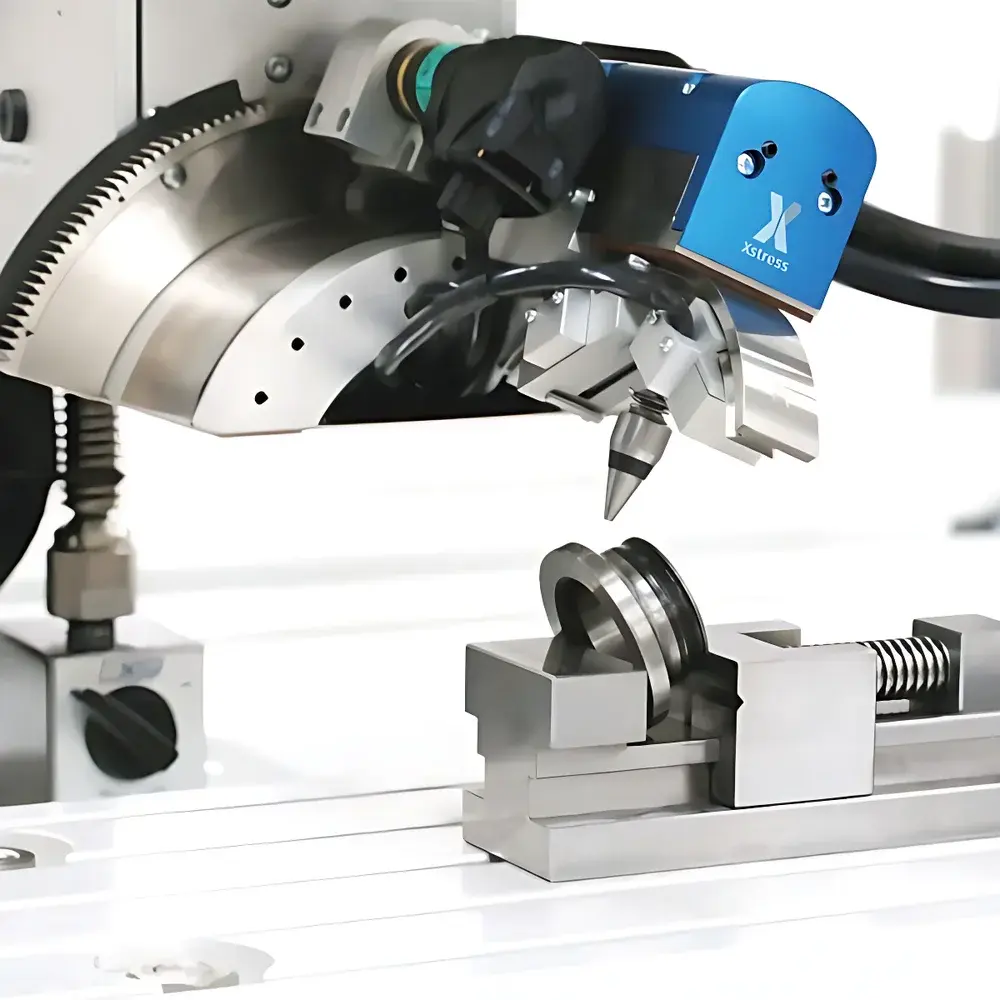
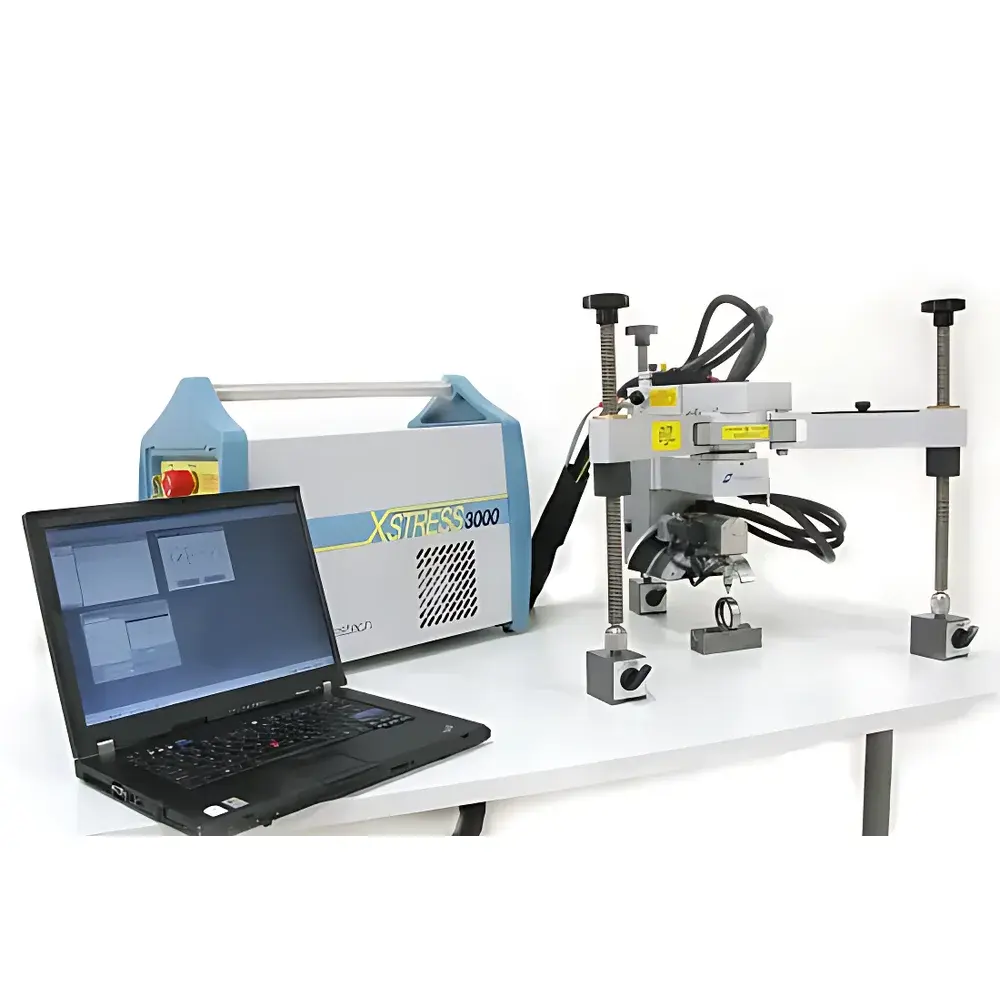
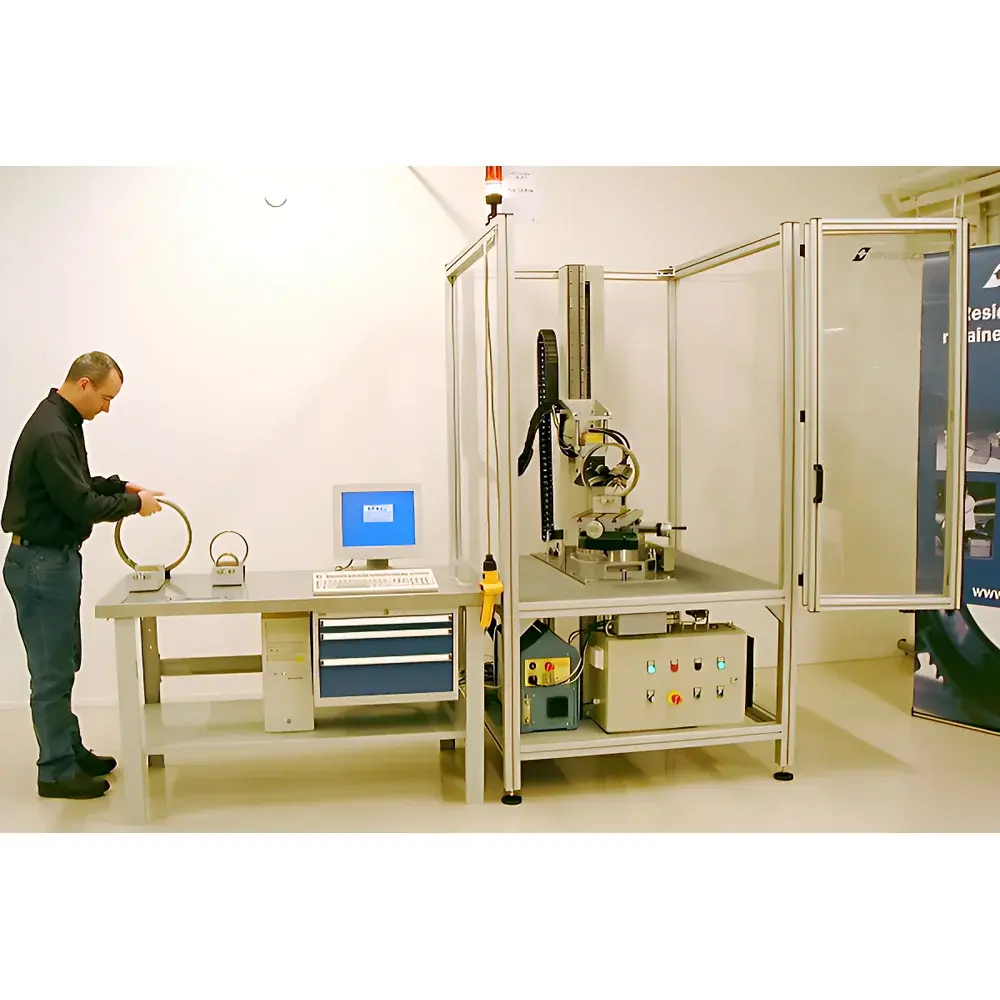
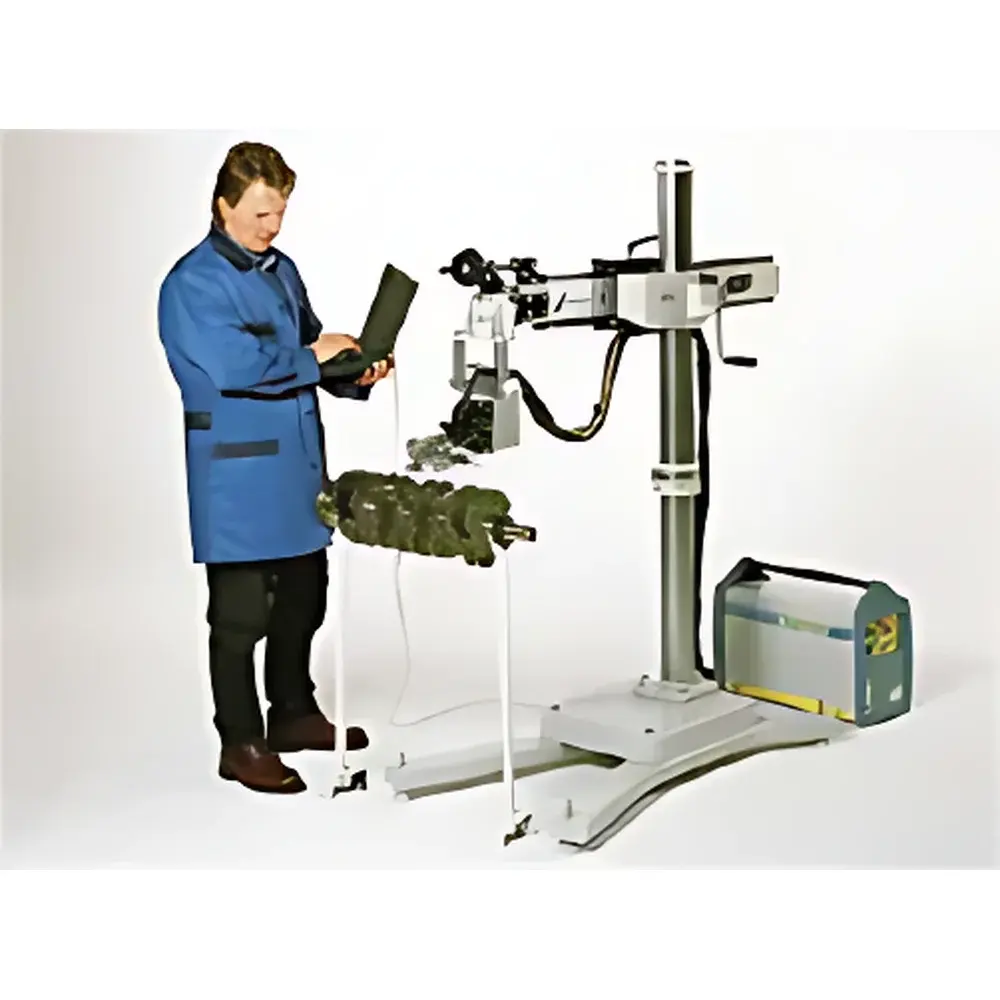
Stresstech Xstress3000 Residual Austenite & Stress Analyzer
| Brand | Stresstech Oy |
|---|---|
| Origin | Finland |
| Model | Xstress3000 |
| X-ray Tube | 5–30 kV / 0–10 mA / 300 W adjustable |
| Target Materials | Cr, Cu, Co, Ti, Mn |
| Detector Geometry | Dual symmetric detectors, side-inclination (y-geometry) |
| 2θ Range | 110°–171° continuous adjustment |
| Collimator Options | Ø0.5 mm, Ø0.8 mm, Ø1 mm, Ø2 mm, Ø3 mm, Ø5 mm |
| d-sin²ψ Measurement Mode | Multi-point with cross-correlation peak shift analysis |
| Calibration | Fully automated, positioning error < 0.003 mm |
| Cooling | Closed-loop recirculating system with active forced cooling |
| Safety | Integrated interlocks and radiation shielding compliant with IEC 61010-1 and EN 62495 |
Overview
The Stresstech Xstress3000 Residual Austenite & Stress Analyzer is a portable, high-precision X-ray diffraction (XRD)-based instrument engineered for non-destructive determination of residual stress and retained austenite content in metallic components. It operates on the sin²ψ method—applying Bragg’s law to lattice strain-induced peak shifts in diffraction patterns—to quantify macroscopic residual stresses in crystalline materials. Simultaneously, it quantifies volume fraction of retained austenite (γ-Fe) in hardened steels using integrated intensity ratios of characteristic (200), (220), and (311) austenite peaks relative to ferrite (α-Fe) (200) and (211) reflections. Designed for both laboratory and field deployment, the Xstress3000 maintains metrological integrity under variable ambient conditions—enabling measurements directly on large, immobile parts such as turbine discs, welded pressure vessels, gear teeth, and additively manufactured aerospace components without disassembly.
Key Features
- Compact, battery-compatible portable architecture weighing under 25 kg—optimized for on-site use in production floors, maintenance hangars, and field service environments.
- Dual symmetric silicon drift detectors (SDD) with energy discrimination capability, enabling high signal-to-noise ratio even at low count rates and minimizing background interference.
- Side-inclination (y-geometry) goniometer with fully motorized tilt and rotation axes, supporting standard sin²ψ, cosα, and modified ψ-scan protocols per ASTM E915, ISO 21943, and EN 15305.
- Microfocus X-ray tube with selectable anode targets (Cr, Cu, Co, Ti, Mn) and continuously adjustable voltage (5–30 kV) and current (0–10 mA), ensuring optimal excitation for diverse alloy systems—from low-Z aluminum alloys to high-absorption nickel-based superalloys.
- Automated collimator changer with precision apertures ranging from Ø0.5 mm to Ø5 mm, enabling spatial resolution down to sub-millimeter scale for localized stress mapping across case-hardened layers or weld heat-affected zones (HAZ).
- Fully integrated closed-loop recirculating cooling system with thermoelectric assist, maintaining stable tube temperature and spectral output during extended measurement sequences.
Sample Compatibility & Compliance
The Xstress3000 accommodates flat, curved, and irregularly shaped ferrous and non-ferrous components—including gears, bearing races, crankshafts, camshafts, rolled plates, and powder-bed-fused AM parts—with surface roughness up to Ra 6.3 µm. Sample preparation is limited to surface cleaning and optional electropolishing for highly stressed near-surface layers. The system complies with EU Directive 2013/59/Euratom (radiation protection), IEC 61010-1 (electrical safety), and EN 62495 (X-ray equipment for industrial use). Measurement procedures align with ASTM E915-22 (standard test method for verifying residual stress measurement by X-ray diffraction), ISO 21943:2020 (non-destructive testing — X-ray diffraction — determination of residual stress), and ISO 20932-2:2020 (quantification of retained austenite in steel).
Software & Data Management
The proprietary Xstress Software Suite runs natively on Windows 10/11 (64-bit) and provides full instrument control, real-time high-voltage monitoring, exposure parameter scripting, and concurrent data acquisition, peak fitting, and stress calculation. It supports multi-point d-sin²ψ scans with cross-correlation-based centroid detection for sub-pixel peak shift resolution. A built-in materials database includes over 1,200 crystallographic references (ICDD PDF-4+ compatible), elastic constants, and diffraction parameters for common engineering alloys. All measurement sessions are timestamped and logged with full audit trail metadata—including operator ID, calibration history, collimator ID, and environmental sensor readings (temperature, humidity)—supporting GLP/GMP documentation requirements and FDA 21 CFR Part 11 electronic record compliance when deployed with validated user access controls.
Applications
- Aerospace: Residual stress profiling in turbine blades, landing gear forgings, and cold-expanded fastener holes to assess fatigue life and stress corrosion cracking susceptibility.
- Automotive: Quantifying retained austenite in carburized transmission gears and verifying compressive stress distribution after shot peening or roller burnishing.
- Additive Manufacturing: In-process validation of thermal stress evolution in Ti-6Al-4V and Inconel 718 builds; post-build evaluation of stress relaxation following HIP or heat treatment.
- Energy Sector: Field assessment of welding residual stress in nuclear reactor piping and offshore wind tower flanges per ASME BPVC Section III, Division 1.
- Research & Academia: In situ stress development studies during thermo-mechanical cycling, phase transformation kinetics in metastable stainless steels, and benchmarking of numerical models (e.g., FEM-based stress prediction).
FAQ
What standards does the Xstress3000 support for residual stress measurement?
ASTM E915, ISO 21943, EN 15305, and SAE AMS 2772—all implemented via configurable measurement protocols within the software.
Can the system measure both stress and retained austenite in a single setup?
Yes. The instrument acquires overlapping diffraction spectra optimized for both lattice strain analysis and phase quantification without hardware reconfiguration.
Is radiation safety certification required for field operation?
The system is classified as a “Type B” radiation device under IEC 62495 and requires site-specific risk assessment and local regulatory notification—but no permanent shielding infrastructure due to its inherently low-dose, collimated beam design.
How is calibration traceability maintained?
Each unit ships with NIST-traceable reference samples (Si, Fe, Ni powders); automated calibration routines verify angular accuracy, detector linearity, and tube output stability before every measurement session.
Does the software support automated report generation for quality documentation?
Yes—customizable PDF and Excel reports include raw spectra, fitted peaks, stress tensors, austenite volume fractions, uncertainty estimates per GUM (JCGM 100), and digital signatures for QA sign-off.
Related Products





