
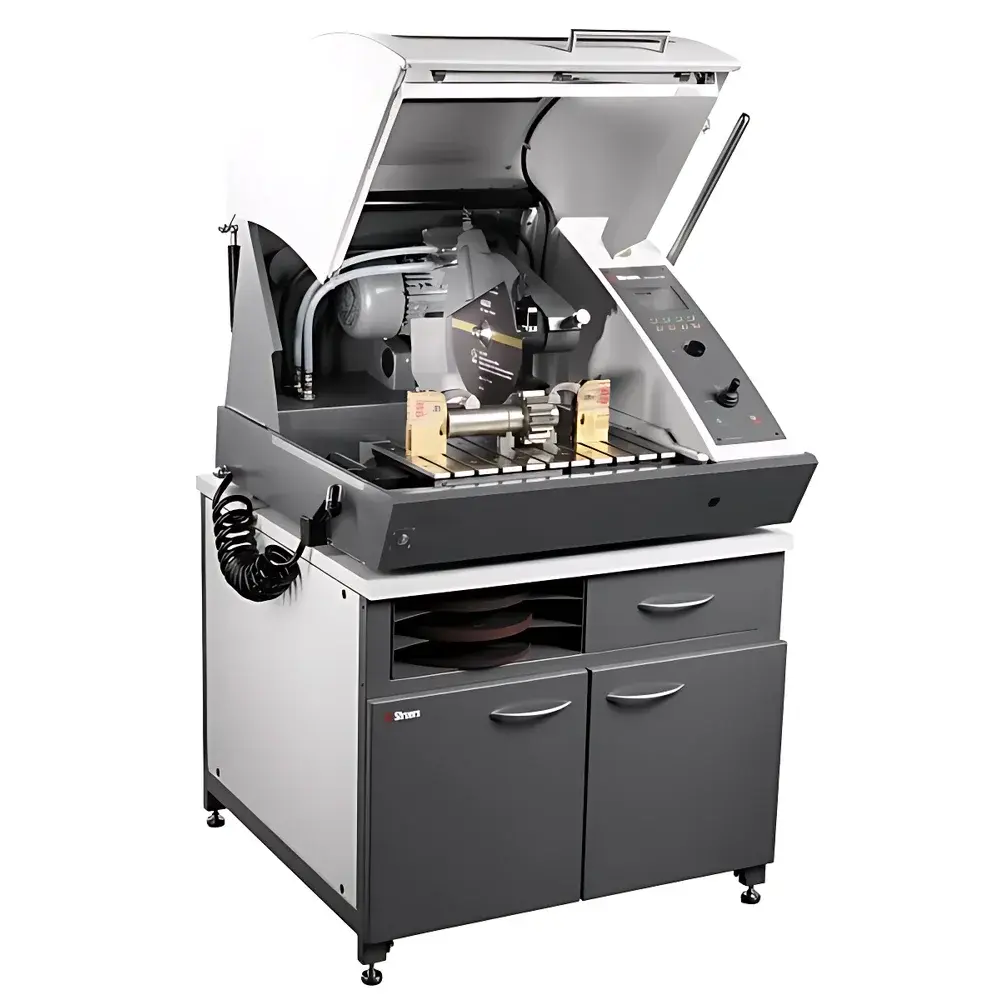
Struers Discotom-100 Automated & Manual Metallographic Cutting Machine
| Brand | Struers |
|---|---|
| Origin | Denmark |
| Model | Discotom-100 |
| Instrument Type | Metallographic Cutting Machine |
| Cutting Table Dimensions | 620 × 270 mm |
| T-Slot Width | 10 mm |
| Control Interface | Icon-Based Touchscreen GUI |
| Feed System | OptiFeed Automatic Feed Control |
| Cutting Modes | Auto MultiCut (4 preset X-axis programs), Manual ExciCut, and Semi-Automatic Operation |
| Integrated Features | AxioWash Automatic Blade Cleaning, Electric Brake System |
| Compliance | Designed for ISO 14971 risk management and aligned with ASTM E3, ISO 3887, and EN 61000-6-2 EMC standards |
Overview
The Struers Discotom-100 is an engineered metallographic cutting system that bridges precision sample preparation with operational flexibility. Built on Struers’ decades-long heritage in materials science instrumentation, the Discotom-100 employs a robust mechanical architecture optimized for controlled abrasive cutoff under variable load, speed, and feed conditions. Its core operation relies on high-torque motor-driven wheel rotation combined with programmable axial feed motion—enabling reproducible kerf width control, minimal heat-affected zone (HAZ) generation, and consistent surface integrity across diverse metallic, ceramic, and composite specimens. Unlike entry-level cut-off machines limited to fixed-speed or manual-only workflows, the Discotom-100 integrates dual-mode functionality—fully automated sequential sectioning and operator-guided manual intervention—within a single platform. This hybrid design supports both routine QC batch processing and R&D-grade specimen optimization where iterative parameter tuning is essential.
Key Features
- Large-format cutting table (620 × 270 mm): Offers industry-leading work envelope among benchtop metallographic cutters—accommodating oversized castings, multi-sample holders, and irregularly shaped components without repositioning.
- 10 mm T-slot modular fixture system: Compatible with Struers’ full range of clamping solutions—including hydraulic vices, rotary fixtures, and custom jig adapters—ensuring secure, repeatable positioning for specimens ranging from sub-millimeter wires to 150 mm diameter rods.
- OptiFeed intelligent feed control: Dynamically adjusts downward force and traverse rate based on real-time torque feedback, maintaining optimal wheel engagement across varying material hardness and geometry—reducing wheel wear and improving cut consistency.
- ExciCut manual override mode: Enables direct joystick-controlled feed with live RPM and torque display, facilitating rapid trimming of hardened steels, tungsten carbides, or brittle intermetallics where pre-programmed paths may lack adaptability.
- MultiCut X-axis automation: Four user-configurable X-axis motion profiles support serial sectioning at defined thicknesses (e.g., 1 mm, 2 mm, 5 mm), stepwise taper cuts, or offset slicing—ideal for serial section reconstruction or gradient microstructure analysis.
- Integrated AxioWash and electric brake: Automatically flushes coolant and debris from the cutting zone post-cycle; electromechanical braking halts wheel rotation within <1.2 seconds—enhancing lab safety and reducing turnaround time between samples.
Sample Compatibility & Compliance
The Discotom-100 accommodates a broad spectrum of conductive and non-conductive engineering materials—including ferrous and non-ferrous alloys, sintered metals, thermal spray coatings, cemented carbides, graphite electrodes, and fiber-reinforced composites. Its adjustable coolant flow (0–8 L/min), variable wheel speed (500–4,500 rpm), and programmable feed rates (0.01–10 mm/s) allow method development per ASTM E3-22 (Standard Guide for Preparation of Metallographic Specimens) and ISO 3887 (Metallic Materials — Micrographic Determination of the Depth of Decarburization). The system’s electrical architecture complies with EN 61000-6-2 (immunity) and EN 61000-6-4 (emission) standards, while its mechanical design follows ISO 14971:2019 principles for risk management of medical device-related materials testing applications. Full audit trails, user access levels, and electronic signature support are available when paired with Struers’ StruSoft LabSuite software for GLP/GMP-aligned environments.
Software & Data Management
Operation is managed via an icon-driven, high-contrast touchscreen interface with multilingual support (English, German, French, Chinese, Japanese). All cutting parameters—including wheel type, coolant composition, speed/feed profiles, and cycle logs—are stored in non-volatile memory. When connected to StruSoft LabSuite (v5.2+), the Discotom-100 enables remote monitoring, SOP-based method locking, PDF report generation with embedded metadata (operator ID, timestamp, machine ID), and seamless integration into LIMS platforms via OPC UA or CSV export. Audit trail functionality meets FDA 21 CFR Part 11 requirements for electronic records and signatures in regulated laboratories.
Applications
- Routine metallographic sectioning for failure analysis labs handling turbine blades, weld joints, or rail steel specimens.
- Precision serial sectioning of additively manufactured parts for porosity mapping and grain boundary characterization.
- High-throughput sample prep in foundry QA labs requiring >50 specimens/day with traceable process parameters.
- Research workflows involving dissimilar metal joints, clad materials, or functionally graded structures demanding adaptive feed strategies.
- Forensic metallurgy where manual ExciCut mode supports controlled removal of corrosion layers or localized damage zones.
FAQ
What types of cutting wheels are compatible with the Discotom-100?
The machine accepts standard 250 mm and 300 mm diameter abrasive wheels with 32 mm arbor holes, including resin-bonded SiC, diamond-impregnated, and reinforced alumina variants—subject to maximum operating speed ratings.
Can the Discotom-100 be integrated into an automated sample prep line?
Yes—via optional I/O module (8 digital inputs/outputs) and Ethernet/IP protocol support, enabling synchronization with robotic loaders, conveyors, or downstream grinding/polishing stations.
Is training and method validation documentation included?
Struers provides factory-certified installation qualification (IQ), operational qualification (OQ), and application-specific method validation templates aligned with ISO/IEC 17025 requirements.
Does the system support variable coolant concentration monitoring?
While the base unit delivers proportional coolant flow, integration with external refractometer modules (e.g., Vaisala CARBOCAP®) is supported through LabSuite’s analog input expansion port.
What maintenance intervals are recommended for long-term reliability?
Daily coolant filtration checks, monthly spindle bearing lubrication, and biannual calibration of torque and position sensors—detailed in the Struers Preventive Maintenance Manual (P/N 9012-345-001).



