
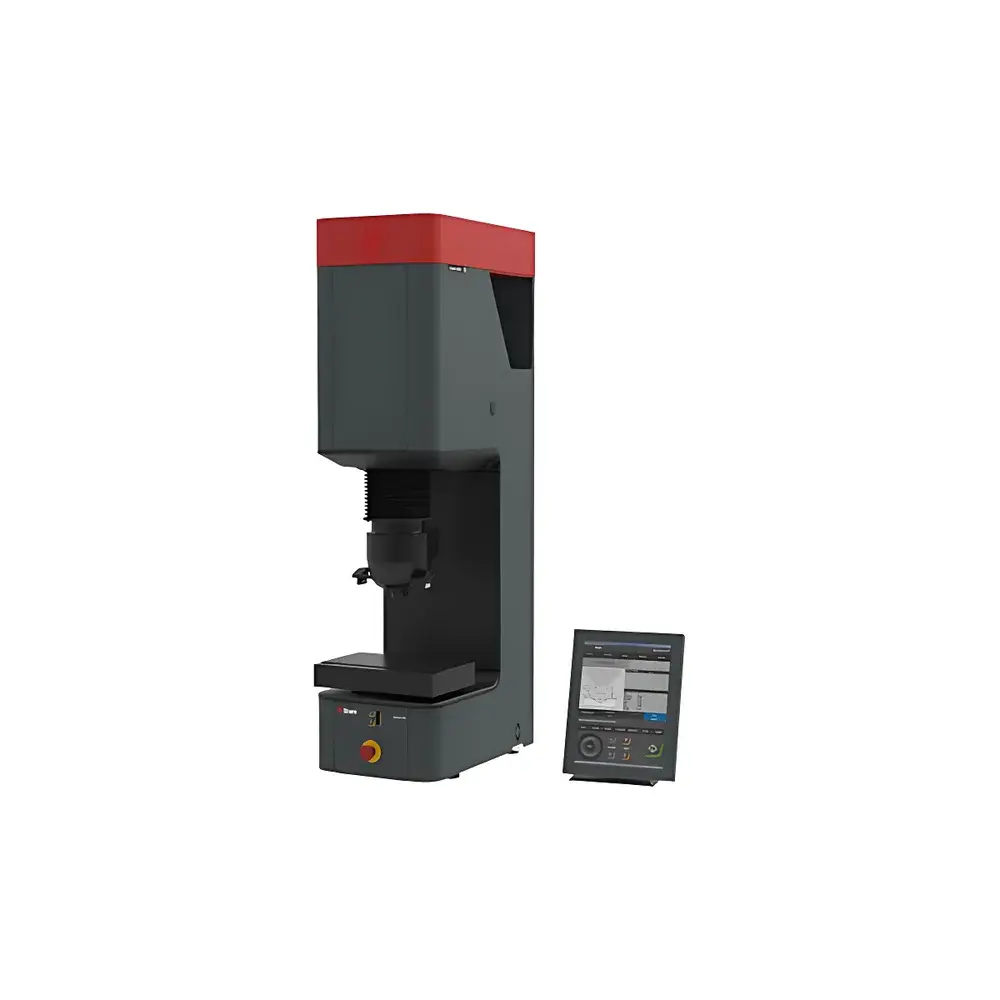
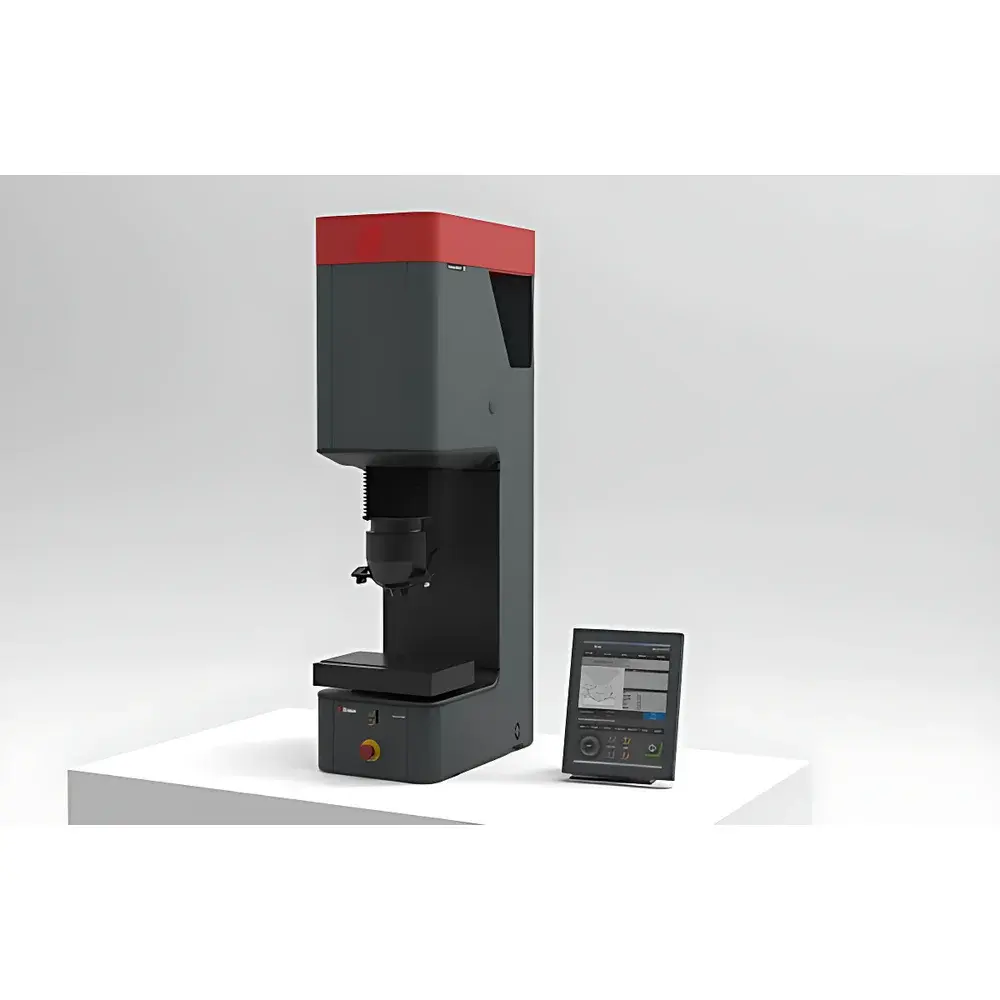
Struers Duramin-650 Universal Hardness Tester
| Brand | Struers |
|---|---|
| Origin | Denmark |
| Model | Duramin-650 |
| Load Ranges | 1–250 kgf, 3–750 kgf, 5–3000 kgf |
| Test Methods | Vickers, Knoop, Brinell, Rockwell |
| Automation Level | Semi-Automatic & Fully Automatic |
| Max Specimen Height | 300 mm |
| Max Specimen Depth | 220 mm |
| Control Interface | 15″ Color LCD Touchscreen |
| Load Cell Technology | Yes |
| Motorized Indenter | Yes |
| Motorized XY Stage (AC variants) | 390 × 262 mm travel, 250 × 160 mm scratch area |
| Turret | 6-position (M) or 8-position (AC) motorized |
| Optical System | Panoramic overview camera + laser positioning + auto-focus + auto-illumination |
| Compliance | ASTM E384, ASTM E10, ASTM E18, ISO 6507, ISO 6506, ISO 6508, ISO 2039 |
Overview
The Struers Duramin-650 Universal Hardness Tester is an engineered solution for high-precision macro- and micro-hardness testing across metallurgical, aerospace, automotive, and quality assurance laboratories. Designed around load cell-based force measurement technology—rather than traditional dead-weight systems—the Duramin-650 delivers traceable, linear, and highly reproducible indentation forces across its full operational range. It supports four standardized hardness scales: Vickers (HV), Knoop (HK), Brinell (HBW), and Rockwell (HR), enabling seamless transition between test methodologies without hardware reconfiguration. Its modular architecture accommodates both semi-automated operation—ideal for R&D and method development—and fully automated workflows optimized for high-throughput production control. The system integrates mechanical, optical, and computational subsystems into a unified platform: motorized indenter actuation, programmable XY-stage motion (in AC variants), panoramic imaging for rapid specimen navigation, laser-assisted positioning, and embedded touchscreen control—all governed by deterministic real-time firmware.
Key Features
- Load cell technology ensures ±0.5% force accuracy across the entire range (9.8 N to 29,430 N), compliant with ISO 6507-2, ISO 6506-2, and ASTM E10/E18 requirements for force verification.
- Three configurable load ranges: M1/AC1 (1–250 kgf), M2/AC2 (3–750 kgf), and M3/AC3 (5–3000 kgf), allowing one instrument to replace multiple dedicated macro-hardness testers.
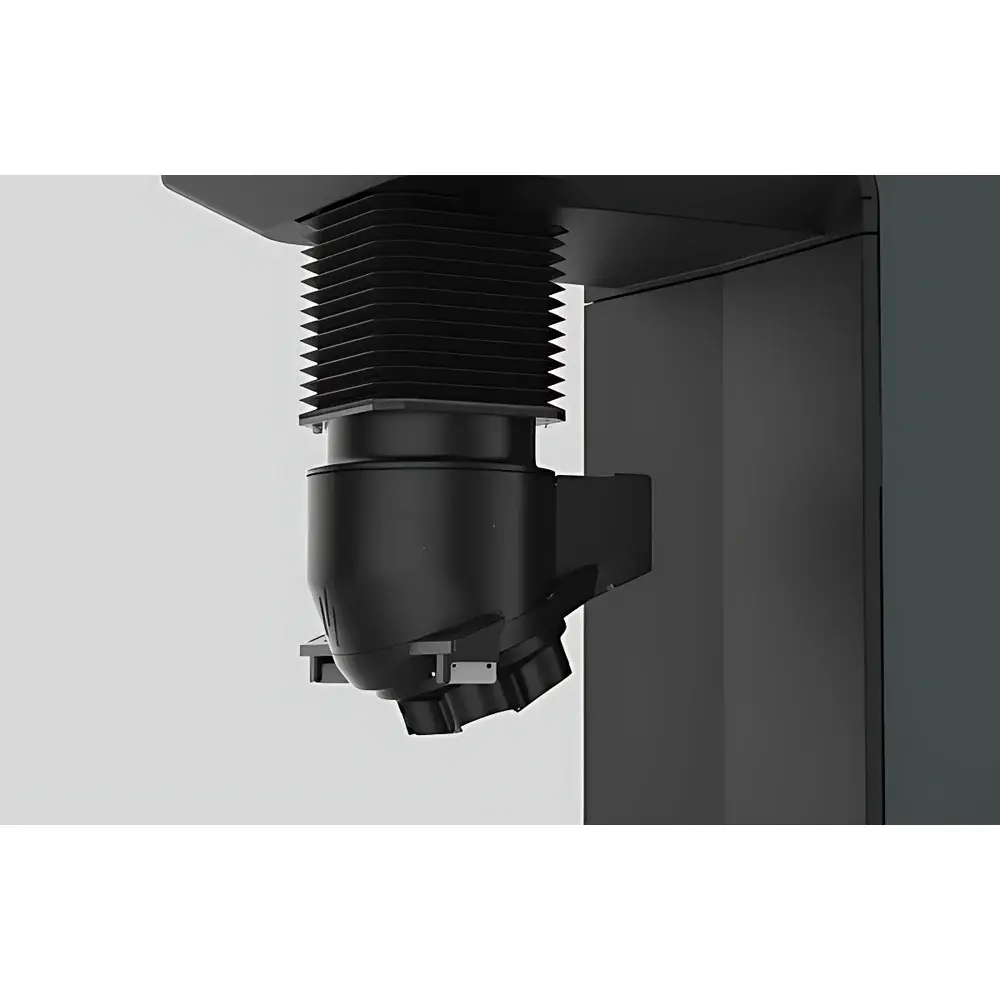
- Motorized indenter and turret (6-position in M-series; 8-position in AC-series) enable sequential multi-scale testing—including mixed HV/HK/HR protocols—without manual intervention.
- Integrated panoramic camera with adjustable LED illumination and auto-focus provides real-time specimen overview, facilitating precise region-of-interest selection prior to indentation.
- Laser crosshair projection enables sub-millimeter alignment accuracy, critical for localized hardness mapping near weld zones, heat-affected areas, or case-hardened layers.
- 15″ capacitive touchscreen interface runs embedded Linux-based software with intuitive workflow navigation, user-level access control, and audit-trail logging for GLP/GMP environments.
- Collision avoidance system monitors Z-axis proximity in real time, automatically halting descent if unexpected obstruction is detected—protecting both indenter and specimen.
Sample Compatibility & Compliance
The Duramin-650 accommodates specimens up to 300 mm in height and 220 mm in depth, supporting standard metallographic mounts, forged components, castings, and large-section weld coupons. Its fixed anvil (M-series) or motorized XY-stage (AC-series) allows repeatable positioning of irregular geometries, including curved surfaces and stepped profiles. All test sequences adhere to international standards: Vickers and Knoop testing per ISO 6507-1/ASTM E384; Brinell per ISO 6506-1/ASTM E10; Rockwell per ISO 6508-1/ASTM E18. Force calibration certificates are traceable to national metrology institutes (e.g., DKD/DAkkS), and software supports 21 CFR Part 11-compliant electronic signatures and immutable audit trails when configured with optional validation packages.
Software & Data Management
The embedded Struers Hardness Suite provides guided test setup, automated measurement (including diagonal length detection, indentation classification, and outlier rejection), and statistical reporting (mean, SD, CV%, min/max, histogram, trend charts). Data export is supported in CSV, PDF, and XML formats—with structured metadata including timestamp, operator ID, calibration status, environmental conditions (optional sensor integration), and raw image archives. Network connectivity enables centralized data aggregation via Struers LabManager™ or third-party LIMS platforms using secure HTTPS/FTP protocols. Software updates are delivered via signed firmware packages with SHA-256 verification, ensuring integrity and version control in regulated environments.
Applications
- Quality control of heat-treated steels, aluminum alloys, and titanium components in aerospace OEM supply chains.
- Case depth profiling of carburized or nitrided surfaces using Knoop micro-indentation gradients.
- Weld qualification per AWS D1.1 and ISO 15614, including HAZ hardness mapping and post-weld heat treatment verification.
- Research into grain-boundary hardening mechanisms using automated grid-based Vickers arrays.
- Failure analysis labs performing comparative hardness assessment across fracture surfaces, inclusion-rich zones, and intermetallic phases.
- Foundry process optimization via Brinell testing of as-cast iron and ductile iron samples under variable cooling rates.
FAQ
What hardness standards does the Duramin-650 support?
It complies with ASTM E384 (Vickers/Knoop), ASTM E10 (Brinell), ASTM E18 (Rockwell), ISO 6507 (Vickers), ISO 6506 (Brinell), ISO 6508 (Rockwell), and ISO 2039 (plastics—when configured with appropriate indenters and load ranges).
Is the system suitable for ISO/IEC 17025-accredited laboratories?
Yes—when equipped with documented calibration records, uncertainty budgets, and validated software modules, the Duramin-650 meets technical requirements for accredited hardness testing under ISO/IEC 17025:2017 Clause 6.4 and 6.5.
Can the Duramin-650 perform hardness mapping on non-planar surfaces?
With optional height-sensing Z-axis compensation and panoramic camera-assisted navigation, it supports controlled indentation on gently curved or stepped specimens—though extreme topography may require custom fixturing.
How is force calibration verified?
Struers provides factory-certified load cell calibration with annual recalibration intervals recommended; users may perform intermediate verification using certified reference test blocks traceable to NIST or PTB.
What data security features are included?
Role-based user accounts, encrypted local storage, audit trail logging (user actions, parameter changes, results modifications), and optional 21 CFR Part 11 compliance package with electronic signatures and biometric authentication support.



