
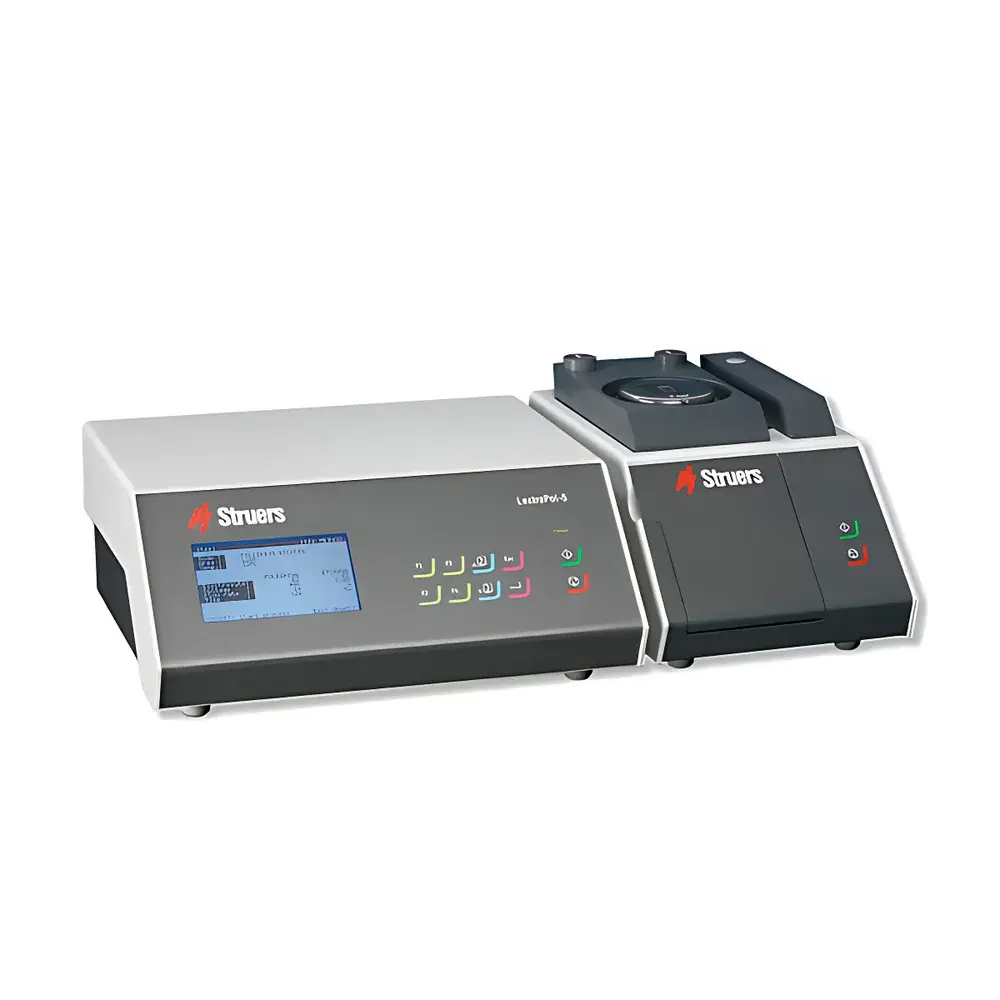
Struers LectroPol-5 Electrolytic Polishing and Etching System
| Brand | Struers |
|---|---|
| Origin | Denmark |
| Model | LectroPol-5 |
| Application | Automated Electrolytic Polishing & Etching of Metallographic Specimens |
| Control Architecture | Dual-unit (Separable Control Unit + Polishing Unit) |
| Scanning Functionality | Real-time Voltage Sweep with Graphical Display |
| Method Library | Preloaded 10 Material-Specific Protocols + User-Definable Storage for 20 Custom Methods |
| Compliance Framework | Designed for GLP/GMP-aligned metallographic labs |
Overview
The Struers LectroPol-5 is an engineered electrolytic polishing and etching system designed for precise, reproducible preparation of metallographic specimens in industrial quality control and materials research laboratories. Operating on the principle of controlled anodic dissolution in conductive electrolytes, the LectroPol-5 applies a regulated direct current between the specimen (anode) and a counter-electrode (cathode) to selectively remove surface material at the microstructural level—eliminating mechanical deformation, smearing, or relief effects inherent to conventional grinding and polishing. Unlike manual or semi-automated electrolytic units, the LectroPol-5 integrates real-time electrochemical scanning, microprocessor-driven parameter optimization, and a structured method database to ensure consistent surface finish across diverse metallic alloys—including stainless steels, aluminum, titanium, nickel-based superalloys, and copper alloys—without iterative trial-and-error setup.
Key Features
- Dual-Unit Modular Design: Physically separable control unit and polishing unit enable flexible benchtop integration, improved cable management, and simplified maintenance—critical in high-throughput lab environments where spatial constraints and workflow segregation matter.
- Intelligent Voltage Scanning: The built-in scanning function performs automated voltage sweeps (typically 0–30 V DC range, adjustable step resolution) while monitoring current response; the resulting I–V curve is displayed in real time, allowing users to identify optimal polishing/etching potentials based on characteristic inflection points—minimizing operator dependency and reducing method development time by up to 70% versus conventional approaches.
- Pre-Validated Method Library: Ships with 10 factory-optimized protocols covering common engineering metals and intermetallics, each specifying electrolyte composition, temperature setpoint, voltage/current mode (constant voltage or constant current), duration, and agitation parameters—fully traceable and compliant with ASTM E3, ISO 16700, and EN 10365 documentation requirements.
- User-Extensible Database: Supports storage of up to 20 custom methods with full metadata logging—including user ID, timestamp, electrolyte batch number, ambient temperature, and post-run image reference tags—enabling version-controlled protocol management and retrospective analysis.
- Integrated Safety Architecture: Features dual redundant overcurrent protection, electrolyte level sensing, thermal cutoff (≥50 °C), and automatic power shutdown upon lid opening or electrode disconnection—meeting IEC 61010-1 safety standards for laboratory electrical equipment.
Sample Compatibility & Compliance
The LectroPol-5 accommodates standard metallographic specimens up to 30 mm in diameter (or rectangular samples ≤25 × 30 mm) mounted in thermosetting resins (e.g., phenolic, epoxy) or conductive mounts. It is compatible with a broad spectrum of aqueous and non-aqueous electrolytes—including perchloric acid–ethanol mixtures, oxalic acid solutions, and chromic–phosphoric acid blends—subject to local chemical handling regulations. All operational parameters are logged with ISO/IEC 17025-compliant timestamping and cannot be altered post-execution without audit trail generation. The system supports GLP and GMP workflows through configurable electronic signatures, user access levels (admin/operator/guest), and exportable CSV/Excel reports suitable for regulatory submissions (e.g., FDA 21 CFR Part 11–compliant data integrity when paired with Struers’ LaboPlan software suite).
Software & Data Management
While the LectroPol-5 operates as a standalone instrument with intuitive front-panel interface, it interfaces seamlessly with Struers’ LaboPlan 4.x software via USB or Ethernet. LaboPlan enables remote method deployment, batch scheduling, trend analysis of historical polishing outcomes (e.g., surface roughness correlation vs. voltage), and automated report generation with embedded SEM/OM image overlays. All parameter changes, run logs, and error events are stored in an encrypted SQLite database with SHA-256 hashing—ensuring data integrity and facilitating internal audits or external accreditation reviews.
Applications
- Routine QC of weld zones, heat-affected zones (HAZ), and additive manufacturing (AM) build layers in aerospace and energy sectors
- Revealing grain boundaries, phase distributions, and precipitate morphology in duplex stainless steels per ASTM E112
- Preparing artifact-free surfaces for subsequent EBSD, TEM lamella extraction, or nanoindentation testing
- Standardized etching of aluminum alloys (e.g., AA2024, AA7075) for corrosion susceptibility assessment per ASTM G150
- High-reproducibility sample prep for interlaboratory round-robin studies under ISO/IEC 17043 proficiency testing frameworks
FAQ
What electrolytes are compatible with the LectroPol-5?
The system supports all standard electrolytes used in metallography, including but not limited to 10% perchloric acid in ethanol (for austenitic steels), 10% oxalic acid (for aluminum), and 20% chromic acid + 80% phosphoric acid (for nickel alloys). Users must verify compatibility with local chemical safety regulations.
Can the LectroPol-5 be integrated into an automated sample prep line?
Yes—via digital I/O signals and Modbus TCP protocol support, enabling synchronization with Struers’ AccuPress, Rotopol, or Tegramin platforms for end-to-end unattended preparation sequences.
Is method validation documentation provided?
Struers supplies a Factory Acceptance Test (FAT) report and IQ/OQ templates aligned with ISO 9001 and ISO/IEC 17025; PQ validation support is available through certified application engineers.
Does the system require external cooling or ventilation?
Ambient air cooling is sufficient for standard operation; however, continuous high-duty-cycle use (>4 hrs/day) recommends installation in a fume hood with ≥150 m³/h exhaust capacity per ASTM D3438 guidelines.
How is firmware updated?
Firmware updates are delivered via Struers’ secure customer portal and installed using a USB memory stick—no internet connection required during field deployment.



