
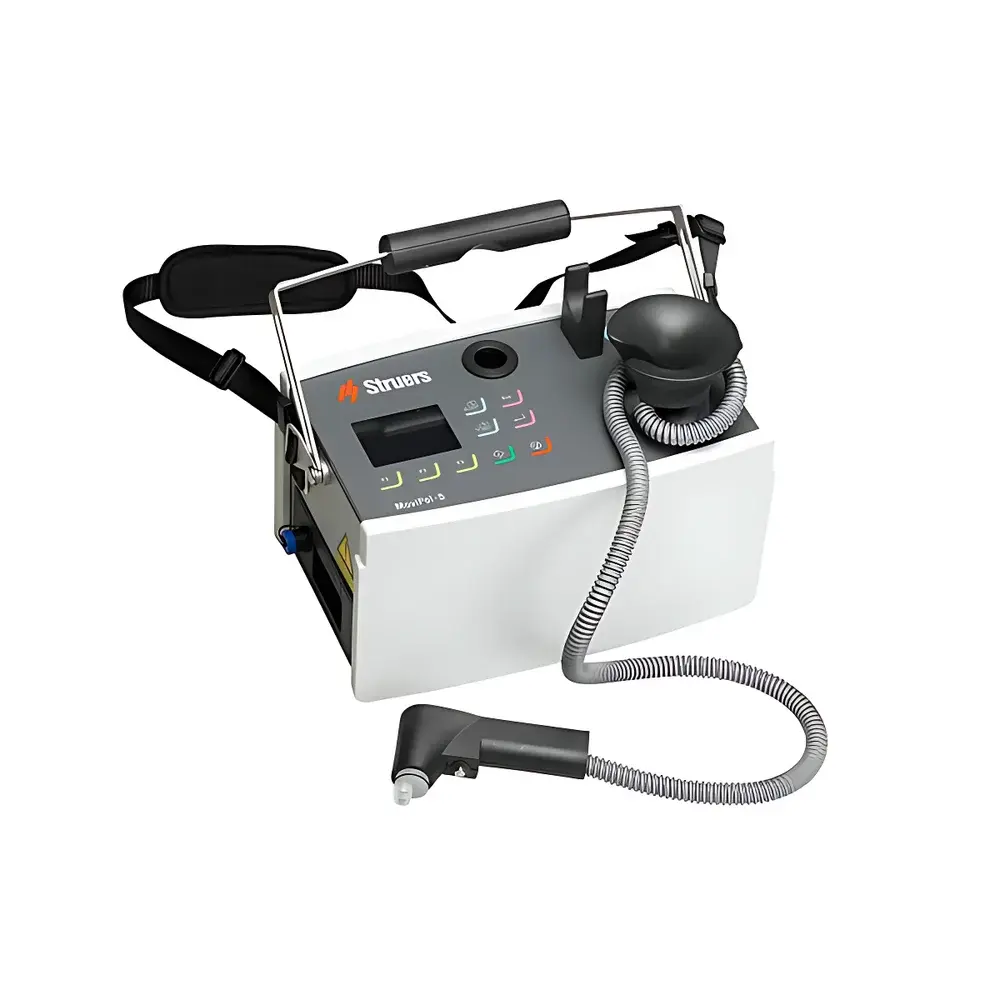
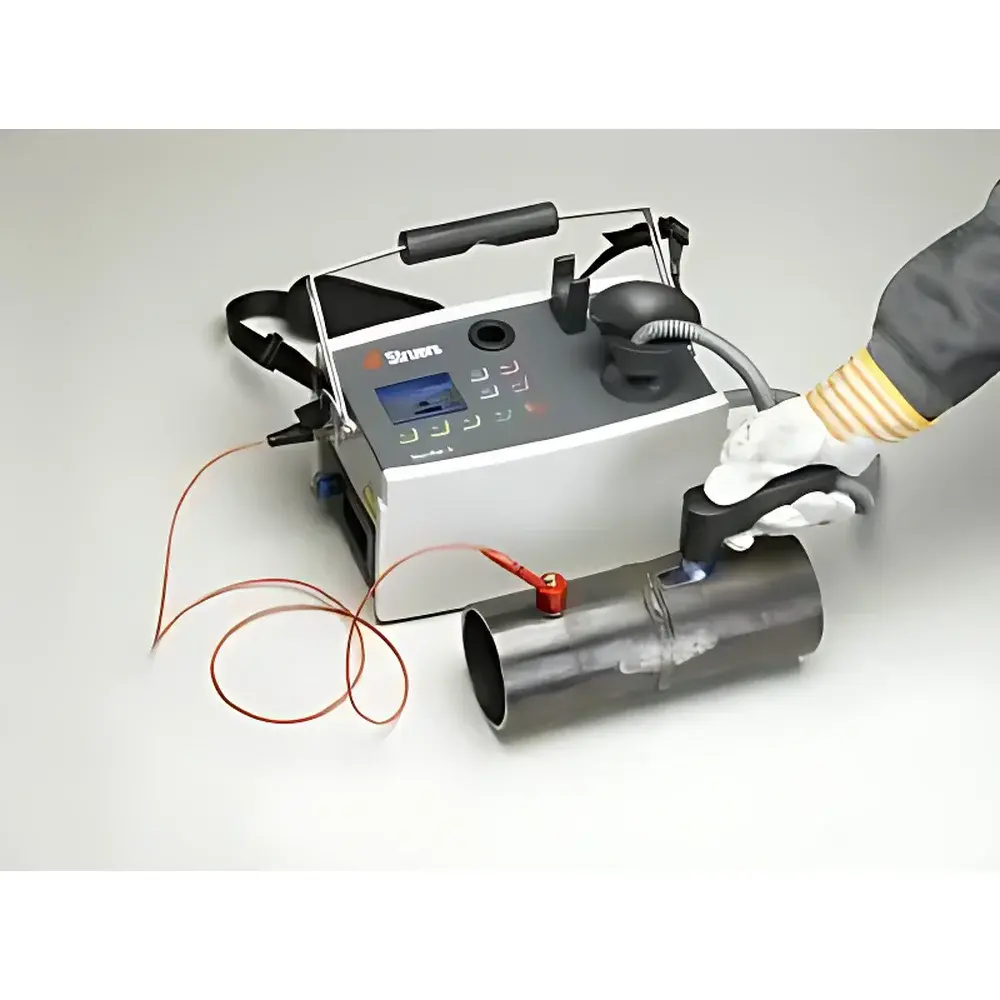
Struers MoviPol-5 Portable Electrolytic Polishing and Etching Unit
| Brand | Struers |
|---|---|
| Origin | Denmark |
| Model | MoviPol-5 |
| Power Source | Rechargeable Li-ion Battery (1.5 h continuous operation) |
| Application | On-site metallographic surface preparation |
| Technique | Electrochemical polishing & etching |
| Portability | Handheld, field-deployable unit |
| Surface Marking | Non-invasive, minimal surface alteration |
| Typical Use Cases | Weld inspection, pipeline integrity assessment, large-component joint analysis |
| Compliance | Designed for ISO 14823, ASTM E3, ASTM E407, and EN 1369-compliant metallographic workflows |
Overview
The Struers MoviPol-5 is a handheld, battery-powered electrolytic polishing and etching system engineered for rapid, non-destructive metallographic surface preparation in field environments. Unlike conventional mechanical grinding and polishing—processes that introduce deformation, heat-affected zones, or topographical artifacts—the MoviPol-5 employs controlled electrochemical dissolution to selectively remove surface material at the microscale. This principle leverages Faraday’s laws of electrolysis, where precise current density, electrolyte composition, voltage, and exposure time govern material removal kinetics. The result is a deformation-free, artifact-minimized surface ideal for subsequent optical microscopy, SEM imaging, or microhardness testing. Its design targets applications where component accessibility, structural integrity, or operational continuity preclude disassembly—such as in-service weld inspections on pressurized pipelines, turbine casings, offshore platform joints, or nuclear containment welds.
Key Features
- Battery-operated architecture with integrated rechargeable Li-ion pack delivering up to 90 minutes of uninterrupted operation—enabling full workflow execution without external power sources.
- Ergonomic, lightweight housing (≤3.2 kg) with IP54-rated ingress protection against dust and water splashes, certified for industrial outdoor and confined-space deployment.
- Adjustable DC power supply (0–30 V, 0–10 A) with real-time current/voltage monitoring and automatic shut-off upon open-circuit detection or overcurrent conditions.
- Modular electrolyte delivery system supporting multiple chemistries—including Struers OP-S, H₃PO₄-based, and custom formulations—for ferrous alloys, stainless steels, aluminum, nickel superalloys, and titanium grades.
- Non-contact electrode configuration with flexible cathode foil and precision-machined anode tip, ensuring uniform current distribution across curved, irregular, or vertically oriented surfaces.
- Minimal surface impact: removes only 0.5–3 µm of material per cycle, leaving no mechanical scratches, smearing, or phase pull-out—critical for accurate grain boundary delineation and inclusion analysis.
Sample Compatibility & Compliance
The MoviPol-5 is validated for use on metallic components ranging from flat plates to pipes with diameters ≥50 mm and wall thicknesses up to 100 mm. It accommodates both conductive and passivating alloys, including austenitic and duplex stainless steels, Inconel® 625/718, Ti-6Al-4V, and carbon-manganese steels. All operational parameters adhere to ASTM E3 “Standard Guide for Preparation of Metallographic Specimens”, ASTM E407 “Standard Practice for Microetching Metals and Alloys”, and ISO 14823 “Metallographic examination of welds”. When used in regulated industries (e.g., ASME BPVC Section V, API RP 2X, NADCAP AC7108), the device supports documented traceability via manual log entries aligned with GLP/GMP record-keeping requirements. While not inherently 21 CFR Part 11 compliant (as it lacks electronic audit trails), its outputs integrate seamlessly into validated laboratory information management systems (LIMS) when paired with digital microscopy platforms.
Software & Data Management
The MoviPol-5 operates as a standalone hardware unit with no embedded firmware or proprietary software interface. All process parameters—including voltage setpoint, current draw, duration, electrolyte batch ID, and operator initials—are manually recorded per sample using Struers’ optional Field Logbook Template (PDF/Excel), designed for alignment with ISO/IEC 17025 documentation standards. For digital integration, users may pair the unit with third-party image acquisition systems (e.g., Olympus Stream, Zeiss ZEN) to correlate polished surface morphology with location-specific metadata (GPS coordinates, asset ID, weld number). Struers provides editable SOP templates and calibration verification protocols compatible with internal QA audits and external accreditation bodies.
Applications
- On-site weld integrity verification in oil & gas transmission pipelines, eliminating need for destructive coupon extraction.
- Routine inspection of heat-affected zones (HAZ) in pressure vessel circumferential welds during turnaround maintenance.
- Microstructural evaluation of repaired turbine blade root attachments without dismounting rotating assemblies.
- Failure analysis triage at incident sites—rapid generation of polished replicas for remote expert review via high-resolution digital microscopy.
- Quality assurance of additive-manufactured metal parts, where surface layer fidelity directly correlates with build parameter optimization.
- Regulatory compliance checks per EN 13445-5 Annex C and ASME Section IX QW-194 for post-weld heat treatment verification.
FAQ
Can the MoviPol-5 be used on painted or coated surfaces?
No—surface coatings must be fully removed prior to electrolytic polishing, as they inhibit electrical contact and cause uneven dissolution.
What electrolytes are recommended for duplex stainless steel?
Struers OP-S electrolyte (phosphoric–sulfuric acid blend) is validated for duplex grades; alternative formulations require user validation per ASTM E407 Annex A3.
Is operator training required before field deployment?
Yes—Struers offers certified 1-day field application workshops covering safety protocols, electrolyte handling, current density optimization, and replica preparation techniques.
Does the unit support automated process logging?
Not natively; however, integration with Bluetooth-enabled multimeters or data loggers enables external timestamped parameter capture for audit-ready records.
How is calibration verified?
Calibration is performed semi-annually using certified reference resistors and calibrated multimeters per ISO/IEC 17025 Clause 6.5; Struers provides traceable calibration certificates upon request.
Related Products



