
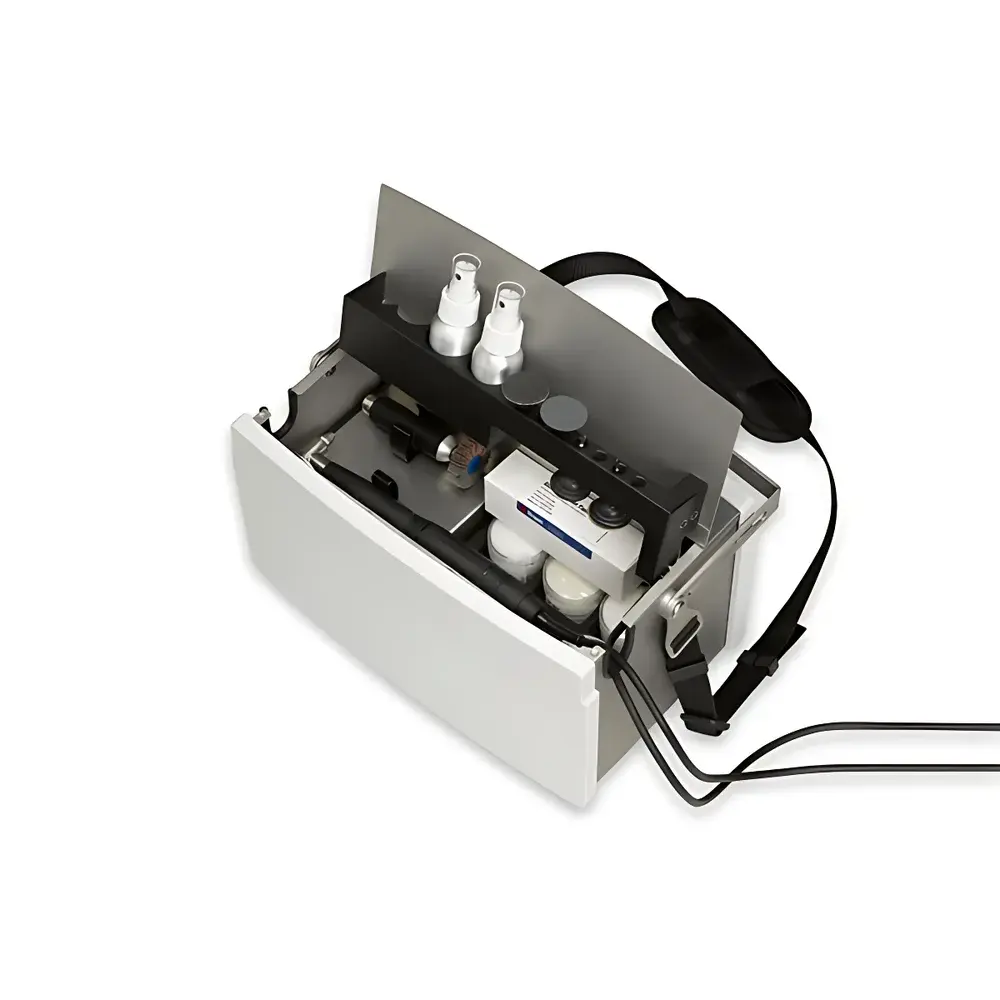
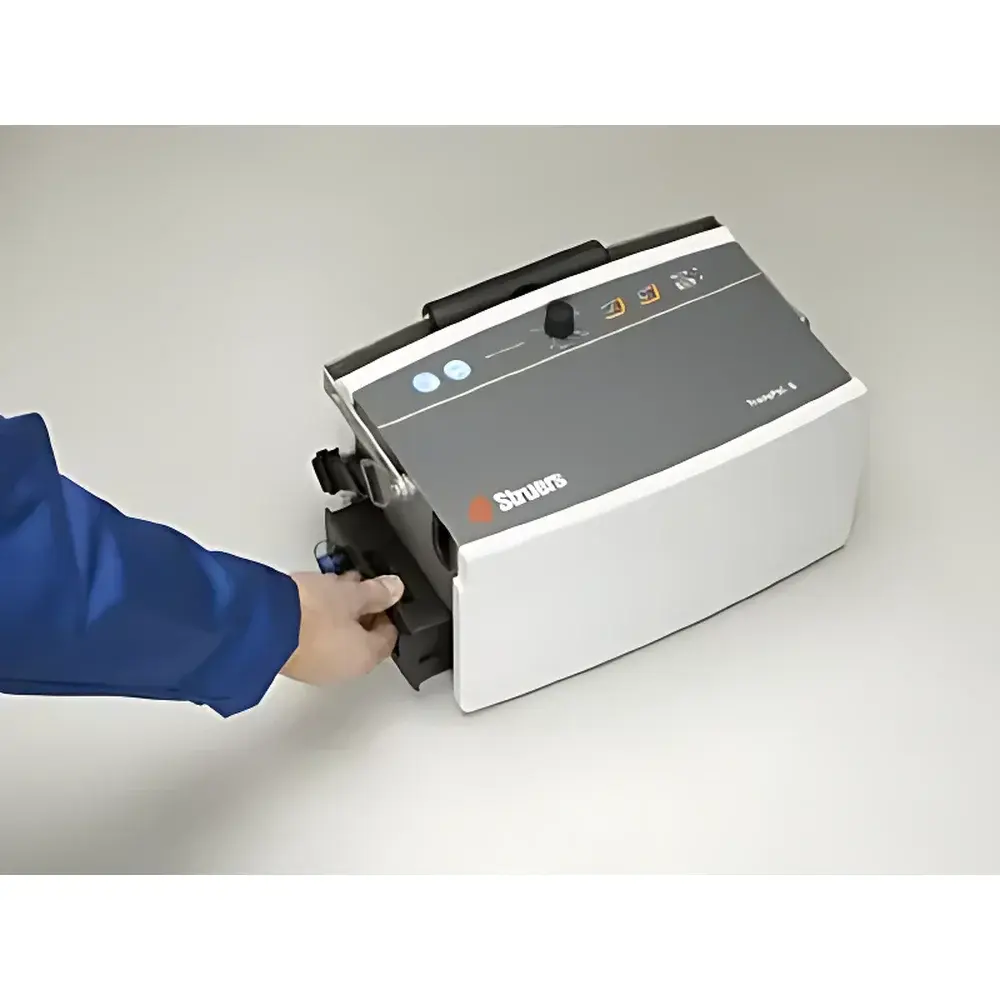
Struers TransPol-5 Portable Metallographic Grinding and Polishing Machine
| Brand | Struers |
|---|---|
| Origin | Denmark |
| Model | TransPol-5 |
| Power Supply | Rechargeable Li-ion battery or AC adapter (100–240 V, 50/60 Hz) |
| Motor | High-torque brushless DC motor |
| Grinding/Polishing Plate Diameter | 32 mm |
| Cable Length | 3 m remote control cable |
| Weight | ≤ 4.5 kg |
| Dimensions (L×W×H) | 220 × 120 × 180 mm |
| Included Accessories | Battery pack, charger, transport case, consumables kit (grinding papers, polishing cloths, diamond suspension), remote control unit |
| Compliance | CE, RoHS, IP54 rated for dust and water resistance |
Overview
The Struers TransPol-5 is a purpose-engineered portable metallographic grinding and polishing system designed for on-site microstructural sample preparation under demanding field conditions. Unlike conventional benchtop metallography units, the TransPol-5 operates on a robust brushless DC motor architecture delivering consistent torque across variable load conditions — enabling reliable material removal even when using coarse grit grinding papers (e.g., P80–P220) on hardened steels, welds, or corrosion-resistant alloys. Its measurement principle relies on controlled mechanical abrasion and planarization, where rotational speed (fixed at 150 rpm for optimal balance of removal rate and surface integrity) and applied pressure are optimized to minimize artifact generation — such as edge rounding, pull-out, or smearing — critical for subsequent optical or electron microscopy analysis. The device conforms to ASTM E3, ISO 14489, and EN 10365 standards for metallographic specimen preparation, supporting traceable, repeatable surface conditioning essential for failure analysis, weld QA/QC, and in-service component inspection.
Key Features
- Compact 32 mm diameter grinding/polishing plate enables access to confined geometries — including pipe welds, turbine blade roots, rail joints, and structural steel connections — without requiring component disassembly.
- Dual power mode: Integrated rechargeable lithium-ion battery (runtime ≥ 90 min per charge at full load) and universal AC adapter (100–240 V, 50/60 Hz) ensure uninterrupted operation in remote locations with unstable or absent grid infrastructure.
- IP54-rated enclosure provides protection against dust ingress and low-pressure water jets, permitting safe use in outdoor, offshore, or industrial environments with ambient humidity, oil mist, or particulate exposure.
- Ergonomic handle design with integrated pressure feedback zone allows consistent operator-applied force (recommended 15–25 N), reducing inter-user variability during manual polishing sequences.
- Modular battery system supports hot-swapping — a second charged battery pack can be inserted without powering down, maintaining workflow continuity during extended field campaigns.
- Remote control via 3 m shielded cable decouples operator position from vibration and slurry splash zones, improving safety and procedural reproducibility.
Sample Compatibility & Compliance
The TransPol-5 accommodates ferrous and non-ferrous metallic specimens up to 50 mm in thickness and irregular profiles with curvature radii ≥ 25 mm. It is routinely deployed for preparing cross-sections of pipeline girth welds (API 1104), aerospace fasteners (AMS 2300), nuclear reactor components (ASME BPVC Section V), and railway axle steels (EN 13674-1). All consumables — including silicon carbide grinding papers, woven polyester polishing cloths, and colloidal silica suspensions — are certified to ISO 12127 and comply with GLP documentation requirements. Device firmware logs operational timestamps, battery state-of-charge, and motor load cycles — supporting audit readiness per ISO/IEC 17025 and FDA 21 CFR Part 11 when integrated with Struers’ LabReport software.
Software & Data Management
While the TransPol-5 operates as a standalone hardware platform, its accessory ecosystem interfaces seamlessly with Struers’ LabReport 5.2 software suite. This desktop application enables digital archiving of preparation protocols (grit sequence, dwell time, lubricant type), annotation of specimen IDs, and synchronization with microscope image repositories. Audit trails record user login, parameter changes, and export events with SHA-256 hashing — satisfying data integrity mandates under GMP Annex 11 and EU GMP Annex 15. No cloud dependency is required; all data remains resident on local network drives or encrypted external SSDs.
Applications
- In-situ weld integrity verification for petrochemical piping networks prior to hydrostatic testing.
- Microstructural assessment of heat-affected zones (HAZ) in offshore wind turbine tower welds exposed to cyclic loading.
- On-rail evaluation of wheelset tread fatigue cracks without wheel removal.
- Forensic metallurgical analysis of failed boiler tubes in thermal power plants.
- Pre-commissioning validation of clad layer bond quality in duplex stainless steel pressure vessels.
FAQ
Can the TransPol-5 be used on non-metallic materials such as ceramics or composites?
Yes — with appropriate consumable selection (e.g., diamond-impregnated pads for SiC ceramics or alumina suspensions for CFRP), though recommended maximum rotational speed is reduced to 120 rpm to prevent delamination.
Is calibration required before each use?
No routine calibration is specified; however, daily verification of battery voltage output and motor RPM consistency using Struers’ certified tachometer (Part No. TP-CAL-01) is advised per internal QA procedures.
Does the device support automated force control?
No — force application remains operator-managed per ASTM E3 guidelines; however, the ergonomic handle geometry and tactile pressure indicators reduce deviation to ±3 N across trained users.
What maintenance intervals are recommended?
Brushless motor requires no scheduled servicing; battery health check every 6 months; O-ring seals in housing replaced annually or after 200 operating hours in saline environments.



