
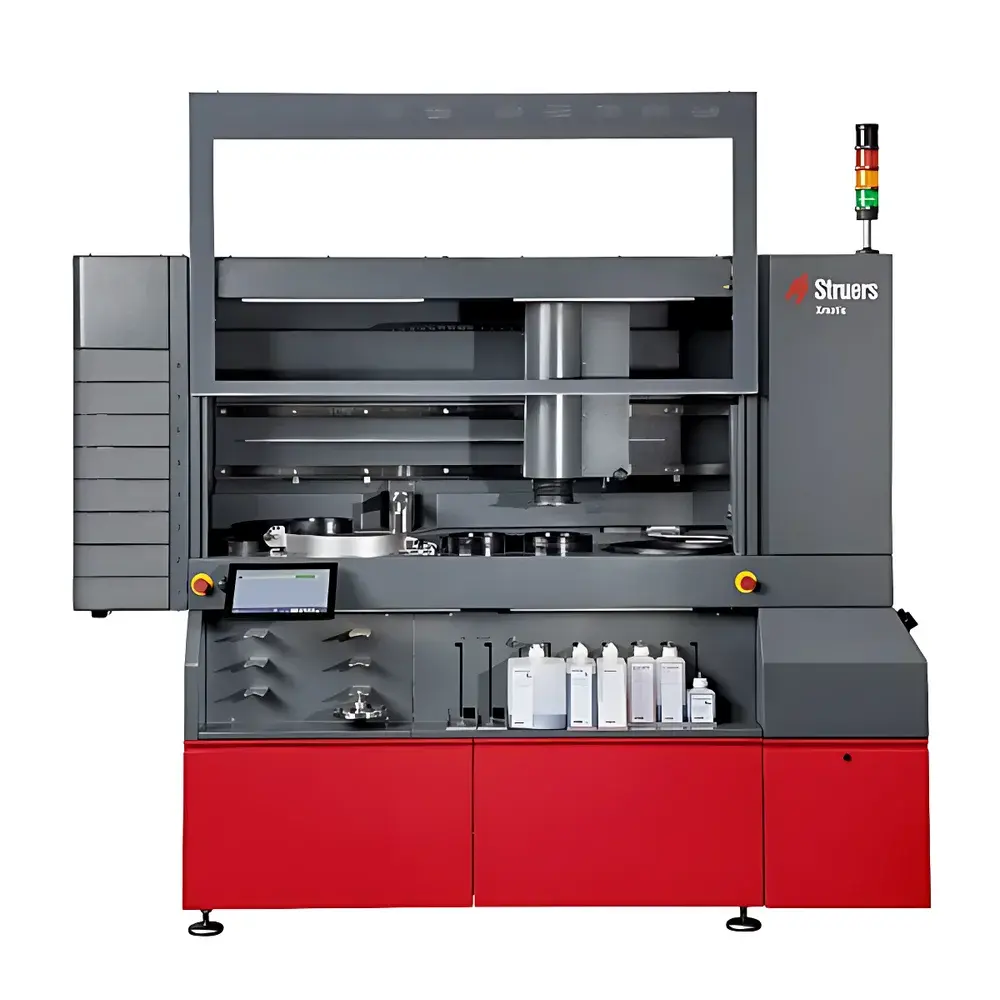
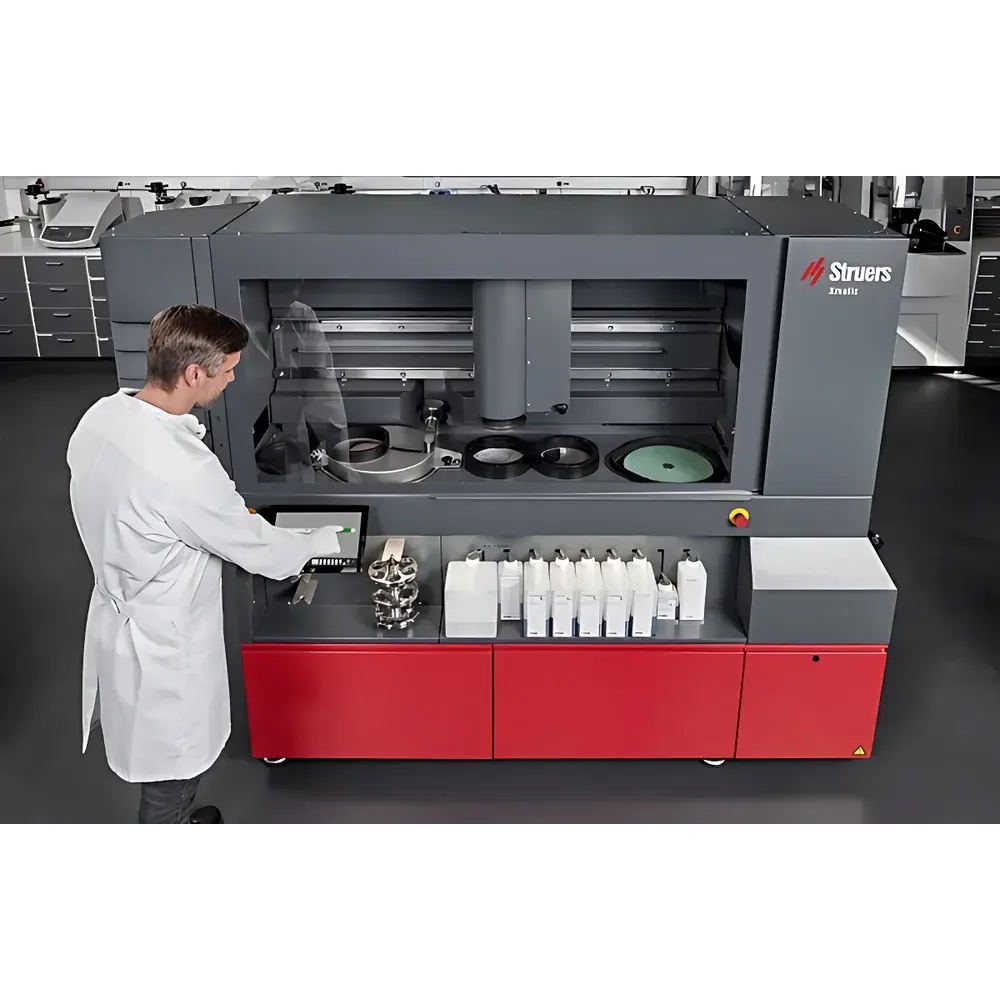
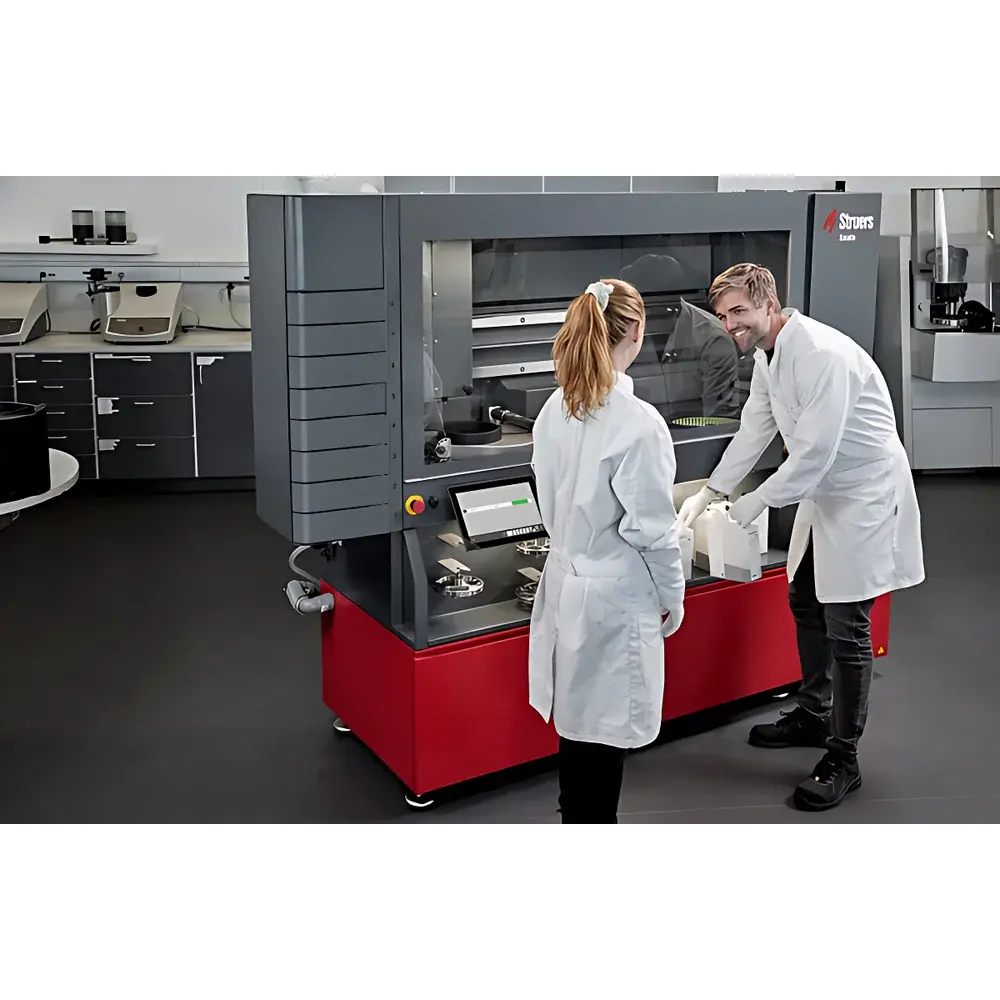
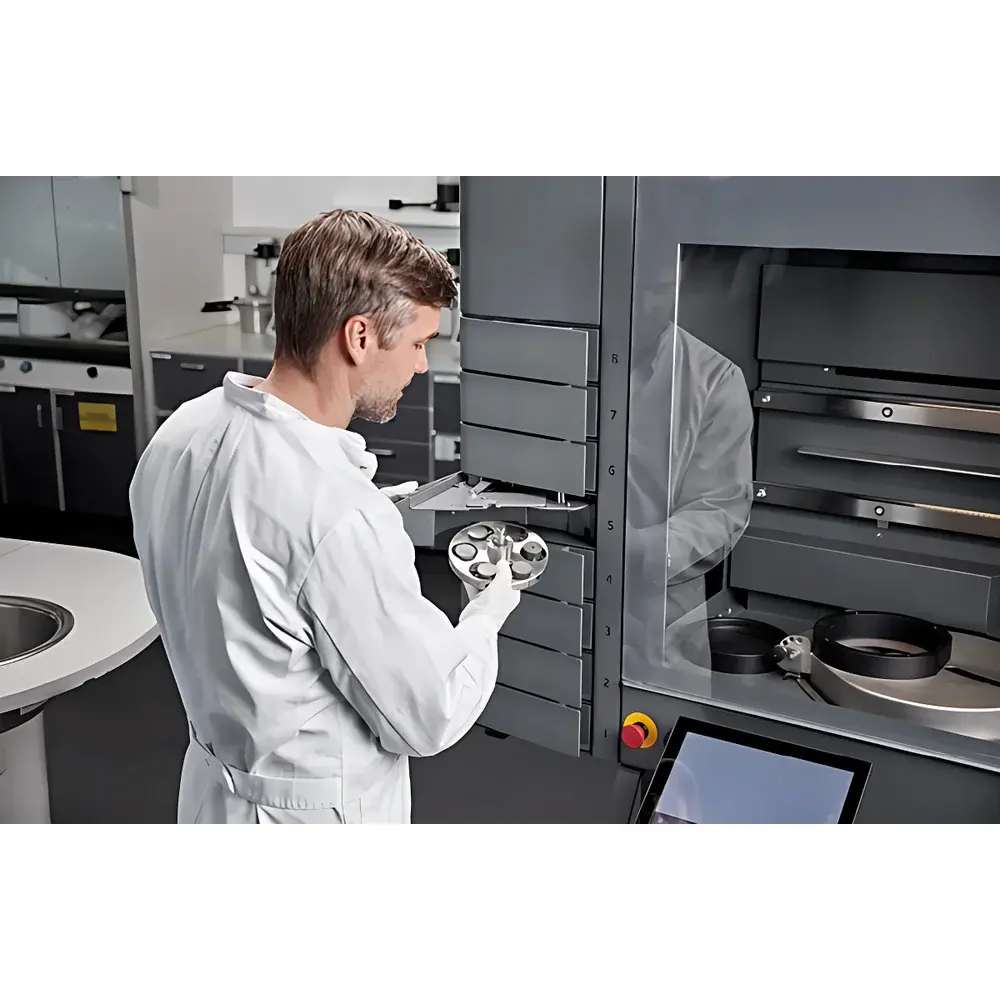
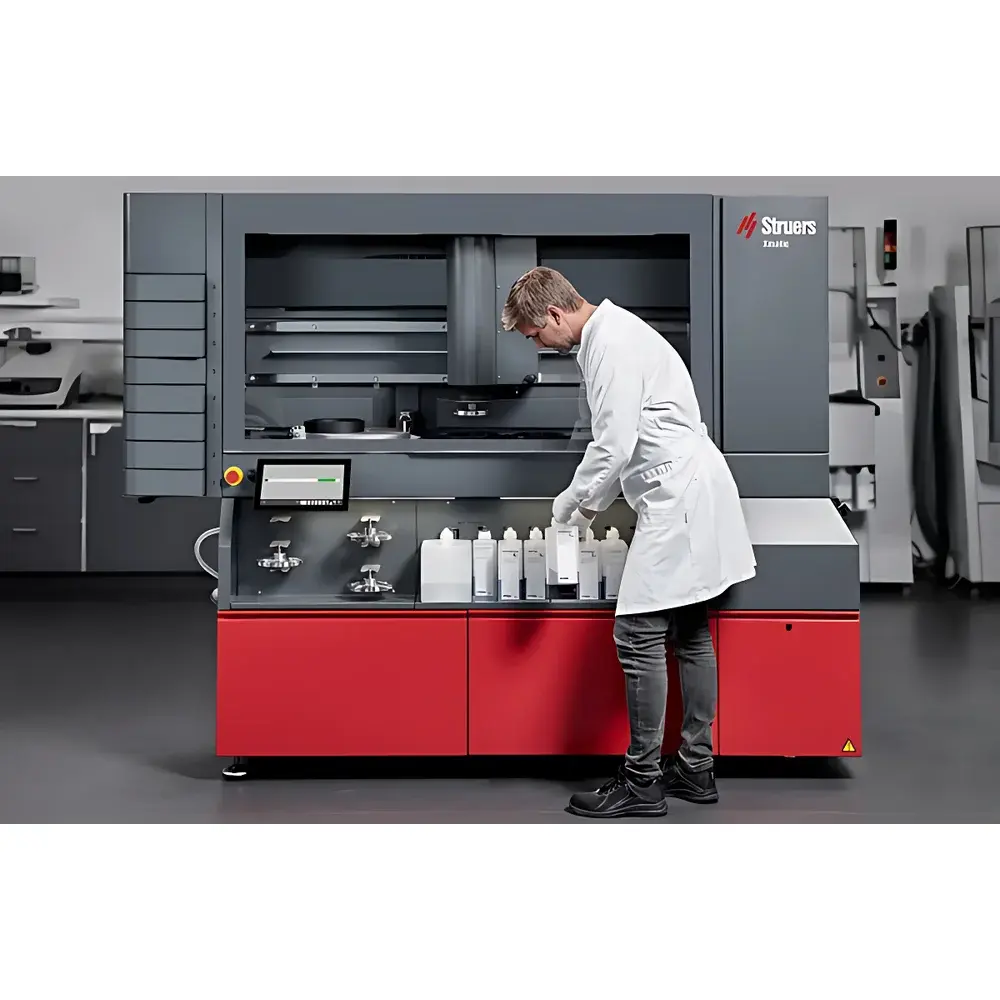
Struers Xmatic Fully Automated Grinding and Polishing System
| Brand | Struers |
|---|---|
| Origin | Denmark |
| Model | Xmatic |
| Maximum Speed | 600 rpm |
| Platen Diameter | 300 mm |
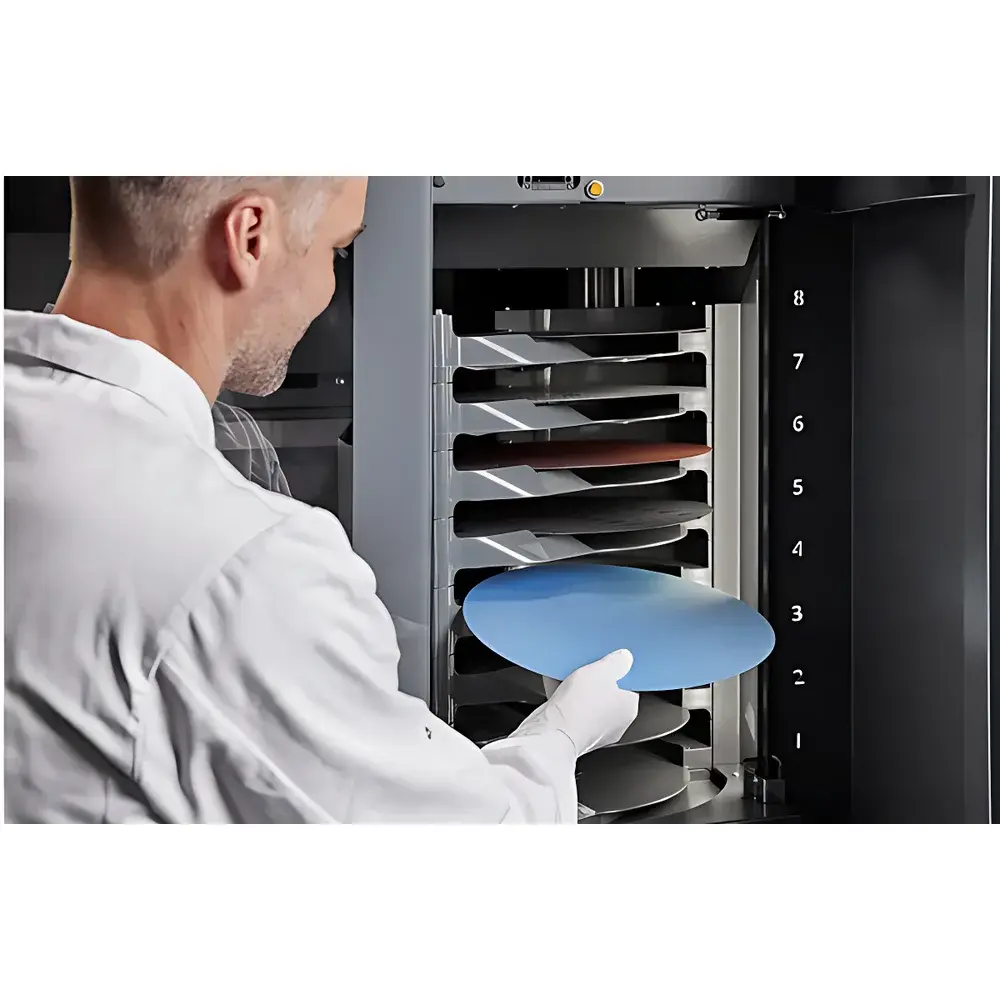
| Number of Platens | 8 |
| Dimensions (L×W×D) | 2420 × 750 × 1200 mm |
| Automation Level | Fully Automated End-to-End Sample Preparation System |
| Compliance | Designed for ISO/IEC 17025, ASTM E3, ASTM E407, ISO 14487, and GLP/GMP-aligned documentation workflows |
| Software | STRUERS LaboPlan® Integration Ready |
| Cleaning | Integrated High-Pressure Rinse, Ultrasonic Cleaning Module, Auto-Cleaning Dosing Lines |
| Force Control | Load-adaptive, sample-count-synchronized force modulation |
| Dosing | Viscosity-independent precision dosing pump with pre-wetting function |
| Documentation | Full audit trail, timestamped process logs, method versioning, user access control |
Overview
The Struers Xmatic Fully Automated Grinding and Polishing System represents a paradigm shift in metallographic and materials sample preparation. Engineered for precision and reproducibility, the Xmatic implements a closed-loop, sensor-driven automation architecture grounded in deterministic mechanical control and real-time process feedback. Unlike semi-automated or manually supervised systems, the Xmatic executes end-to-end grinding, intermediate polishing, final polishing, and post-process cleaning without operator intervention—each step governed by pre-validated, parameter-locked methods. Its core operational principle relies on synchronized rotational kinematics (up to 600 rpm), adaptive normal-force application calibrated per specimen count and holder geometry, and viscosity-compensated liquid dosing to ensure consistent slurry delivery across abrasive types—from silicon carbide papers to diamond suspensions and colloidal silica. Designed and manufactured in Denmark, the system meets stringent European machinery directives (2006/42/EC) and is engineered for integration into ISO/IEC 17025-accredited laboratories where traceability, method integrity, and inter-laboratory comparability are non-negotiable.
Key Features
- Fully automated 8-platen configuration (300 mm diameter), enabling parallel or sequential processing of up to eight distinct preparation steps—including coarse grinding, fine grinding, rough polishing, and final polishing—within a single run.
- Adaptive force modulation: Automatically adjusts applied load based on the number of specimens mounted in the holder, ensuring uniform material removal rates and minimizing edge rounding or relief effects.
- Viscosity-independent dosing pump with integrated pre-wetting function: Delivers precise, repeatable volumes of lubricants, abrasives, and etchants regardless of fluid rheology—critical for consistency when switching between water-based slurries and oil-based diamond pastes.
- Integrated high-pressure rinse station and ultrasonic cleaning module: Eliminates cross-contamination between steps and removes embedded particles from porous polishing cloths or soft metals such as aluminum or lead alloys.
- Self-cleaning dosing lines and automatic drip-tube purging: Prevents crystallization, clogging, and carryover between methods; validated for use with aggressive reagents including perchloric acid electrolytes and colloidal silica.
- Comprehensive digital audit trail: Every operation—method selection, force profile, rotation speed, dwell time, dosing volume, cleaning cycle—is timestamped, user-attributed, and exportable in CSV or PDF format compliant with FDA 21 CFR Part 11 requirements.
Sample Compatibility & Compliance
The Xmatic accommodates a broad spectrum of materials—from ferrous and non-ferrous metals (steel, titanium, aluminum, copper alloys) to ceramics, composites, geological specimens, and electronic packaging substrates. Its programmable force range (5–500 N per specimen) and variable speed control (50–600 rpm) support both brittle-phase preservation and rapid stock removal protocols. All standard Struers consumables—including MD-Allegro, MD-Piano, and DP-Silicon polishing cloths—are auto-recognized via RFID-tagged holders. The system complies with ASTM E3 (Standard Guide for Preparation of Metallographic Specimens), ASTM E407 (Standard Practice for Microetching Metals and Alloys), and ISO 14487 (Metallographic specimen preparation—Grinding and polishing). Process documentation meets GLP and GMP requirements for regulated industries including aerospace, medical device manufacturing, and nuclear materials testing.
Software & Data Management
The Xmatic operates under Struers’ LaboPlan®-compatible firmware environment, supporting method import/export, version-controlled protocol libraries, and role-based user permissions (administrator, technician, auditor). All preparation sequences are stored as encrypted XML files with cryptographic checksums to prevent unauthorized modification. Data logging includes real-time torque monitoring, platen temperature tracking (±0.5 °C resolution), and dosing line pressure profiling—enabling root-cause analysis during failure investigations. Export formats include CSV for LIMS integration and PDF reports with embedded digital signatures for regulatory submissions.
Applications
- High-throughput quality control labs requiring >50 specimens/day with sub-micron surface finish repeatability (Ra < 0.02 µm).
- Failure analysis laboratories performing serial sectioning of solder joints, battery electrodes, or turbine blade coatings.
- Research institutions conducting comparative studies across alloy families where inter-run variability must be < ±1.2% in grain boundary delineation accuracy.
- Certification bodies validating microstructural compliance per ASME BPVC Section II or EN 10002-1 standards.
- Contract testing facilities maintaining auditable chains of custody for litigation-support metallurgical evidence.
FAQ
Does the Xmatic support custom method development?
Yes—users can define new preparation sequences via the LaboPlan® desktop interface, including multi-step force/speed/dosing profiles, conditional branching logic, and validation checkpoints.
Can existing Struers consumables be used without modification?
All Struers-certified grinding papers, polishing cloths, and diamond suspensions are fully compatible; RFID-enabled holders enable automatic detection and parameter loading.
Is remote monitoring or troubleshooting supported?
The system includes Ethernet/IP connectivity and optional Struers Remote Assist service, enabling secure, encrypted remote diagnostics with technician screen-sharing and firmware update deployment.
What maintenance intervals are recommended?
Platen alignment verification every 500 operating hours; dosing pump calibration quarterly; ultrasonic bath solution replacement after 200 cycles or per manufacturer’s chemical compatibility chart.
How is data integrity ensured during power interruption?
Non-volatile memory retains active method state and log entries; upon recovery, the system resumes from the last validated checkpoint without compromising result traceability.



